


At some point, most service business owners make the same call: the invoice isn't worth the conversation anymore. You've sent two follow-ups. The client apologized, promised payment by Friday, then went quiet. You let it go. Not because the money didn't matter, but because you calculated, correctly, that pressing the issue would cost more than absorbing the loss.
The calculation happens invoice by invoice, client by client, without anyone tracking the total. Each one looks like a small compromise. Across a year, the total is a number most owners have never actually sat down to calculate.
Key takeaways
- More than half of US small businesses carry outstanding unpaid invoices at any given time, with the average affected business owed $17,500. The downstream costs cash flow disruption, credit reliance, deferred hiring - run significantly higher than the invoices themselves.
- Chasing late payments treats a process problem as a behavioral one. Better follow-up emails don't fix the structure. Moving payment authorization earlier in the client relationship does.
- The owners who end the cycle aren't more assertive than their peers. They change when payment is collected, not how.
The scale of the problem
Late payments aren't a fringe problem for small service businesses. The 2025 Intuit QuickBooks Small Business Late Payments Report, a January 2025 survey of 2,487 US businesses with fewer than 100 employees, found that 56% of small businesses are currently owed money from unpaid invoices, with the average affected business carrying $17,500 in outstanding receivables. Nearly half of respondents, 47%, reported invoices overdue by more than 30 days.
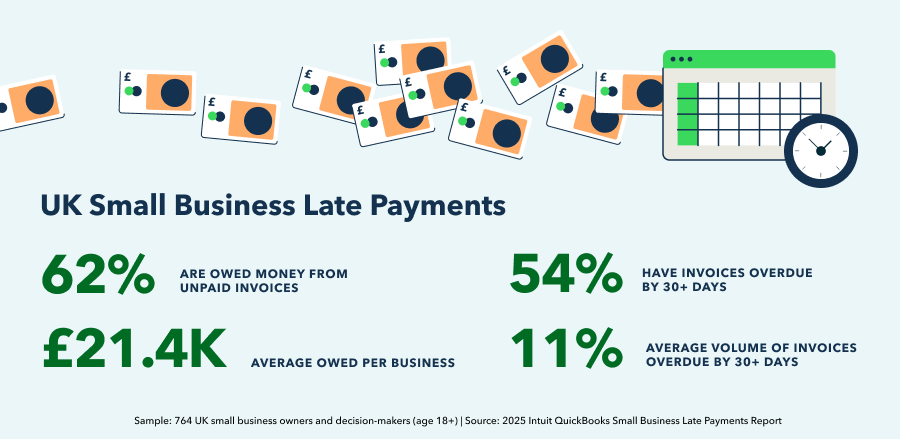
The downstream effects extend well past the unpaid invoice itself. QuickBooks found that small businesses with higher volumes of overdue invoices are 50% more likely to report cash flow problems, 1.7 times more likely to say they've grown more reliant on credit cards over the past year, and 1.3 times more likely to report difficulty hiring skilled workers. The Federal Reserve's 2024 Small Business Credit Survey, which reached more than 7,600 US employer firms, found that 51% cited uneven cash flows as a financial challenge and 56% cited difficulty paying operating expenses.
The personal financial impact follows the same pattern. Bluevine's February 2026 survey of 1,052 US small business owners found that nearly 3 in 10 have delayed paying themselves because customers didn't pay on time, and 17% have missed or nearly missed payroll for employees as a direct result. For most firm owners, those figures won't be surprising. What may be surprising is what the cumulative cost adds up to when you sit down to calculate it properly.
Why small service businesses stop chasing
Service business owners don't stop chasing late payments because they're disorganized or conflict-averse. They stop because the calculation, made invoice by invoice, consistently tells them stopping is the rational choice. The cost of chasing, measured in relationship risk, administrative time, and psychological load, exceeds the invoice value often enough that giving up feels like good judgment.
The relationship cost of chasing
For a bookkeeping or accounting firm, following up on an overdue invoice involves a particular kind of discomfort: the person sending the collection follow-up is also the person managing the client's finances. The advisory relationship that creates value is the same one that makes the conversation harder.
The math looks rational on its face: a $2,000 invoice on one side, a $40,000 annual recurring relationship on the other. Most owners choose to absorb the loss and protect the client. The decision is made without tracking the cumulative cost across the portfolio. The firm that absorbs $2,000 once and makes the same call eleven more times over the year has written off $24,000 in revenue rationalized as relationship preservation. Without a running total, each individual call still feels like good judgment.
The administrative cost of following up
The chasing itself carries a cost even before an owner decides to stop. QuickBooks research covering firms with 25 or more employees found that 65% of businesses spend an average of 14 hours per week on administrative tasks related to collecting payments. For smaller firms with one to 15 staff, the figure is lower. The pattern holds: accounts receivable follow-up is non-billable time that comes directly out of capacity.
For a solo bookkeeper billing at $100 per hour, four hours per week on collection-related admin is $400 per week in lost billable time, more than $20,000 annually, before a single invoice is written off. The administrative load creates its own threshold: at some point, the cost of following up exceeds the value of what's being chased, and stopping is the economically correct decision, not the path of least resistance.
The psychological toll that doesn't show in the accounts
Collection fatigue accumulates in ways that don't appear in financial statements but do show up in how decisions get made.
QuickBooks research found that 78% of businesses reported greater stress about late customer payments year over year. Bluevine's 2026 survey of more than 1,000 US small business owners found that for 41% of owners, the biggest source of financial anxiety isn't debt, taxes, or even payroll. It's the timing gap between money owed and bills due. Cash flow uncertainty driven by unpredictable accounts receivable shifts behavior: deferred hiring, slower investment decisions, projects approved cautiously when they should have moved quickly. The cost isn't only the invoices. Every business decision made from a position of working capital uncertainty rather than confidence carries an opportunity cost that compounds on top of the direct write-offs.
What stopping chasing actually costs
The full cost of absorbing late payments is rarely calculated because no single component looks large enough to demand attention on its own. Unpaid invoices get written off one at a time. The interest on credit used to bridge payroll while waiting for payment gets absorbed quietly. The hours spent on follow-up before giving up don't get invoiced back to anyone.
Add those components together and the number is substantially larger than most owners expect.
For a firm billing $300,000 per year, a 5% late payment absorption rate is $15,000 per year written off in direct invoice losses alone. At $600,000 in annual billings, it's $30,000. Add the financing cost of bridging cash flow gaps using credit, typically carried at 18 to 24% APR on business credit cards, and the opportunity cost of growth investments deferred because working capital was tied up in outstanding invoices, and the actual cost runs significantly higher than the face value of the unpaid invoices themselves.
The calculation you can run in under five minutes: take your total annual billings. Estimate the percentage of invoices that either go unpaid or get partially written off to close the client conversation. Multiply. The result is the direct absorption cost. Add an estimate of interest paid on any credit used to bridge slow-payment gaps. Add the cost of hours spent on follow-up that never converted to payment. The result is the actual annual cost of treating late payment as a normal part of doing business.
Most small service businesses, when they run it, find the number is meaningfully larger than the invoices they remember writing off. The ones they remember are the ones that required a conversation. The ones absorbed quietly, invoice by invoice, with no argument, are the ones that add up.
Why chasing doesn't work as a strategy
Chasing late payments is not a collection problem that a better process can fix. Late payment is a structural problem routinely treated as a behavioral one, and that misidentification is what keeps the problem from being solved. The assumption behind most follow-up advice, that clients would pay on time if reminded more effectively, is correct for occasional delays and wrong for chronic ones.
For clients who pay late occasionally because an invoice got buried in their inbox or their approval queue ran behind, that assumption holds. A well-timed reminder works, the payment arrives, and the problem resolves itself.
For clients who consistently pay late, the reason is structural: there is nothing in their process that makes paying on time easier than delaying. Your invoice sits in their accounts payable queue. Approval cycles run on their timeline. Their cash flow management decisions determine when your invoice gets prioritized, and you are not in that conversation.
A better reminder sequence doesn't change any of that. Neither does a more professionally worded follow-up email, a longer payment terms window, or an escalation sequence that moves from polite to firm over 45 days. All of those approaches try to solve the reader's problem by adjusting your behavior, when the actual variable is where payment authorization sits in the engagement.
Firms that invest in better follow-up sequences often see marginal improvement in their average collection period, not structural change. The process becomes more organized. The structural problem doesn't move. The firms that see real change in their accounts receivable profile are the ones that address the structure itself.
The one process change that ends the chase
The firms that stop experiencing late payment fatigue aren't better at collections. They changed when they collect payment authorization, moving it from after the invoice goes out to before the engagement begins. For accounting and bookkeeping firms, the shift is structural: payment method on file before the work starts, not chased down after the invoice goes unpaid.
In practice: when a client signs the proposal, they connect a payment method as part of the same step. The invoice generates automatically on the agreed date based on the payment terms embedded in the signed engagement. Payment collects without follow-up. No chasing. No uncomfortable conversation after the work is done. No calculation about whether the relationship is worth more than the outstanding invoice.
Platforms like Anchor build this into the proposal workflow directly. The client signs the agreement and authorizes a payment method in the same action. From that point, billing runs on the agreed schedule without requiring any further action from the firm. The payment is collected, not requested. For a bookkeeping or accounting firm running 40 recurring monthly clients, the shift eliminates the category of problem rather than managing it better.
The distinction matters: this is not a collection improvement. Collections is what happens after an invoice goes out unpaid. Agreement-first billing means payment authorization is captured before the invoice exists, so there's nothing to chase when it generates. The invoice is a confirmation of an already-authorized transaction, not a request awaiting client approval.
For firms still navigating the current AR cycle, Anchor's accounts receivable management guide covers how invoice automation and each part of the AR process fit together and where the highest-impact intervention points are.
See how agreement-first billing works →
Frequently asked questions
How do late payments affect small businesses?
Late payments disrupt cash flow, force businesses to rely on credit to cover operating gaps, and constrain investment in hiring and growth. The 2025 Intuit QuickBooks Small Business Late Payments Report found 56% of US small businesses carry outstanding unpaid invoices, with the average affected business owed $17,500. Nearly 3 in 10 small business owners have delayed paying themselves as a direct result, and 17% have missed or nearly missed employee payroll.
When does a small business need help collecting delinquent payments?
If an invoice is overdue by more than 60 to 90 days and direct follow-up hasn't resolved it, the practical options are collections agencies (which typically charge 20 to 35% of recovered debt), small claims court for amounts under the applicable state limit, or a formal written demand from an attorney. Recovery rates drop significantly once an invoice passes 90 days unpaid. Anchor's payment demand letter guide covers what a formal written notice should include before escalating further.
What is the best way to avoid chasing late payments?
Require clients to connect a payment method when they sign the initial engagement agreement. When payment authorization is captured at the start of the engagement, invoices collect automatically on the agreed date without any follow-up required. The change is structural: it removes the payment chase before it begins rather than improving the process of having one. The outstanding invoices guide covers how to manage accounts already in the collection cycle while building a system that prevents the next ones.
The owners who end the late payment cycle are not more assertive than their peers, and they are not running better reminder sequences. They moved payment authorization earlier in the relationship. Everything after that runs without intervention. The chase ends before it starts.
Start getting paid on autopilot with Anchor! Get started for free →