


When cash is unpredictable, you don’t just feel it in your bank balance.
You feel it in the pause before you approve a hire. The second-guessing before you commit to a tool. The “let’s wait until next month” that quietly becomes your operating posture. You tell yourself you’re just being careful. What you’re really doing is trying to make decisions without solid ground.
Here’s the hard truth: late payments create decision drag, not just by slowing down accounts receivable, but by slowing down leadership, and the problem is getting worse.
New research shows nearly 70% of finance leaders have seen late customer payments increase over the past 12 months, and 78% say unexpected AR issues are forcing changes to investment, hiring, or borrowing decisions. That’s decision drag at scale.
In this article, we’ll break down how late payments distort your biggest decisions, why “just following up harder” rarely fixes the root cause, and what it looks like to build cash certainty by connecting agreements, billing, and payments so reality doesn’t drift.
Key takeaways
- Late payments undermine decision quality: When timing is unreliable, leaders delay or downgrade decisions on hiring, capacity, and investment.
- The highest cost is frozen momentum: Decision drag shows up as missed opportunities, partner stress, and a constant “wait and see” posture.
- Reducing drift is the best remedy: The gap between what was agreed, what was billed, and what got paid is where uncertainty multiplies.
- Cash certainty comes from connected systems: When the agreement drives billing, billing triggers automatically, and scope changes are documented cleanly, leaders can act earlier and with more confidence.
Decision drag: The pattern you feel but can’t always name
Late payments rarely announce themselves as a “big problem.” They show up as a constant layer of uncertainty beneath everything else. When you can’t trust payment timing, you start managing the firm with one foot on the brake. That friction is what we mean by decision drag.
What decision drag looks like in real life
Most often, decision drag isn’t one dramatic moment. It’s a slow accumulation of tiny hesitations that feel rational in isolation, and expensive in aggregate:
- You postpone hiring even though the workload is real, because you want one more month of “proof” before you commit.
- You keep partner time trapped in exceptions, because taking on overhead feels riskier than burning senior bandwidth.
- You push improvements to “after busy season,” and then busy season becomes the excuse that never expires.
- You avoid hard conversations with a few clients, because you want the cash to land before you tighten terms.
- You accept operational mess as the price of stability, even when the mess is what keeps cash unpredictable.
None of this looks reckless. It looks responsible. The issue is the slow trade you’re making: short-term caution in exchange for long-term momentum.
Why the problem is getting worse, not better
Late payments used to be treated like a back-office nuisance. Now they’re showing up as a real constraint on leadership decisions, because they create downstream uncertainty that touches everything: payroll, capacity, investment, and even borrowing.
That’s the shift. When AR surprises start shaping hiring and investment, “collections” no longer serves as the right mental model.
What you’re managing is certainty. And the firms that win are the ones that design for it upfront, instead of trying to recover it after the fact.
The five leadership decisions late payments distort
If you want to spot decision drag, don’t start with your AR aging. Start with the decisions you keep postponing. Late payments quietly narrow your options in the key areas leaders use to shape a firm: staffing, capacity, systems, pricing, and leadership time.
Hiring and staffing
Most firms don’t avoid hiring because they don’t need help. They avoid hiring because committing to payroll feels different when you can’t predict when cash will land.
So you stretch the team. You lean harder on senior team members. You tell yourself it’s temporary, just until things stabilize. Then the “temporary” period becomes the default.
The cost shows up in predictable places:
- Senior staff time gets consumed by production and exceptions
- Turnaround and quality get harder to protect
- Capacity becomes brittle because it depends on people absorbing spikes instead of a plan that can hold
Late payments turn hiring into a “maybe later” decision, and “maybe later” slowly becomes your staffing strategy.

Capacity planning and delivery timelines
When cash timing is unreliable, planning gets warped. You start making operational calls based on the hope that cash arrives on schedule, or the fear that it won’t.
That’s how firms end up in a strange middle ground: overcommitting “just in case” you need the revenue, then reshuffling priorities when payment lags, or a client delays approval.
But then, the schedule stops being a schedule. It becomes a negotiation between deadlines, client behavior, and uncertainty.
Investment in tools and systems
The best investments are those that eliminate repetitive manual work. Late payments make it harder to invest because every spend feels like a bet.
So you defer improvements. You live with workarounds. You accept the labor tax as “the cost of doing business,” even when it’s really the cost of a system that can’t hold the line.
This is where the irony lives: the tools that would reduce chaos and protect margins often get delayed because chaos makes leaders more conservative. You end up funding inefficiency with human time, month after month.
Client mix and pricing posture
Uncertainty makes you compromise in places you normally wouldn’t.
You keep the client who pays late but “means well.” You soften terms. You allow exceptions. You discount to get cash in. Not because it’s good business, but because predictability feels more urgent than principles.
Over time, this reshapes your book:
- Your best clients subsidize the mess created by the worst behavior
- Your pricing posture gets timid because you’re managing the fear of churn
- You teach clients that friction gets rewarded because the exception becomes the pattern
Late payments don’t just affect cash. They affect who you decide to keep, and what you decide to tolerate.
Partner focus and leadership bandwidth
When the system can’t enforce the workflow, leadership becomes the workflow.
Partners and managers get pulled into “just this once” scope calls, billing debates that should’ve been settled in the agreement, payment exceptions that require relationship capital, and internal fire drills when the team is trying to protect delivery while cash is uncertain.
This is one of the most expensive forms of decision drag because it consumes your highest-leverage time. Leaders end up protecting revenue that should have been protected by design, and every hour spent doing that is an hour not spent improving the firm.
Why “better follow-up” rarely fixes this
Follow-up isn’t the enemy. It’s just not the foundation. Most firms can tighten up reminders, adopt a tougher tone, or send invoices faster, yet they still end up with the same underlying problem: they don’t have a single, clean place where the truth lives.
At a practical level, you need a single source of truth for three things:
- What was agreed: scope, pricing, terms, start date, and the billing schedule
- What was billed: what went out, when it went out, and under which rules
- What was paid: timing, method, and current status
When those three truths stay aligned, AR is manageable. When they drift, AR stops being a single problem and turns into a chain of small problems: a missed invoice here, a scope mismatch there, a client surprised by timing, a partner pulled into an exception. Each link adds uncertainty, which in turn contributes to decision load.
Drift multiplies fastest when work changes midstream
This is where “late payments” often begin. Not because a client has bad intentions, but because the commercial reality changed and the documentation lagged behind. The work stayed fluid, but the agreement and billing rules stayed frozen.
It usually looks like normal business:
- A “one-time” request quietly becomes a monthly thing.
- A service gets added mid-month, and nobody wants to restart paperwork.
- Pricing changes, but the billing schedule continues to run under the old rules.
- Net terms shift, but the invoice timing never gets updated.
That gap is exactly what professional guidance warns against: if the work expands beyond what the engagement covers, it’s not “extra help,” it’s a scope change that should be documented. From a risk standpoint, the advice is equally direct. When services or scope shift, confirm the updated understanding with the client in writing, whether that’s an email, an addendum, or an amendment.
That’s the standard. The friction is execution when execution feels like a hassle.
It’s also why “follow up harder” rarely solves the issue. Follow-up treats the symptom. Drift is the disease. Every drift point becomes a decision tax.
The cash certainty framework: Stop drift before it starts
Here’s the shift: stop treating AR like a cleanup job. If the process is “send invoice, hope it’s paid, follow up when it isn’t,” you’re always working downstream of the real issue.
Cash certainty comes from designing the workflow so money can’t drift away from the agreement. That’s what the principles below are designed for. They’re based on the five failure points where firms usually lose predictability.
If you tighten these areas, you won’t just get paid faster. You’ll get back the ability to make decisions without waiting for the next batch of payments to land.
Principle 1: Put the rules where they can’t be forgotten
Your engagement shouldn’t be a PDF that lives in someone’s inbox. It should be the operational truth your team can rely on, including:
- Scope and boundaries (what’s included and what isn’t)
- Pricing and what triggers pricing changes
- Start date and timing expectations
- Billing schedule
- Payment method expectations
When the rules live in memory and email threads, you’re building a system that depends on perfect follow-through. Perfect follow-through isn’t a strategy.
Principle 2: Make billing automatic, not a weekly decision
If someone has to decide each week who gets billed, what changed, and which exception applies, billing isn’t a process. It’s a meeting you keep re-running.
Billing should be triggered by the agreement and schedule so it happens consistently, even when the team’s buried in client work. The more you remove “someone has to remember,” the less room there is for drift and downstream drama.
Principle 3: Make payment a workflow, not an event
Payment gets unpredictable when it’s treated like something that happens later, after delivery, after the invoice goes out, after someone follows up.
The goal isn’t to “chase.” It’s to design the workflow so that payment is the natural continuation of the terms you already agreed to. When payment is built into the engagement flow, cash timing becomes less emotional and more routine.
Principle 4: Treat scope changes as normal, and document them fast
Scope changes aren’t a failure. They’re the default in professional services. The problem isn’t change. The problem is lag.
Your system should make it easy to:
- Update the agreement
- Get client approval when it’s required
- Keep the billing schedule aligned with the updated terms
- Maintain an audit trail of what changed and when
When amendments are lightweight and normal, you don’t avoid them. And when you don’t avoid them, billing stays honest, and clients stay clear.
Principle 5: Put visibility in front of decision-makers
Leaders shouldn’t need a gut check to know what’s supposed to happen next. You want clear answers to:
- What cash is expected to land, and when
- What’s outstanding
- What timing risk is coming up
Visibility won’t magically fix cash flow, but it does something just as valuable: it reduces fear-based decisions. And that’s how you start getting momentum back.
What it looks like when the system holds the line
In a certainty-first workflow, the agreement isn’t paperwork. It drives what gets billed, when it’s billed, and how payment happens. That’s the difference between constantly reconciling reality after the fact and running a process you can trust.
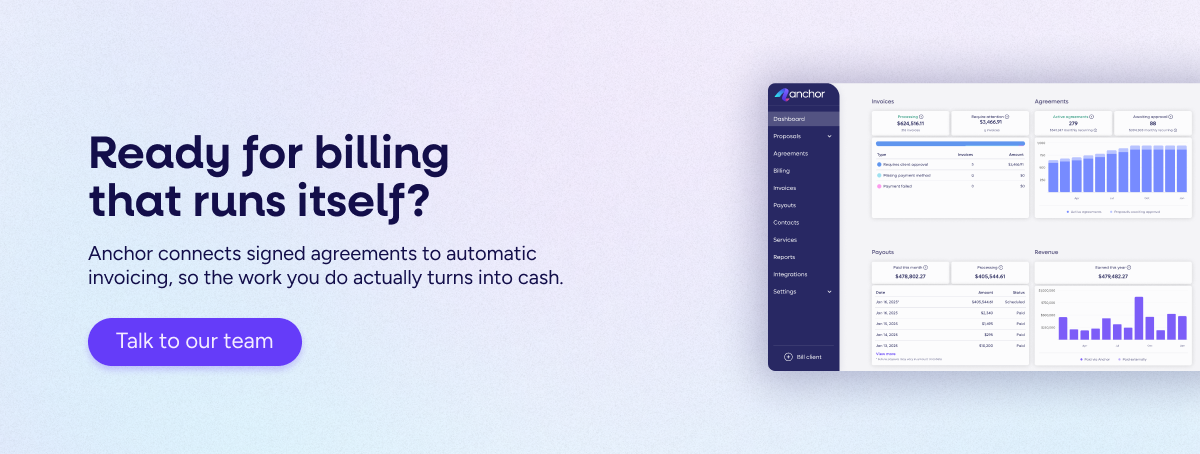
It’s also what Anchor is built for. Anchor connects agreements, billing schedules, invoices, payments, and changes into a single flow, keeping the work and the money aligned by default.
It starts when terms are set. Anchor captures the commercial details up front, so fewer “we’ll sort it out later” moments turn into billing drift. From there, invoices trigger from the signed terms and billing schedule, whether it’s recurring work, one-time work, or a mix. Billing isn’t waiting on someone to remember, or on the one week nobody’s slammed.
Payment is part of the same workflow. With automatic payments configured, collection stops being a separate project built on follow-ups and timing guesswork. And when credit cards are used, fees can be collected from the client when configured.
Reality still changes. Scope expands. Pricing shifts. Terms get updated. Anchor supports amendments so you can update services, pricing, discounts, and terms without restarting the engagement. When a change requires explicit client approval, the client sees what changed and approves it, keeping the agreement current rather than turning it into a side conversation.
When agreements, billing, and payments stay connected, visibility stops being a spreadsheet exercise. You can see what’s expected, what’s outstanding, and what cash timing looks like ahead, which takes weight off leadership decisions. Not more follow-up. A system that keeps reality from drifting in the first place.
Cash certainty isn’t a financial win. It’s a leadership win.
Late payments not only create admin work. They create hesitation. They pull leaders into exception handling. They slow down straightforward decisions.
If you want faster growth, calmer operations, and less time spent by partners protecting revenue, you need fewer drift points between what was agreed to, what was billed, and what was paid.
If you want to reduce decision drag by making cash timing more predictable, book a quick call with one of our advisors and see how Anchor connects agreements, automated invoicing, automatic payments, and amendments into a single, connected flow.