


Write-offs show up at the end of the billing cycle. The process failure that produced them usually started months earlier: in the unsigned engagement letter, the invoice sent thirty days after you completed the work, the payment method you never captured at signing.
Chaser's 2026 accounts receivable report found that 38% of businesses write off between 3% and over 14% of annual revenue as bad debt. For a firm billing $50,000 a month, a 3% write-off rate erases $18,000 a year in completed work.
The guide below covers what bad debt expense is, how to calculate it correctly under GAAP, and the structural changes that reduce and eventually prevent it.
Key takeaways
- The allowance method is the GAAP-required approach for accrual-basis firms. It records the estimated cost of uncollectible receivables in the same period as the revenue they offset, keeping your financials accurate instead of producing a surprise write-off months after the work was done.
- Three structural causes drive most bad debt expense in accounting and bookkeeping firms: vague or unsigned engagement terms, invoicing delays that push accounts past 60 days outstanding, and no payment method captured at the time of signing.
- Prevention operates differently from reduction. Reduction works on receivables that already exist. Prevention works upstream, at the moment the client signs, by capturing payment authorization before the work begins.
What is bad debt expense?
Bad debt expense is the cost a business records when a receivable becomes uncollectible. Under GAAP's matching principle, firms record this estimated loss in the same period as the revenue it offsets, not when they give up on collecting. The result is financial statements that reflect what you actually expect to collect, not the total you billed.
The distinction from a cash write-off matters here. A write-off records the loss when you give up on a specific invoice. Bad debt expense, calculated in advance through the allowance method, records the estimated loss before that point. And for an accrual-basis firm, recording the expense early is what keeps your income statement from overstating revenue for months until a write-off finally appears.
One more distinction worth keeping clean: bad debt expense is not a revenue recognition failure. You earned the revenue. You delivered the work. Recording the estimated uncollectible portion separately is what keeps your balance sheet accurate about what you will actually collect.
How to calculate bad debt expense
Two methods exist for calculating bad debt expense. The allowance method, which GAAP requires for accrual-basis firms, estimates uncollectible amounts in advance using either a percentage of credit sales or an AR aging schedule. The direct write-off method records the expense only when a specific account goes uncollected. For most professional services firms on accrual, the allowance method is the correct choice and the GAAP-required standard.
The allowance method (percentage of sales)
The percentage of sales approach estimates bad debt as a fixed percentage of your credit sales for the period. A firm that has historically lost 2% of credit revenue to uncollectible accounts applies that rate to the current period's sales to calculate the allowance.
Using a $500,000 annual revenue service firm: $500,000 × 2% = $10,000 estimated allowance for the year. You record this as a debit to bad debt expense for $10,000 and a credit to allowance for doubtful accounts for $10,000. Total accounts receivable on the balance sheet stays unchanged, but the allowance contra-asset reduces net AR to reflect what you realistically expect to collect.
GAAP prefers this method because it matches the estimated expense to the revenue period that generated it. You recognize the probable loss when you recognize the revenue, not months later when a client stops responding to invoices.
The percentage you apply should come from your firm's own collection history, not a published benchmark. Three years of your own write-off data is more relevant than an industry average from a different client mix.
The allowance method (AR aging schedule)
The aging schedule approach groups receivables by how long they have been outstanding and applies different loss percentages to each bucket. Older receivables default at higher rates, so this method typically produces a more precise allowance than a flat percentage.
A firm with $100,000 in total receivables might build the estimate this way:
Compare that to a flat 2% applied to the same $100,000 balance, which produces a $2,000 allowance. When 8% of the receivable book sits in the 90+ bucket, a flat rate materially understates the expected loss.
Running this calculation requires a current AR report sorted by age bucket. The AR reporting guide walks through how to read that report and act on what you find.
The direct write-off method
The direct write-off method records bad debt expense only when you determine a specific account uncollectible. You debit bad debt expense and credit accounts receivable at that point. No advance estimate, no allowance account.
The timing problem: revenue and the related loss land in different periods. A firm that bills in March and gives up on collection in September has overstated income for six months, which violates GAAP's matching principle. Accrual-basis firms that produce GAAP-compliant financials cannot use the direct write-off method for book purposes.
For tax purposes, the IRS allows deductions only for specifically identified uncollectible debts, not general allowances, so your book accounting and tax accounting will diverge. That divergence is normal. Keep documentation of your collection attempts for each account you plan to write off, in case of audit.
What drives bad debt in service businesses
\Bad debt in service businesses is driven primarily by inadequate client credit checks, vague payment terms, delayed billing processes, and poor invoice follow-up. Additional causes include unresolved client disputes over service quality, unexpected client insolvency, and weak cash flow management that allows unpaid accounts to age without intervention.
- Vague or unsigned engagement terms. When the engagement letter does not define scope, fees, and payment schedule clearly, billing disputes follow. And billing disputes are where bad debt begins. A client who questions the scope of an invoice in month three usually had the opening to do so in the engagement letter your client should have signed in month one. Scope creep that goes undocumented becomes a receivable that goes uncollected.
- Manual invoicing delays. Firms that invoice after work is complete, with no payment method on file, start the collection clock after the client has already received the value. Every extra day in the collection cycle adds default risk. According to Certinia, the average professional services firm loses close to 5% of revenue to billing leakage from manual processes. Some of that leakage covers work you never invoiced. The rest is work you billed but never collected because follow-up broke down. The DSO guide covers how to calculate your current collection timeline and what shortening it by 15 days does to your exposure.
- No payment method on file. When a client pays on receipt of an invoice, the client makes a payment decision every billing cycle. Most months they decide to pay. Some months they delay. A few months they push back. No payment method on file means every invoice is a fresh negotiation, and the older the receivable, the weaker the negotiating position.
How to reduce bad debt expense
Reducing bad debt expense requires tightening the conditions under which bad debt forms. That means vetting clients before engagement begins, shortening payment terms, reviewing the AR aging report monthly, and following up faster when invoices enter the 31-to-60-day window. None of these tactics eliminates bad debt entirely, but each one compresses the window in which a receivable ages into a write-off.
Four adjustments move the needle at the process level:
- Screen clients before engagement. Ask for references and review any available credit history before extending terms to a new client. A weak client in month one is a bad debt problem in month six.
- Tighten payment terms. Move from Net 30 to Net 15, or to payment due on receipt. Every additional day in the collection cycle is additional default risk.
- Review the AR aging report monthly. Act on 31-to-60-day receivables before they cross into the 61-to-90 bucket. The further right a balance moves on the aging report, the lower your probability of full recovery.
- Follow up faster. A call at 15 days past due reaches a different client than one at 60. Speed of follow-up is one of the most reliable predictors of collection success.
Tighten your engagement terms
Every engagement that starts without a signed agreement defining scope, fees, and payment schedule is an engagement you may not collect on in full. The dispute usually starts in the engagement letter, or where one should have been. Vague scope language becomes a billing conversation in month three. Undocumented add-ons become a dispute when the client expected something different from what you delivered.
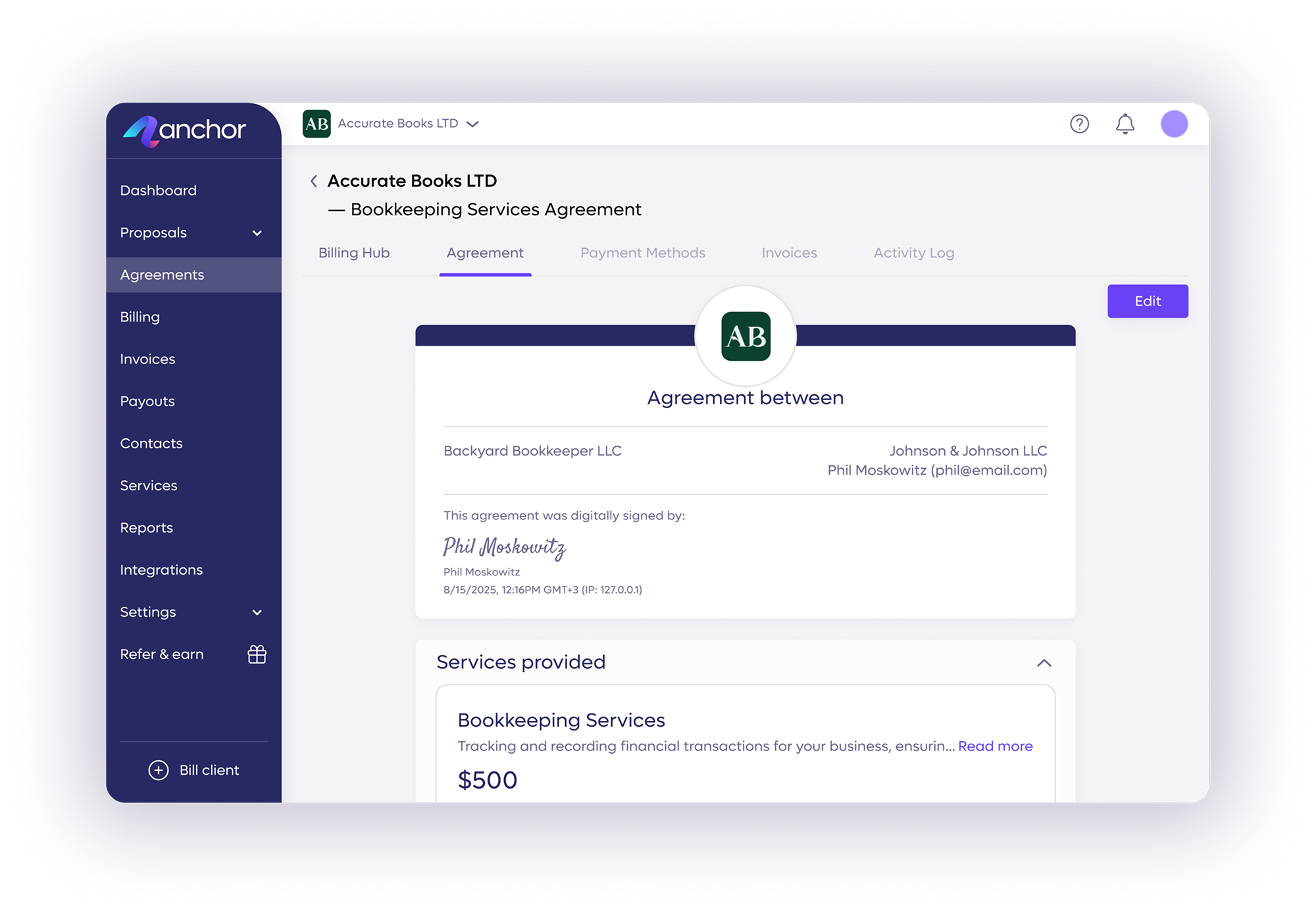
Anchor's agreements feature lets firms build service-level detail into interactive proposals that clients sign before work begins, with fees and payment terms disclosed at the point of signature.
Shorten your collection cycle
Moving from Net 30 to Net 15, or to on-receipt payment terms, compresses the window in which an account can age into a collection problem. A receivable at 15 days is easier to collect than one at 45. The aging schedule above shows why: loss rates climb steeply between age buckets, so the cost of a slow collection cycle runs beyond interest. Every additional day is additional default probability.
The DSO formula post covers how to calculate your current collection cycle and model what a 15-day improvement looks like in expected write-offs. The AR system guide covers how to build an aging review cadence and the right response at each age threshold.
How to prevent bad debt before it forms
Preventing bad debt requires thorough client credit vetting, upfront payment terms, upfront retainers or deposits, and prompt billing processes. Establishing clear contractual milestones, enforcing strict credit limits, and maintaining transparent communication stops non-payment risks before work begins.
The mechanism matters. Every reduction tactic in the previous section treats a symptom. The symptom is a receivable sitting in a queue, waiting for someone to act on it. Prevention moves the billing decision to the beginning of the engagement rather than the end of the service cycle. When a client pre-authorizes payment at signing, subsequent invoices become automatic: the amount was set in the agreement, the payment method is stored, and the charge runs on the due date.
The firms that move to this model report near-elimination of outstanding AR, not reduction.
GWCPA, Anchor’s client- an 80-year-old tax and accounting practice, carried a six-figure AR balance for years before switching to agreement-first billing. Barrett Young, the firm's managing partner, attributed the balance to the absence of systematic follow-up: clients who signed kept receiving work regardless of what they owed. Within about one year of moving to pre-authorized billing, the balance reached near-zero. The first six months cleared most accounts by volume. The firm addressed remaining balances through structured payment plans built into new agreements. Read further on this great success story
“I now have a 25-year-old admin who started with us as an intern. She is creating proposals, following up with clients, and talking them through signing. All of that is out of my hands after one and a half years of using Anchor. That’s pretty amazing.”
Barrett Young, Tax Managing Partner, GWCPA

Expert Bookkeeping eliminated more than $40,000 in outstanding AR within six months of the same transition. Jacob LaCour, the owner, had previously estimated he spent four to five hours per week on collection follow-up. Today, AR for the clients on Anchor's autopay is zero.
PBS Consulting & Tax Solutions estimated it was losing between $20,000 and $50,000 per year in ad hoc and out-of-scope revenue because the admin overhead required to bill for that work was too high. After building automated billing workflows for ad hoc charges and annual price increases, the firm billed more than $20,000 in previously unrecovered work in the first year.
Sam Hallburn, Director of Operations, attributed the change to removing the bottleneck between work completed and invoice sent.
Frequently asked questions
What is bad debt expense in accounting?
Bad debt expense is the estimated cost of receivables a business expects not to collect, recorded in the same period as the revenue those receivables represent. Under GAAP, accrual-basis firms use the allowance method to estimate this loss before any specific invoice is written off. The resulting allowance for doubtful accounts, a contra-asset on the balance sheet, offsets total accounts receivable to show the net amount the firm realistically expects to collect.
How do you calculate bad debt expense?
Two methods apply. The percentage of sales method multiplies total credit sales by the firm's historical loss rate: a $500,000 firm with a 2% history records $10,000 in bad debt expense for the period. The AR aging schedule method applies escalating loss rates to each age bucket of outstanding receivables and typically produces a more precise estimate when older balances represent a significant portion of the book. GAAP requires the allowance method for accrual-basis firms; the direct write-off method is acceptable only for cash-basis filers or for tax purposes.
Can you prevent bad debt entirely?
Near-zero is achievable for firms that capture a payment method at the moment the client signs the engagement agreement and run automated billing against that stored authorization. Firms that made this structural change report AR balances at or near zero for the clients on pre-authorized billing. Some residual exposure remains for clients on older arrangements or for project-based work billed on completion. But the bulk of what most recurring-service firms write off annually comes from the specific process gap that pre-authorization closes.
Conclusion
Bad debt is a process problem. The write-off happens late in the billing cycle, but the conditions that produced it formed at the start of the engagement: the agreement that was not signed clearly, the invoice that went out late, the payment that was never pre-authorized.
Calculate it correctly using the allowance method so your financials reflect what you will actually collect. Tighten the conditions that allow it to form by documenting engagement terms and shortening collection cycles. For recurring client work, remove the collection queue entirely by capturing payment authorization before the work begins.
See how Anchor's agreements capture payment authorization at signing →