


Two agencies can bill the same $1.9 million in a year, serve clients of similar size, and run teams that look nearly identical on paper. One makes confident hiring decisions in January. The other sweats payroll in March.
The variable separating them is rarely service quality or client mix. More often it's the billing model underneath that revenue.
Agency billing models determine when cash arrives, how far margins run by month twelve, how confidently you can plan headcount, and what a buyer will eventually pay for the business. Treating this as a sales preference rather than a financial architecture decision means solving the same cash flow problem every six months.
Each of the three core models has a legitimate place. Monthly retainers, project-based billing, and performance-based pricing carry distinct risk profiles, margin behaviors, and growth trajectories. Understanding what each one actually does to your numbers is the prerequisite for choosing the right mix.
The three core agency billing models
Agency billing models fall into three categories: monthly retainers, project-based billing, and performance-based pricing. Most agencies run some combination of all three, but the mix they default to determines their cash flow rhythm, their delivery efficiency over time, and ultimately how scalable the business becomes. Each model serves a different purpose and carries a different set of risks.
Monthly retainer
A monthly retainer is a recurring agreement where a client pays a fixed fee for a defined scope of services, with no defined end date. The client pays on a set date each billing cycle, and the relationship continues as long as the agency delivers results and value. Retainers are most common for SEO, paid media management, content marketing, social media, and fractional advisory work, where the value compounds over time and ongoing access to an expert team is the product. For small agencies, retainer engagements typically run $2,500 to $12,000 per month, depending on scope and service mix. The primary risk is scope drift: a retainer without a clear change-order process becomes an open-ended engagement that quietly compresses margin without a single difficult conversation.
Project-based billing
Project-based billing ties a fixed fee to a bounded scope: a website build, a brand identity package, a campaign launch, a technical audit. The deliverables, timeline, and price are set at the outset, and revenue stops when the work does. Project fees for small-to-mid-size agencies typically run $5,000 to $50,000 or more per engagement, depending on complexity. The model works cleanly when the SOW is airtight. When it isn't, scope creep takes margin that was never priced. Project billing produces revenue that arrives in spikes rather than on a recurring schedule, which creates the feast-or-famine pattern that most agency owners know well and nobody wants to repeat.
Performance-based billing
Performance-based billing ties agency compensation to measurable outcomes: cost-per-lead, revenue share, or a percentage of managed ad spend. According to the 4A's 2024 Compensation Methodologies Survey, agencies typically charge 10 to 20 percent of managed ad spend for performance-based arrangements. The model works when attribution is clean and the agency has genuine influence over the outcome. Pure performance billing is rare in practice. Agencies avoid it because revenue uncertainty makes payroll planning nearly impossible. Most performance arrangements layer a bonus or share on top of a retainer base rather than replacing it entirely, usually after the agency has established a track record and both parties have agreed on attribution methodology upfront.
The cash flow math no one shows you
The cash flow difference between billing models isn't about which generates more revenue over a year. It's about which model determines whether project revenue becomes growth fuel or survival income. An agency where retainers alone cover fixed costs operates in a fundamentally different financial position than one where project revenue fills the gap every month.
The distinction comes down to a ratio worth tracking. Iota Finance's agency CFO practice describes it as the Fixed Cost Coverage Ratio: Monthly Recurring Revenue divided by Monthly Fixed Costs. It measures what percentage of your committed monthly outflow, including salaries, rent, and software, that retainer income covers before a single project closes.
A rough framework for reading the number: under 50 percent coverage means most fixed costs depend on winning new project work each month, which is a structurally fragile position. Between 50 and 80 percent, the recurring base carries the majority of fixed costs. Above 100 percent, retainers fully cover the cost base and project revenue becomes growth upside rather than operational necessity.
Two agencies with identical annual revenue tell very different stories when you run this number. Take a $60,000-per-month fixed-cost agency. At 50 percent retainer coverage, $30,000 arrives before the first project invoice goes out. A slow project month directly threatens payroll. At 80 percent retainer coverage, $48,000 arrives before any project closes. A slow project month is lean, not a crisis.
Project revenue is profitable on paper. The problem is that paper profit and account balance are two different things. A project that closes in February, invoices in March, and collects on a 30-day term reaches the bank in April. Salaries do not wait for April. Agencies that confuse profitable income statements with healthy cash positions are almost always the ones running low retainer coverage ratios and high project dependency.
"Search doesn't stand still, so neither can the strategy. Retainers mean we're always adjusting to what's actually happening — not reacting to what happened last quarter."
Liraz Postan, International AI-First SEO & content agency owner
Scalability trade-offs: what each billing model does to your business
The billing model question typically gets framed as a sales or positioning decision. It's more accurately a financial operations question. Each model behaves differently across the three dimensions that determine whether an agency can scale: cash flow predictability, margin behavior over time, and what the business is worth when you're ready to exit.
Cash flow predictability
Retainers create a recurring revenue floor. Because the same invoice recurs each month, retainer revenue covers fixed costs on a predictable cadence and makes capacity planning possible. An agency can make a hiring decision in October based on what it knows will arrive in November. Project revenue doesn't work that way. A strong project pipeline in Q2 masks a thin one behind it, and the gap between closing one engagement and billing the next is where cash flow squeezes happen even when the agency is profitable on paper.
The retention data makes the compounding advantage concrete. According to Focus Digital's 2026 agency churn analysis, retainer clients stay an average of 56 months, while project clients stay an average of 24 months. A client paying $6,000 per month for 56 months generates $336,000 in lifetime revenue from a single acquisition cost. A project client at a $20,000 engagement average, revisited twice over 24 months, generates $40,000. The math changes what a retained client is actually worth and how much it makes sense to invest in keeping one.
Margin behavior over time
Retainers often look less profitable in month one. Onboarding overhead is real: the team learns the client's brand, tools, and decision-making rhythm. Delivery is slower. The first invoiced month rarely reflects what the relationship will look like by month six. By month four or five, delivery efficiency improves. The team understands the account deeply. Margin expands without any additional sales cost.
Project margins follow a different arc. The headline fee represents the best margin moment, with scope creep, revision rounds, and unclear briefs eroding it before the final invoice goes out. Agencies relying heavily on project billing often build strong-looking income statements while their actual cash position tells a different story.
According to Promethean Research's 2025 Digital Agency Industry Report, agencies generating 60 percent or more of revenue from retainers carry average net margins approximately 8 percentage points higher than primarily project-based peers. Retainers don't just smooth the revenue curve. Over time, they expand it.
Valuation impact
Most agency owners don't hear the valuation argument until they're sitting across the table from a buyer, and by then the billing model has already determined the outcome. Marketing agency valuations typically run 4x to 8x adjusted EBITDA, with predictable recurring revenue pushing multiples toward the higher end of that range, according to Iota Finance's agency CFO analysis.
Check out Anchor’s solution for marketing agencies.
Run the math on a $2 million EBITDA agency. At 70 percent retainer revenue and a 6x multiple, the business is worth $12 million. At 30 percent retainer revenue and a 4x multiple, it's worth $8 million. The work is identical. The billing model is the variable. Buyers pay a premium for businesses where revenue arrives without a sales cycle, and retainers are the mechanism that makes revenue predictable in the way buyers value.
The agency billing model decision framework
Choosing the right agency billing model, or the right blend, comes down to three questions about your agency's current financial and service position. The goal isn't to identify the theoretically superior model. It's to match your model to where your agency actually is.
Question 1: Is the work ongoing or bounded? Services producing compounding results over time, including SEO, paid media, content, and ongoing social media management, fit retainer structures because the value increases with continuity. Services with a defined start, deliverable, and end date, including website builds, brand identities, audits, and campaign launches, fit project billing because the scope is naturally bounded. Forcing a bounded engagement into a retainer creates a relationship with no natural renewal point and no clear value anchor for the recurring fee.
Question 2: Can you measure the outcome clearly enough for performance billing? Performance-based arrangements require clean attribution before the agency can justify the first fee. If the agency can't isolate its contribution from market conditions, competitor activity, or the client's own sales team, performance billing becomes a source of attribution disputes rather than aligned incentives. Most agencies add performance components on top of a retainer base, after establishing a track record with the client and agreeing on attribution methodology upfront.
Question 3: What percentage of your monthly fixed costs does your current recurring revenue cover? Run the Fixed Cost Coverage Ratio. Agencies under 50 percent coverage have a structural problem that project volume alone won't solve, because project revenue arrives in peaks and troughs that don't align with payroll schedules. Agencies in this position should focus on converting their most successful project clients into retainers, not on winning more projects.
A practical staging model: agencies under $1 million in revenue build proof through project work and use it to land their first retainers with clients who've seen results. Growth-stage agencies, between $1 million and $3 million, introduce retainers to stabilize cash flow and target 40 to 60 percent recurring coverage of fixed costs. Agencies above $3 million build toward retainer-dominant revenue and use project work as a pipeline for retainer conversion rather than as the core business model.
See how - > https://www.youtube.com/watch?v=F5zmP_I1G74
Where every billing model breaks down
Every billing model shares the same failure point, regardless of structure. The retainer sends an invoice late. The project invoice waits on client approval before a 30-day clock starts. The performance arrangement requires metric verification before any charge leaves the client's account. In each case, the breakdown doesn't live in the pricing logic. It lives in the gap between the signed agreement and actual payment collection.
According to OAREX's H1 2025 Digital Media and Advertising Payments Study, 58 percent of all digital media and advertising payments were late in the first half of 2025, the highest rate recorded since OAREX began tracking. The billing model each of those agencies ran didn't determine whether they got paid on time. Their billing process did.
The structural fix is the same regardless of model: capture the client's payment method at the moment the client signs the agreement, and automate the invoice from the agreement terms. Retainers stop functioning as invoice-and-wait relationships. Project invoices trigger on defined milestones without manual action. Performance billing charges against pre-authorized methods when agreed KPIs clear verification.
Agencies that build this infrastructure under their billing model remove the collection variable from the model equation entirely. Payment becomes a system output rather than a conversation outcome.
Anchor connects the signed engagement agreement directly to an automated billing engine: when a client signs, they authorize a payment method, and from that point invoicing and collection run against the agreed terms without manual triggers. For a deeper look at how this breaks down in practice for retainer-specific agencies, see why agency retainers fail to solve cash flow problems.
Frequently asked questions about agency billing models
Agency billing models generate consistent questions about which structure most agencies actually use, how retainers work in practice, and whether switching models mid-engagement is viable. The answers below address each one directly, with data from the most recent agency pricing research where available.
Which pricing model do most agencies use?
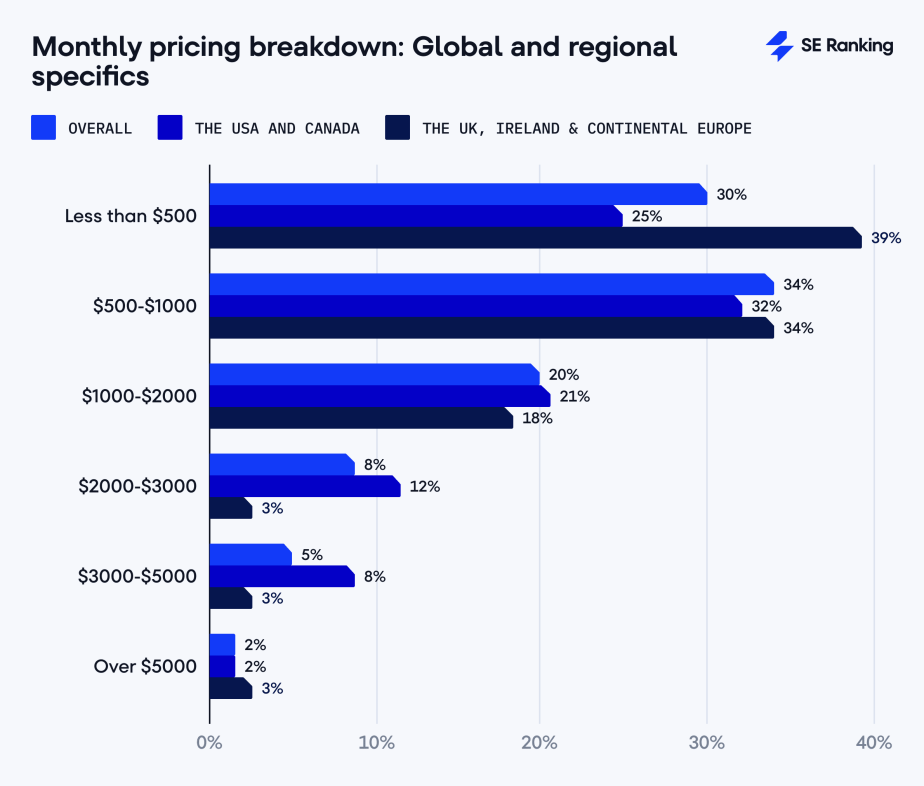
Most agencies blend models rather than committing to one exclusively. In SE Ranking's 2025 survey of 260 agencies, 78.2 percent reported charging monthly retainers, while 48.9 percent also use project-based billing for defined-scope work, and 9 percent use some form of performance-based pricing. The split varies by service type: SEO and paid media skew retainer-heavy; branding, web development, and campaign launches skew project-based. Performance arrangements almost always appear as a component on top of a base retainer rather than as a standalone model.
What is a retainer billing model?
A retainer billing model is a recurring agreement where a client pays a fixed monthly fee for a defined scope of services or a set number of hours. The client pays on a set date each billing cycle, and the engagement has no defined end date. The fee recurs without re-selling. Retainers are most common for services where results compound over time: SEO, paid media management, content marketing, and ongoing advisory work. The agency accumulates deep client knowledge each month, which makes delivery more efficient and the relationship more valuable over time. Unlike project billing, a retainer establishes what to charge and creates the recurring payment structure at the same time.
Get a free retainer agreement template here
Can you switch billing models mid-engagement?
Yes, and most agencies should make this transition at natural inflection points rather than mid-delivery. The most common transition is from project to retainer after a successful engagement, when the client has seen results and trusts the team. Build this flexibility into contracts from the start with a 60-day notice clause and a defined renegotiation trigger tied to project completion or a quarterly review. Adding a performance component to an existing retainer works best once attribution infrastructure is in place and both parties have agreed upfront on how to measure the outcome.
Conclusion
No billing model is inherently better. The right model fits your service mix, your client type, and where your agency sits in its growth. Early-stage agencies need project work to build proof. Growth-stage agencies need retainers to stabilize cash. Scale-stage agencies need both, structured correctly.
What matters more than the model is the billing execution underneath it. The agency that outgrows its billing model stalls. The agency that outgrows its billing process loses revenue regardless of model. Payment captured at signing, invoiced automatically from the agreement: that's the infrastructure that makes any model deliver what it promises.