
Get started for free

A practical guide to showing up, managing fear, and building with grit.
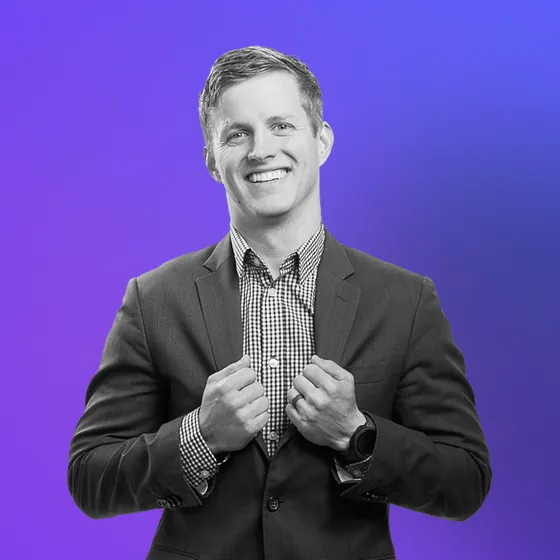
There's a story my dad told me growing up that I keep coming back to. It's one of those things that sounds simple on the surface but gets more true the longer you're in business.
The story
He was a young dad with three kids and no clear path. We were in a church ministry, living lean, and things just weren't working. He went outside one morning, probably anxious, probably stressed, and prayed. Asked for help. For direction. For something.
And he looked down and saw a bird land on the ground, press its beak into the dirt, and pull up a worm.
So he started walking around the neighborhood. He spotted a man up on a roof and asked if he needed help. The roofer asked if he knew how to roof. My dad said yes. He had never roofed a day in his life. Within a year, he had a quarter-million-dollar roofing business. Today, he runs a $20 million company.
I grew up watching all of it, including the parts that didn't work out. And what I took from him wasn't just hustle or boldness. It was something harder to practice: the willingness to show up when you don't have answers, put your beak in the ground, and see what's there.
That idea has shaped everything about how I think about business.
You have to show up, especially when you don't feel like it
I think there's a version of entrepreneurship that gets sold as confidence, momentum, and knowing what you're doing. And I just don't think that's honest.
Most of the things I've done in business have been a process of being afraid and doing it anyway. Not because I had it figured out. Because I showed up.
My dad wasn't ready to be a roofer that morning. He was just ready to try. And I think that's actually the more realistic picture of how businesses get built. Not by people who had a perfect plan. By people who kept showing up no matter what happened yesterday.
There are going to be hard seasons. There are going to be moments where nothing is working and you don't know what to do next. The question is whether you let that stop you or whether you get back up and put your beak in the ground again.
I think about that image a lot. The bird doesn't wait for conditions to be right. It just lands and tries. That's the practice.
Fear is not the problem
I want to be honest about this: I'm afraid too. I have been afraid through most of the decisions I've made in business.
And I think that's normal. Anyone who comes across as above fear is either performing or hasn't hit the hard moments yet. The hard moments are coming for everyone.
Fear is not the problem. The problem is what you do with it.
If you let fear keep you from starting something, or making a decision, or taking a risk that actually makes sense, that's where it becomes dangerous. If you stay with it, if you let it envelop you, if it starts to dictate what you do or don't do, that's where you get into trouble.
Being open about fear is part of what keeps it from winning. I've found that just naming it, saying out loud that I'm uncertain or worried or not sure this is going to work, takes some of the power out of it. The people who stay closed, who hold everything tightly and never let the hard stuff out, are the ones who get stuck. Or who find other ways to manage what they're carrying.
Vulnerability is not a weakness in business. It's actually one of the more strategic things you can practice.
What this looks like in practice
There's a difference between reckless risk and strategic risk
Not all risk is the same, and I think it's worth being clear about that.
Early on, I took risks mostly out of naivety. I didn't fully understand the consequences, so I just went. That worked sometimes. It didn't always. And I think there's a season for that, where you're learning and moving fast and figuring things out as you go.
But as you build, you have to get more intentional about it. There's reckless risk, and there's strategic risk. Getting comfortable with one doesn't mean embracing the other.
Strategic risk is the kind where you've thought through the downside, made peace with it, and decided the move is still worth making. Whether that's buying a business, making a hire that stretches you, or committing to a new direction. These are real decisions with real stakes. And learning to tolerate that kind of appropriate risk, not reckless, not paralyzed, is part of what separates businesses that grow from ones that stall.
I really believe that the businesses that will make it through uncertain times are not the ones that played it safe. They're the ones who took strategic risks and kept moving. If you're not growing, you're stagnating. And stagnation is its own kind of risk.
A few questions worth sitting with before you take a risk
You don't need perfect answers. You need enough clarity to move with intention rather than impulse or avoidance.
You don't have to carry it alone
I'll be honest here because I think it matters: my faith is the reason I'm still doing this.
Entrepreneurship is lonely. Anyone who's been at it for a while will tell you that. The decisions land on you. The weight of it sits with you in a way that's hard to explain to people who haven't felt it. And I think a lot of business owners try to carry all of that by themselves, which is one of the reasons so many people burn out or get stuck.
For me, the thing that has kept me going through the hardest stretches is the belief that I'm not carrying it alone. That there's something bigger than the business at stake, and something outside myself that's invested in the outcome. I can bring my fears to God, lay them down, and keep moving. That's not a handout. It's not passivity. I still have to be the bird. But I'm not doing it entirely by myself.
I'm not prescriptive about what that looks like for everyone. But the underlying principle holds regardless: you need people and perspectives outside yourself to stay healthy in this. Whether that's faith, a mentor, a peer group, a colleague you trust, the form matters less than the habit of not doing it alone.
The people who stay completely closed off are the ones who get trapped.
Where to start
Grit is not glamorous. It's just not quitting.
After the Chiefs won their first Super Bowl in my lifetime, my dad gave me a copy of the newspaper from the next morning. The headline read:
Never Quit.
I've kept that with me.
Not because the message is complicated. Because it isn't. Because some days, the most important thing you can do is just not stop. Get back on the horse. Try again. Show up again. Put your beak in the ground again.
My dad's business didn't follow a clean straight line. Not every risk paid off. There were moments where he got upside down, where things didn't go the way they were supposed to. The $20 million company didn't come from everything working. It came from someone who kept going anyway.
That's the grit I'm talking about. Not the kind that performs toughness or pretends nothing is hard. The kind that wakes up the next day and goes back to work.
Where to start
You don't need to have everything figured out. You just need to take the next step.
Set aside 30 minutes and work through this:
Exercise
Set aside 30 minutes
Start there.
At the end of the day, the goal isn't just to build a firm. It's to build something that shapes you as much as it serves your clients. And that requires showing up, being honest, taking risks you're not sure about, and staying in it when things get hard.
Show up. Put your beak in the ground. See what's there.
Download this manual as a PDF, then explore the rest of the Pay it Forward library.
