


Scope changes are a good sign. It usually means the client trusts you, the work is growing, and the relationship is working.
But in a lot of firms, scope changes still turn into the same mess: someone says “sure” in an email, the team starts working, and the billing never catches up. Weeks later, you realize you’ve been doing extra work for free. Then it feels awkward to bring it up.
A simple amendment system fixes that. It turns “quick requests” into a normal process that protects your margin, keeps billing accurate, and actually builds trust because the client always knows what they approved.
Key takeaways
- Scope changes should be routine: Treat them like a normal step in delivery, not a special event that triggers dread.
- Speed beats perfection: A short, clear amendment sent before work starts prevents “we’ll fix it later” revenue loss.
- Billing has to match the agreement: If the scope changed, the invoice should change on the same timeline.
- Low-friction approval matters: If a client can approve on their phone in seconds, changes don’t stall.
Why amendments feel like a headache (and why they shouldn’t)
Most firm owners avoid amendments for one reason: they think it will create friction. They picture a client getting defensive, the project slowing down, or a long back-and-forth over “contract language.” So they try to keep it casual. That’s where the money leaks.
The bigger issue is that “casual” creates gaps. Work happens in real life, but your agreement and billing stay frozen in time. Your team is trying to be helpful, so they do the extra task. Then nobody wants to be the person who says, “Hey, we should charge for that thing we already delivered.”
It also creates stress inside the firm. The partner might say yes on a call. The manager might hear about it two weeks later. The billing person might never hear about it at all. By the time someone notices, it’s not just one missed add-on. It’s a pattern.
Amendments aren’t about being strict. They’re about being clear. Clear is kinder. When the client sees a clean update before the work starts, they don’t feel surprised later. And your team doesn’t have to play detective at the end of the month.
Amendment vs. addendum vs. new agreement
You don’t need to overthink this, but you do need a simple way to decide what to use. The goal is to move fast without turning every small change into a legal project.
An amendment is the most common. It changes specific terms of an existing agreement. Think: fee change, adding a service, shifting a deadline, adjusting the monthly scope. It’s the “we’re updating what we already agreed to” tool.
An addendum is for something that’s truly an extra. It’s a tag-along attachment that adds a distinct piece of work without rewriting the main agreement. Think: a one-time cleanup project added to a monthly engagement, or a specific new deliverable that should stand on its own.
A new agreement is for a real reset. If the client’s structure changes a lot, your service model changes, or it’s been years since anything was signed, start clean. That protects you and the client because everyone is working from the same current foundation.
Disclaimer: This is operational guidance, not legal advice. Talk to your counsel for the exact language.
The no-drama amendment workflow
If scope changes rely on “good memory” and “best intentions,” they’ll keep slipping. What works is a simple workflow that your team can repeat the same way every time. Routine beats willpower.
Start by spotting the trigger. Most scope changes sound harmless in the moment: “Can you also…”, “While you’re in there…”, “We decided to add…”. Train the team to hear those phrases as a flag. Not a problem. Just a flag that says: pause and capture the change.
Next, classify the change quickly. Is it a clarification (no real extra work) or an expansion (more work, more value, more risk)? This one decision keeps you from amending everything, while still protecting you from the expensive stuff.
Then price it without improvising. The fastest way to make this awkward is to wing it on a call. Build a simple menu for common add-ons so your team can say, “Yep, we can do that. Here’s what it costs.” When you have a price ready, you don’t stall, and you don’t cave.
After that, document it before the work starts. This is the part most firms skip. They tell themselves they’ll “clean it up later.” Later is where revenue goes missing. Send the amendment, get approval, then start the new work.
Finally, connect the change to billing so it can’t drift. The effective date in the amendment should match when billing changes. If the work starts mid-month, your billing should reflect that reality, including proration when needed.
What every amendment should include
A lot of amendment issues come from one thing: the document is vague. Vague scope is how you end up arguing about what was included and when it started. A good amendment is short, specific, and boring in the best way.
First, make the effective date obvious. Not “ASAP.” Not “starting next cycle” unless you define the cycle. Put the real date the new work and the new billing begin. That protects both sides.
Next, spell out the scope change in plain language. You don’t need ten pages, but you do need clarity. If you’re adding an entity, say that. If you’re adding payroll runs, say how often. If you’re removing something, say what’s being removed so expectations don’t linger.
Then add a simple “everything else stays the same” line. This stops the amendment from accidentally reopening the whole agreement. It also helps the client feel safe because they can see it’s a focused update, not a surprise rewrite.
You also need the fee change stated clearly. What’s the new total? What’s the additional amount? If there’s proration, show the math in one sentence so nobody has to guess later.
And last, make sure you have proof of approval. Whether that’s a signature or digital acceptance depends on your setup, but you need an audit trail that shows who approved it and when.
Scripts that keep it professional
Most “money awkwardness” is really “wording awkwardness.” People freeze because they don’t know how to say it without sounding defensive. A script fixes that. You’re not asking for permission to value your work. You’re keeping the engagement clean.
Here’s the mindset: you’re aligning scope and billing so the client isn’t surprised later. That’s the most client-friendly framing, and it’s true.
Use language that’s calm and normal. No big build-up. No apology. Just “Here’s the next step so we stay aligned.” When you deliver it like a routine, clients treat it like a routine.
A few scripts you can adapt:
- Alignment: “Happy to add that. To keep billing lined up with the work, I’ll send a quick amendment with the updated scope and fee. Once you approve it, we’ll get started.”
- Clean records: “We want the paperwork clean on both sides. I’m sending a short amendment so the next invoice matches what we’re doing.”
- Choice: “We can do that. It’s outside the current monthly scope, so we can either swap out [current task] or I can send an amendment to add it. What do you prefer?”
Common amendment scenarios
Amendments don’t need to be rare. In healthy client relationships, they show up all the time. What matters is that they don’t turn into chaos.
One common scenario is mid-year growth. A client adds a second entity, expands to a new state, launches a new revenue stream, or hires enough people that the workload changes. The best amendment here is simple: update the services to include what’s new, update the fee, and set the effective date. If the change starts mid-month, prorate it so the invoice matches reality.
Another is the cleanup pivot. You start with a three-month cleanup and then discover the problem is bigger. This is where firms often eat work because it feels bad to say, “Actually, it’s double.” But the client usually understands if you show them what you found and give them a clean path forward. Amend the term, adjust the fee, and reset the billing schedule so it matches the new plan.
A third is priority work. A client wants something bumped to the front of the line, like an audit request, a lender package, or a rush deadline. That’s not “free.” It changes scheduling and often pushes other work around. An amendment here can be framed as a choice: keep the current scope as-is, or add priority service for a defined fee.
The pattern is the same every time: name the change, tie it to the fee, set the date, get approval, then work.
The hidden benefit: Why amendments reduce churn
Clients don’t churn just because prices go up. They churn when they feel surprised, confused, or unsafe.
A clean amendment process does the opposite. It shows the client you run a professional operation. They always know what’s included. They always know what they approved. And when the invoice arrives, it matches the paper trail.
Compare that to the “surprise invoice” situation. Even if the work was mentioned in an email, it still feels like you changed the deal after the fact. That creates resentment fast.
When amendments are routine, clients trust the system. And that trust makes expansion easier. Upsells don’t feel like “a big ask” because the process is already familiar and low drama.
What to look for in an amendment system
You don’t need a legal department. You need a setup that makes it easier to do the right thing than to skip it.
First, look for live agreements. You want one source of truth, not a scattered trail of PDFs and email threads. When an agreement can be updated cleanly, your team actually uses it.
Second, you need billing that stays in sync. If an amendment gets approved but someone still has to manually update billing, errors will happen. Manual steps are where things drift.
Third, prioritize low-friction approval. If approval takes printing, signing, scanning, and sending, you’ll lose momentum. If a client can approve in seconds on their phone, scope changes stop getting stuck.
How Anchor handles amendable agreements
Anchor’s view is simple: agreements shouldn’t be static. They should reflect what’s actually happening in the relationship, especially when scope changes.
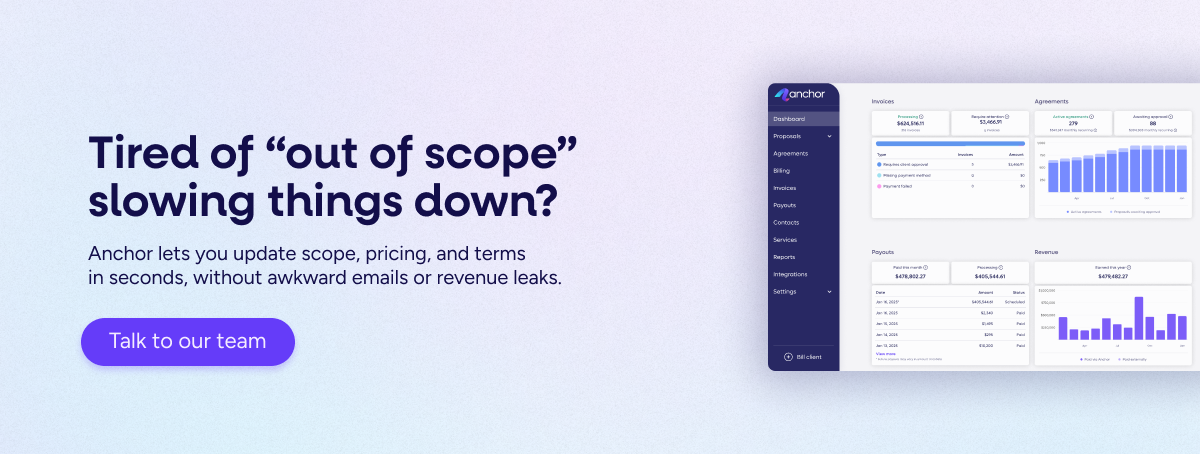
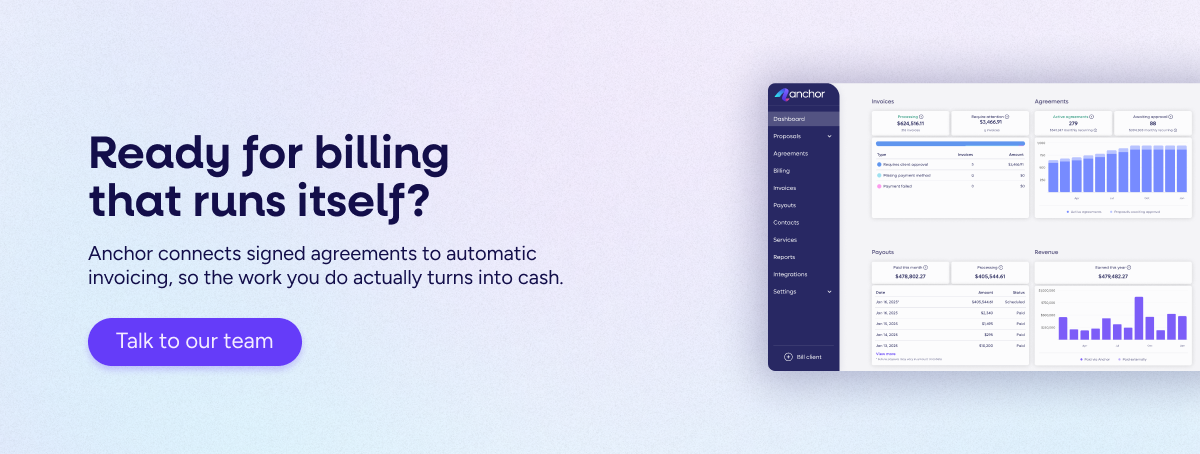
With Anchor, firms can update scope and fees in real time and send for quick client approval. When the client accepts, the change becomes part of the engagement record with a clean audit trail. No messy email archaeology later.
The goal isn’t to “chase” clients. It’s to eliminate the gap between doing the work and getting paid the right amount for it. That’s how you protect margins without turning every scope change into a negotiation.
If you want to stop losing money to “we’ll fix it later,” book a call with one of our advisors. We’ll show you how Anchor keeps agreements and billing aligned in one connected flow.