


Price increases are part and parcel of running a firm. Costs go up, client needs expand, and your team’s time becomes more valuable every year. If you’re planning a 2026 increase, you’re in good company.
In fact, more than 80% of tax pros raise fees every one to two years, typically by 6% to 10%.
Price increases help offset rising costs and maintain a healthier margin so you can keep delivering great work without squeezing your team. But if you raise prices while your billing process is still messy, the extra margin can disappear before you even see it. Exceptions, unclear scope, inconsistent terms, and “we’ll fix it next month” billing habits quietly turn price increases into revenue leakage.
In the following article, we’ll show you where margin usually slips after a price hike and how to lock it down with a tighter system: clear terms, an automatic pricing-to-billing handshake, and a “no drama” scope-change process that clients actually accept.
Key takeaways
- Price increases fail quietly: Margin leaks through exceptions, unclear scope, and inconsistent terms after the increase is approved.
- Ambiguity costs more than you think: When scope and schedules are fuzzy, teams underbill to avoid friction, and clients push back when billing shows up late.
- The fix is the handshake: Pricing only “sticks” when agreements and billing schedules connect automatically, without manual interpretation.
- Scope changes should feel routine: A simple amendment process protects the relationship while ensuring billing stays aligned in real time.
The real risk of price hikes: exceptions and ambiguity
A price increase looks clean on paper. You update your packages, refresh your language, send the notice, and move on. The hard part isn’t deciding on the number; it’s getting that new number to show up consistently in real client work.
That’s where exceptions enter. One client has an old rate you forgot existed. Another has a long list of “included” items that were never written down. A third agrees to the increase but expects extra touchpoints since they’re paying more. None of this makes them unreasonable. It’s normal client behavior when a relationship spans years.
The real risk is what happens within your firm when these edge cases accumulate. If your pricing lives in one document and your billing lives somewhere else, your team fills the gap with judgment calls. They do their best, but the result is uneven.
You’ll see it in small moments:
- Someone bills the new rate but forgets an add-on.
- Someone bills the add-on but uses the old schedule.
- Someone delays invoicing because they’re not sure what’s “allowed.”
- Someone avoids the conversation and quietly eats the work.
Those decisions don’t announce themselves as problems. They just show up later as “why didn’t we get paid for that?”
Price increases don’t protect margin if the system can’t reliably do three things: bill the right amount, on the right schedule, under the right terms. When any of that is unclear, the safest move for a busy team is to undercharge and move on.
If the risk is ambiguous, the next step is straightforward. Identify the specific areas where ambiguity leads to leakage.
Where margin disappears: scope creep and “we’ll fix it next month.”
Most revenue leakage isn’t dramatic. It’s everyday work that slips through the cracks because no one wants to create friction while serving the client. After a price increase, that risk goes up because there’s more change in the air and more room for confusion.
Here are the most common ways margin disappears.
Scope creep
The first is scope creep that feels too small to bill. It starts with a “quick” request, a small correction, an extra report, a call with a vendor, a follow-up with payroll, a second review “just to be safe.” Each item is minor. Over time, it becomes a steady drain.
This is where good people make predictable choices. If the work feels small, the agreement isn’t clear, and the billing process is frustrating, the easiest move is to do the work and keep things smooth. That’s how “just this once” becomes a habit.
Legacy billing
The second is legacy terms living forever. Many firms maintain a mix of old and new arrangements simultaneously. That’s not a moral failure. It’s what happens when you grow. But legacy terms become a problem when they aren’t visible and consistent.
If your team has to ask, “What does this client pay again?” your firm is relying on memory instead of process. Memory does not scale, especially during busy season.
Uneven change updates
The third is inconsistent change orders. Some team members are comfortable drawing boundaries and documenting changes. Others handle it informally. Some update scope in writing but forget to update billing. Others update billing but never update scope. The end result is the same: the client doesn’t know what changed, and your team doesn’t have a clean reason to bill for it.
When billing finally catches up, it often shows up at the worst moment. The client is surprised, asks questions, and suddenly the firm is defending a charge that should have been a simple update weeks earlier.
Inconsistent billing schedules
The fourth is messy billing schedules. A price increase can be effective, but you can still lose revenue if invoices are sent late, inconsistently, or without context. When billing depends on someone remembering to “run invoicing,” delays become normal. When invoices arrive late, clients treat them as optional admin rather than a professional schedule.
Reconciliation lag
Finally, there’s reconciliation lag. Even when clients pay, your team can still lose margin through cleanup work. If payments don’t connect cleanly to invoices and your accounting system, someone has to do detective work. That work rarely feels like “lost revenue,” but it consumes the capacity you were trying to buy back with a price increase.
All of these issues have one thing in common. They happen at the seams, where work transitions from agreement to billing and from billing to payment.
That brings us to the core idea: a price increase only holds up if pricing and billing have a clean, automated handshake.
The pricing-to-billing handshake and how to make it automatic
Pricing is a promise. Billing is execution. When the promise and the execution drift apart, you get leakage, awkward conversations, and busy teams making guesses.
A strong pricing-to-billing handshake keeps your team out of guessing mode. It turns “What should we do here?” into “This is what we agreed, and the system follows it.”
There are four parts to that handshake.
Standard terms that clients can actually understand
Standardization doesn’t mean every client gets the same engagement. It means every engagement is built from a clear structure that your team recognizes. That structure removes interpretation.
When agreements vary wildly, people stop trusting the document. They rely on what they remember. When agreements follow a consistent template, the document becomes the source of truth. That’s the difference between “we should bill for this” and “we can bill for this because it’s in the terms.”
A good template clearly defines scope boundaries, billing cadence, triggers for additional charges, and who approves changes. It also avoids vague phrases like “reasonable support” that sound nice but create endless exceptions.
The goal is not to be rigid. The goal is to make decisions once, intentionally, rather than repeatedly under pressure.
When terms are clear and consistent, your team can act confidently. And confident teams bill what they agreed to bill.
A billing schedule that’s agreed up front
Most billing friction comes from surprises. Not because clients refuse to pay, but because they didn’t expect the timing or the amount.
A schedule solves that. It tells the client, “This is when billing happens,” and it tells your team, “You don’t need to decide when to invoice.”
That schedule may vary by service line. The point is not the exact cadence. The point is that it is explicit, repeatable, and tied to the agreement.
If you bill monthly services monthly, you remove the month-end scramble. If you bill projects at milestones, you avoid the “we’ll bill at the end” trap. If you bill tax work at defined moments, you reduce last-minute payment tension when everyone is already stressed.
Schedules also create a fairer client experience. Clients can plan. Your firm can plan. And when a client asks why something was billed, the answer is straightforward: it’s the schedule we agreed to.
A clear schedule turns billing into follow-through, not a fresh conversation every time.
A default payment method before work starts
If payment is handled at the end of the work, it becomes emotional. It also becomes optional, because it sits in a client’s admin queue with everything else.
When the payment method is set up up front, billing becomes operational. It’s a process the client opted into, not a chase scene at the finish line. Automatic payments eliminate most reminder work because the system collects as scheduled.
This also protects your team. The more manual steps your team has, the more likely they are to delay them when capacity is tight. If your 2026 price increase is meant to improve margins, you don’t want those margins spent on avoidable admin.
Setting payment expectations at the start reduces friction later, for both the client and your team.
Reconciliation that closes the loop
The handshake is not complete when you send an invoice. It’s complete when the payment and the record match cleanly.
If your team spends time hunting down what was paid, which invoice it belongs to, and how to post it, you’re paying a hidden tax on every price increase. It steals time and creates reporting noise. It also makes it harder to trust your numbers when you’re planning the next increase.
Clean reconciliation is not glamorous, but it is margin protection.
This is the point where a connected system matters. Anchor is designed to keep agreements, billing, payments, and reconciliation in one flow so the handshake stays intact.
Anchor supports:
- Standardized templates in interactive proposals so you can use consistent terms without rewriting everything from scratch.
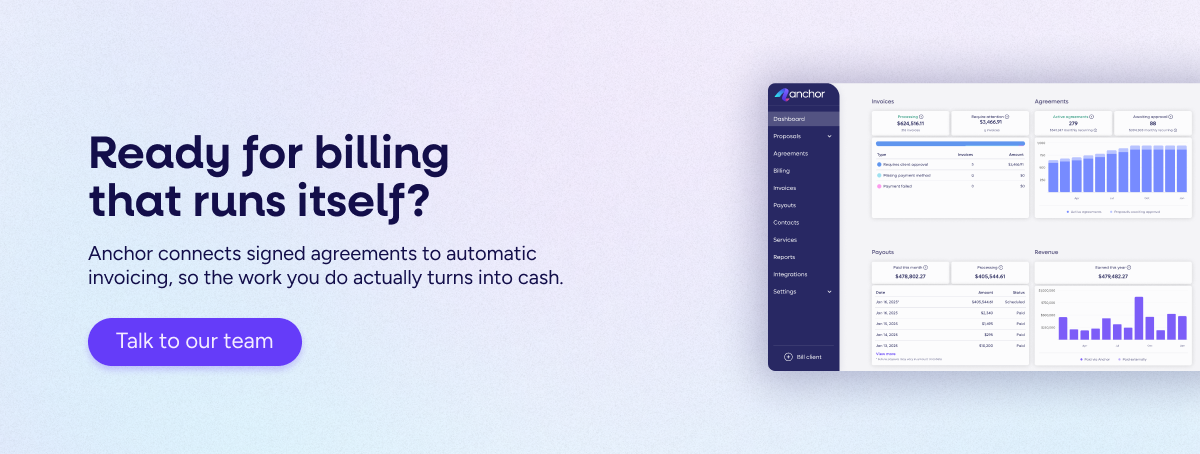
- Automated invoicing based on schedules agreed up front, including recurring and one-time billing.
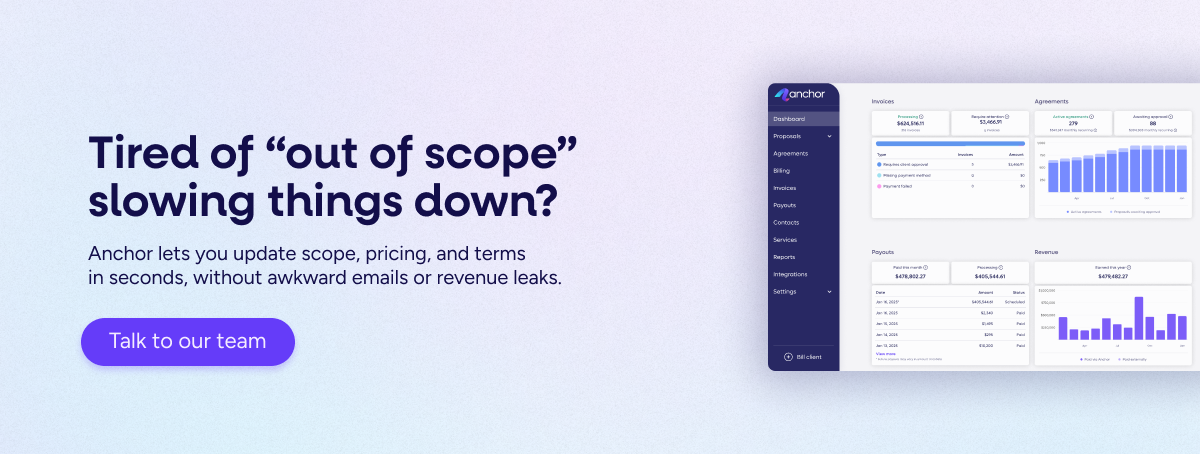
- One-click amendments for scope changes, so updates are routine, and terms stay aligned in real time.
- Integrations and reconciliation so payments sync and close the loop cleanly in systems like QuickBooks or Xero, and stay connected to how your team manages work in tools like Karbon, Keeper, Client Hub, Financial Cents, and monday.com.
The point is simple: you protect margin when billing happens exactly as agreed, without heroics.
Even with a great handshake, scope will still change. The question is whether your process turns change into drama or into a routine update.
A “no drama” scope change process that clients accept
Scope changes are normal. Clients’ needs evolve. The work expands. New issues appear. A healthy firm supports clients through that.
What breaks trust isn’t the change itself. It’s surprise charges, unclear terms, and late billing that make the client feel like they’re being “hit” after the fact. What breaks margin is doing extra work and hoping it sorts itself out later.
A no-drama scope change process solves both sides at once.
Start by naming the change plainly. Use simple language that signals this is standard business:
“This wasn’t included in the original scope.”
“We can help, and we’ll update the agreement to match.”
This removes the emotional tone. You’re not scolding the client. You’re not negotiating your worth. You’re stating a fact and describing the next step.
Next, update the terms immediately, not later. “We’ll fix it next month” is where leakage lives. Later is when details get forgotten, when staff rotate, when the client loses context, and when the firm ends up eating the work to avoid conflict.
Then tie the change to a clear price and schedule. Clients accept change when it is concrete. What’s being added, what it costs, and when it will be billed. Avoid open-ended language that could lead to future disputes.
Finally, make approvals simple. If the process is slow or clunky, your team will avoid it, especially when they’re busy. That’s not because they don’t care. It’s because friction gets cut when capacity is tight.
A good scope change process feels like a routine update, not a confrontation. It should be fast enough for your team to use it every time, not just when the workload is large.
This works in theory, but firms often struggle with one practical challenge: keeping scope updates and billing aligned in real time.
Why amendments need to work in real time
When you raise prices, you create more opportunities for scope and terms to be adjusted. Clients have more questions. Your team is more careful about exceptions. The volume of “small changes” goes up.
That’s why amendments matter, and why they need to work in real time.
Real-time amendments prevent back-billing fights. If you wait until month-end to true up scope, even fair charges can feel unfair because the timing is off. When you update terms during scope changes, billing becomes a straightforward outcome of a documented decision.
They also keep teams aligned. In growing firms, work is shared. If scope changes live in an email thread or in someone’s notes, the next person will miss them. A real-time amendment becomes the single source of truth that everyone can see.
Most importantly, they protect the relationship. Many firms underbill to avoid tension. That tension usually comes from uncertainty, not from the price itself. When scope changes are documented clearly and accepted quickly, the client feels informed and in control. Your team feels protected. And billing becomes easier to stand behind.
If you’re evaluating whether your current setup can handle a 2026 price increase, ask yourself:
- Can we update the scope in minutes, not days?
- Can clients accept changes digitally without confusion?
- Do billing schedules and invoices update automatically after acceptance?
- Do payments and reconciliations remain linked to the updated terms?
If the answer is no, you’re not just risking pushback. You’re risking quiet leakage.
The point of raising prices is to protect your margin. But you don’t do that by arguing harder. You do it by tightening execution.
Protect your price increase with a billing system that doesn’t blink
If you’re raising prices in 2026, the goal isn't just to increase rates. It’s a reliable margin, with fewer awkward money conversations and less admin work for your team.
Reliable margins come from a system that ensures work and billing match every time. Clear terms. Clear schedules. Routine scope updates. Automatic follow-through. Clean reconciliation.
That’s how you stop leakage without turning your team into billing police.
Want to see this in action? Book a 15-minute call with an Anchor advisor and learn how interactive proposals, one-click amendments, automated invoicing, and reconciliation can work together to protect your price increase.
Not ready for a product walkthrough yet? Start by standardizing one engagement template and one scope-change policy for your most common service line.