


If AR keeps creeping up, it’s usually not your clients’ fault. More often, it’s because your billing system leaves too much room for delay, exceptions, and ambiguity when your team is busy.
It shows up in small ways: an invoice goes out late, a scope change is handled in an email but never gets billed, a “special case” client has terms no one can find. It rarely feels dramatic, but over time, it adds up to unpredictable cash flow and extra admin work.
That’s why Atomic Habits, the bestselling self-help book by James Clear, offers a useful lens for firm operations. The book’s thesis isn’t “try harder.” It’s that small behaviors compound, and you don’t rise to the level of your goals, you fall to the level of your systems.
AR works the same way. Overdue balances are often the predictable output of manual handoffs and inconsistent terms. So, in this article, we’ll translate habit science into work-to-cash mechanics: small defaults in agreements, billing schedules, and payments that make financial certainty the baseline. Let’s dive in!
Key takeaways
- AR is usually a system issue, not a client issue: Manual steps and inconsistent terms create delays that compound into overdue balances.
- Defaults beat effort: When agreements define billing and payment up front, billing stops depending on memory and heroics.
- Standardization reduces chaos without reducing service: A few templates and rules per service line eliminate most one-off exceptions.
- Anchor turns good billing habits into a system: It connects proposals, agreements, invoices, payments, amendments, and reconciliations into a single automated work-to-cash flow.
Atomic Habits, applied to firm cash flow
Clear’s core thesis is simple: tiny improvements, repeated consistently, compound into remarkable results. You don’t rise to the level of your goals. You fall to the level of your systems.
That lens is useful for assessing firm cash flow because most AR isn’t created by a single large failure. It’s created by small, repeated behaviors that typically feel harmless in the moment:
- “I’ll send that invoice later today.”
- “They’re a good client, we’ll make an exception.”
- “Scope changed, but we’ll correct it next month.”
- “Let’s not make payment a thing. We’ll deal with it after we deliver.”
Individually, those choices feel customer-friendly. Over time, they quietly train your firm to be inconsistent. And inconsistency compounds into AR, revenue leakage, stress, and internal chaos.
The goal of this article is to apply the Atomic Habits thesis to firm operations. Not inspiration. A baseline set of work-to-cash habits that produce predictable results.
The invisible habits that create AR (and why they stick)
Here’s why these “small” habits are so persistent in accounting firms.
Habit 1: Billing happens after the work, so it loses every priority battle
In a busy firm, delivery always wins. Billing gets bumped for the next deadline, the next client fire drill, the next internal request. The result is not just late invoices. It's a broken rhythm. When invoices go out inconsistently, payments arrive inconsistently.
Habit 2: Exceptions feel like good service, but they create hidden complexity
A special fee arrangement here. A custom billing schedule there. “Just this once” turns into “always.” Exceptions are sticky because they avoid short-term friction. But they create long-term risk because they rely on memory and heroics to execute correctly.
Habit 3: Scope creep is treated like a relationship issue instead of a billing mechanism
Teams notice scope changes. They often don’t have an easy, clean way to update terms and billing without making it a whole process. So the change gets “handled later.” Later becomes never. That’s where revenue leakage lives.
Habit 4: Payment gets discussed too late, when it’s awkward
If payment expectations are unclear until after work is underway, the conversation becomes emotional. Clients feel surprised. Teams feel uncomfortable. Then the firm avoids the topic next time, which repeats the cycle.
If you want predictable cash flow, you don’t need to “stay on top of AR.” You need to change the defaults that create AR.
The baseline system: make the agreement do the work
A strong cash flow system starts before the first deliverable. It starts with the agreement that sets expectations and triggers the work-to-cash flow.
A good agreement does four jobs in plain language:
- Defines scope so there’s less room for “I thought this was included.”
- Defines price and cadence so invoices are expected, not surprising.
- Defines how payments will be made so the firm is not improvising at the end.
- Defines what happens when scope changes, so updates are routine rather than emotional.
This is the practical shift: billing stops being an admin task that happens after the work. It becomes part of the engagement design.
Anchor is built for this style of operation. It connects proposals and engagement terms to automated invoicing and payments based on the rules you set up in advance. That’s how you reduce reliance on memory and stop re-living the same billing issues every month.
Six key tips to build “atomic” cash flow habits that actually stick
These are the small changes that compound. You can implement them in pieces, but they work best as a set because each one reduces friction for the next.
1. Standardize your engagements by service line, not by partner preference
You don’t need 50 versions of “monthly bookkeeping” terms. You need a small handful of patterns you can defend and repeat.
Start with 3–5 templates that cover most of your revenue. Each template should include:
- plain-language scope boundaries
- billing cadence (recurring or milestone-based)
- payment expectations
- a simple amendment path
Your team should know which template to use without asking a partner. That is how you convert tribal knowledge into a system.
Anchor supports this by making it easy to create repeatable, interactive proposals and agreements that automatically carry the billing schedule forward.
2. Make billing cadence boring and predictable
Predictability is a client experience upgrade. Clients rarely complain about consistency. They complain about surprises.
Pick a default cadence per service line and stick to it:
- recurring monthly for recurring work
- milestone-based for project work
- upfront policies where they make sense for your firm
This also protects your team. When billing is predictable, you reduce last-minute admin work and the end-of-month scramble.
3. Treat scope changes like a normal operational event, not a negotiation
Scope changes should trigger a routine update, as a change order would in any other professional services business.
The problem in most firms is not that scope changes happen. It’s that there’s no low-friction mechanism to update terms and billing quickly.
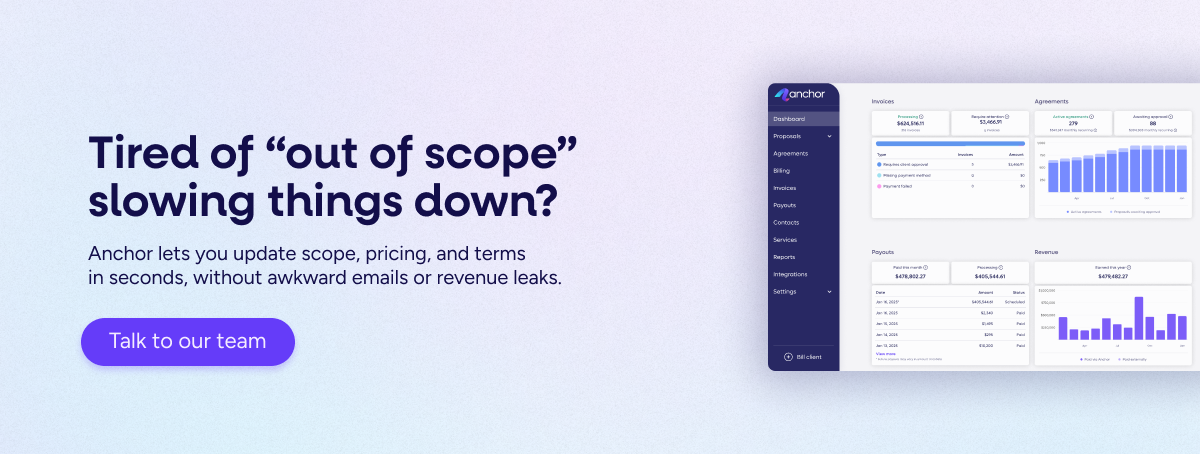
Anchor’s one-click amendments are designed for this moment. You can update terms in real time so the billing stays aligned with the work, without starting from scratch.
4. Stop relying on “someone will remember.”
If “billing accuracy” depends on one person’s memory, it will break when they take PTO, become overloaded, or leave.
You want agreements, billing schedules, and payment rules to live in the system, not in inboxes, spreadsheets, and Slack messages.
Anchor helps by keeping the proposal, agreement, invoice schedule, and payments connected in a single flow. The system becomes the memory.
5. Build visibility that leaders can trust without detective work
One of the fastest ways firms lose control is when leadership cannot answer basic questions without asking three people:
- What’s billed, what’s paid, and what’s outstanding?
- What’s projected to bill and collect next?
- Where are the exceptions and why?
If visibility is manual, it will always be late. When it’s late, you make decisions on feelings instead of facts.
Anchor’s dashboards are designed to give firms a clearer view of outstanding payments and projected cash flow, enabling leadership to regain control more quickly.
6. Reduce month-end cleanup by tightening reconciliation
Cash flow isn’t just about collecting money. It’s knowing where it went and closing the loop cleanly.
When payment data and invoice data are disconnected, reconciliation becomes a recurring time sink. It also erodes confidence in reporting.
Anchor syncs payments and can reconcile into connected accounting systems and tools, reducing manual cleanup and helping your numbers match reality.
What this looks like in real life
When these habits become defaults, the day-to-day experience changes.
- Invoices don’t “go out.” They are triggered by signed terms and schedules.
- Payment expectations are clear before work begins, not after.
- Scope changes don’t linger as resentment. They become amendments.
- Leadership stops guessing about cash flow. Visibility becomes routine.
- Your team spends less time on preventable admin and awkward money conversations.
That’s the compounding effect: fewer exceptions, fewer surprises, fewer write-offs, and a calmer firm that can grow without adding chaos.
Next steps for firm owners
If you want financial certainty, don’t start by telling the team to “stay on top of AR.” Start by removing the conditions that create AR.
Learn how Anchor standardizes proposals, agreements, invoices, payments, amendments, visibility, and reconciliation into an automated proposal-to-retention flow.
Want a second set of eyes on your current billing habits? Book a quick call, and we’ll map the simplest path to more predictable cash flow.