


If you had to write a check for the hours your team spends cleaning up late payments in tax season, would you still call it “just part of the business”?
The truth is, chasing late payments is a lot like tiny paper cuts. Each one feels minor in the moment, so most firms don’t recognize the cost. But tax season has a way of stacking them back-to-back. When they finally show up, it’s as lost hours, escalations, and margin you can’t earn back, right when deadlines are tight, and your team has the least slack.
Below is a bottom-up way to price it. Not with big theories. With the minutes, the roles involved, and the revenue that leaks out when payment becomes a follow-up process.
Key takeaways
- AR is a time problem first: Late payment pulls admin, managers, and partners into work that doesn’t move returns forward.
- Bottom-up math makes AR visible: When you translate minutes and escalation into dollars, the “normal” starts to look expensive.
- Leakage isn’t a single factor: Discounts, write-offs, and underbilling often compound AR and amplify the impact.
- The fix is a better operating model: Agreements, automated invoicing, automatic payments, and clean amendments reduce exceptions without turning every client relationship into a negotiation.
A bottom-up “cost of AR” calculator
I’m going to make a claim that sounds obvious, but most firms don’t run the numbers: accounts receivable during tax season isn’t just “cash coming in later.” It’s additional labor, leadership attention, and margin you don’t get back.
That’s because tax work has a unique pattern. You chase information, do the work under a tight window, deliver, and then you still have to deal with payment. Some firms try to address it by collecting upfront payments. That helps in some cases, but it can also create a different problem when the work expands, and the price doesn’t.
Here’s the goal of this worksheet: estimate the real cost of AR in dollars and hours, including items that typically don’t appear in an AR aging report.
This isn’t meant to be perfect. It’s meant to be useful, and if you can estimate it within a reasonable range, you’ll gain valuable clarity on what to fix first.
What to measure
Before you get into the math, you need four inputs. Think of these as the “shape” of your AR problem. How many clients does it affect, how long does it linger, and how far up the org chart does it climb?
You don’t need fancy reporting to start. You just need estimates you can stand behind, then tighten over time as you see patterns across February through April.
1) Your late payer rate
Start by deciding what “late” means in your firm. Don’t borrow someone else’s definition. Use yours.
For many firms, “late” is simple: payment didn’t arrive when it was expected to, based on the terms you set. The key is consistency.
If you define it the same way each season, the trend will tell you more than the exact number. If you’re unsure, start conservative. You can always revise after tax season when the noise is lower and the data is cleaner.

2) Average days outstanding for late payers
Next, estimate how long late payments stay open once they’ve slipped past the expected date. This is what turns “a delay” into a follow-up loop.
If you don’t want a single average, use buckets:
- 0–15 days late
- 16–30 days late
- 31–45 days late
- 46+ days late
The goal is to capture duration. Once payment becomes a follow-up process, time is the multiplier.
3) Staff time per late payer
Now measure the operational work created by AR. This is the part that rarely gets counted because it’s spread across small tasks throughout the team
What you’re estimating is simple: minutes per late payer per week, by the person who does most of the handling (often admin or billing). Include the work that keeps the loop moving, like checking status, clarifying what’s owed, updating notes, and coordinating internally.
It sounds small on purpose. In a high-volume season, “small per client” becomes “big in total.”
4) Escalation time: manager and partner involvement
Finally, account for the climb. In most firms, payment friction doesn’t stay at the admin level. It escalates.
A manager gets pulled in to smooth it over. A partner gets involved because the relationship is sensitive or the client is important. This is usually the most expensive layer of AR, not only because senior time costs more, but because it’s the hardest time to replace.
If you want a single, clean way to think about this input, estimate how often AR requires manager attention and how often it requires partner attention, then estimate the minutes per week required.
Close the loop: if you can estimate late payer rate, days outstanding, and minutes by role, you can build a solid first pass. Now, let’s turn it into dollars.
The math: hours to loaded cost, plus opportunity cost
Once you have the four inputs detailed above, the math is straightforward. The goal isn’t to build a finance thesis. It’s to translate “this feels messy” into a number you can manage.
This calculator has two parts:
- Loaded labor cost: what it costs your team to handle AR work.
- Opportunity cost: what senior people could be doing instead of getting pulled into payment cleanup.
Together, they create your “time tax,” the real cost of AR before we even talk about discounts, write-offs, or underbilling.
Step 1: Convert minutes into hours by role
Start by turning your estimated minutes into total hours. This is where most firms realize how quickly small follow-ups scale.
Use this structure for each role:
AR hours (role) = late-paying clients × weeks outstanding × minutes per week ÷ 60
A few notes to keep it grounded:
- Weeks outstanding can be estimated from your average days outstanding. If payment is often “about a month late,” model it as about four weeks.
- If your AR pattern is lumpy, use buckets (0–15, 16–30, etc.) and run calculations for each bucket, then sum the results.
- Keep roles separate, because escalation is part of the cost.
Do this separately for:
- Admin/billing
- Account manager
- Partner
Close this step with a quick check: if the hours feel surprisingly high, that’s usually not an error. It’s the compounding effect of volume.
Step 2: Apply loaded cost to those hours
Now, put a true hourly cost next to those hours.
Loaded cost is what an hour really costs after payroll taxes, benefits, and overhead. If you don’t have a formal loaded-cost model, use conservative, consistent internal estimates. The point is directionally correct, not courtroom-ready.
Then:
Loaded labor cost = (admin hours × admin loaded rate) + (manager hours × manager loaded rate) + (partner hours × partner loaded rate)
This number tends to land harder than people expect because it turns “a few follow-ups” into a real payroll cost that repeats every season. It also helps you see where the work is concentrated. If partner hours are higher than you’d like, the fix usually isn’t “try harder.” It’s reducing escalation.
Step 3: Add opportunity cost for senior time
This is the part many firms skip, but it’s often the part that matters most.
When a partner or account manager spends time dealing with payment issues, you don’t just pay for their time. You lose what that time could’ve produced. During tax season, that can look like:
- Reviewing returns and reducing rework
- Managing the team and unblocking delivery
- Serving higher-value client needs
- Improving process so the season runs more smoothly
- Building the next wave of work
A simple, conservative model is:
Opportunity cost = (manager hours + partner hours) × estimated revenue value per hour
You choose the hourly value. Keep it modest if you want. The goal isn’t to inflate the result. It’s to stop treating senior time as free, especially when AR pulls leadership away from the work only they can do.
Now you have the “time tax.” Next, let’s layer in the “leakage tax,” where AR often turns into direct margin loss.

Add leakage: discounts, write-offs, and underbilling
In my experience, AR during tax season often arrives with friends. The follow-up work is frustrating, but the bigger hit is the leakage from your revenue.
Leakage 1: Discounts used to unlock payment
A common pattern is discounting late payers to close the loop. It feels practical: reduce friction, get paid, move on.
But it has two costs:
- You lose revenue.
- You train the client that paying late can come with a reward.
That’s different from an early commitment discount. Early commitment discounts are chosen upfront. You set the price and timing. They help you plan your capacity and schedule. They can be a win-win.
Discounting after the fact is the opposite. It’s not controlled. It’s reactive. And it often becomes a habit.
For the calculator, track:
- Total dollars discounted in response to late payment behavior
Keep it clean. Don’t mix it with intentional upfront pricing decisions.
Leakage 2: Write-offs
Write-offs happen when you decide the money isn’t worth chasing or can’t be collected.
In some professional services firms, write-offs can reach as high as 18% of revenue. The exact number will vary by firm, but the takeaway is consistent: if payment is handled after the work, write-offs stop being rare exceptions and start becoming a recurring leak.
For the worksheet, track:
- Total write-offs for tax work over the season
- A simple reason code (scope mismatch, client disappeared, relationship exception, other)
Leakage 3: Underbilling from upfront pricing that doesn’t match the work
Some firms try to avoid AR by collecting upfront. That can reduce receivables, but it introduces a different risk: tax work can expand.
When extra schedules show up, or the situation changes, the firm has to choose:
- Eat the extra work and protect the relationship, or
- Ask for more money and risk friction and churn
Either way, there’s a cost. Even when the firm does ask for more, it often means an email, a call, and time spent negotiating a change that should’ve been handled cleanly.
For the calculator, estimate:
- How often the work expands beyond what was expected
- The additional fee you should’ve billed but didn’t
- The time spent managing that pricing conversation when you did try to adjust
This section matters because it connects AR to a bigger truth: payment problems aren’t only payment problems. They’re usually a system problem across scope, terms, and enforcement.
Now let’s put it all into a simple worksheet model you can copy.
A simple worksheet model (with examples)
This is the part you can copy into a spreadsheet in 10 minutes. The goal is to get a first-pass number that’s directionally right, then refine it after the season when you have cleaner data.
These numbers are examples only. Use them to structure your worksheet, then replace them with your real inputs.
Inputs
Volume
Start with how many clients you serve, then estimate how many fall into your “late payer” bucket.
- Total tax clients: 250
- Late payer rate: 25%
- Late-paying clients: 62 (rounded)
Timing
Next, estimate how long late payments typically stay open once they slip past the expected date.
- Average days outstanding for late payers: 30 days
- Weeks outstanding: 4
Time per late payer, per week
Now estimate the weekly handling time for each late payer, by role, while the balance remains open.
- Admin/billing: 8 minutes
- Account manager: 5 minutes
- Partner: 2 minutes
Loaded hourly cost (your internal estimates)
Assign a realistic hourly cost to each role. Conservative and consistent beats “perfect.”
- Admin/billing: $35/hour
- Account manager: $80/hour
- Partner: $200/hour
Opportunity value (conservative)
Pick a modest value for what senior time could produce if it weren’t tied up in AR cleanup.
- Senior value per hour (manager + partner): $250/hour
Leakage inputs
Finally, add the direct revenue that tends to leak out when payment becomes a follow-up process.
- Discounts given to get late payments closed: $4,000
- Write-offs: $6,000
- Underbilling from expanded work: $10,000
Step-by-step math
1. Hours by role
Convert your per-client minutes into total seasonal hours.
- Admin hours = 62 × 4 × 8 ÷ 60 = 33.1 hours
- Manager hours = 62 × 4 × 5 ÷ 60 = 20.7 hours
- Partner hours = 62 × 4 × 2 ÷ 60 = 8.3 hours
2. Loaded labor cost
Apply loaded hourly costs to see what the AR handling work actually costs.
- Admin labor = 33.1 × $35 = $1,159
- Manager labor = 20.7 × $80 = $1,656
- Partner labor = 8.3 × $200 = $1,660
- Total labor cost = $4,475
3. Opportunity cost
Estimate the value of senior time you lose when AR pulls managers and partners away from higher-value work.
- Senior hours = 20.7 + 8.3 = 29.0 hours
- Opportunity cost = 29.0 × $250 = $7,250
4. Leakage total
Add the revenue that’s directly lost, not just delayed.
- Leakage = $4,000 + $6,000 + $10,000 = $20,000
5. Total AR “tax”
Combine time costs and leakage into one number.
- Total AR cost = labor ($4,475) + opportunity ($7,250) + leakage ($20,000)
- Total = $31,725 (example)
If you’ve never calculated this before, the result is usually uncomfortable in a useful way. It gives you permission to fix the system rather than expecting your team to “stay on top of it” with additional effort.
Next, let’s define what “good” looks like so you can set targets and choose the right changes.
What good looks like: target metrics and process changes
There isn’t a single universal benchmark because firms differ in client mix, pricing models, and process rigor. But there are clear directional targets that signal you’re moving from “tax season chaos we survive” to “tax season operations we can predict.”
The key is to focus on trends you can actually influence, then tie them back to specific process changes.
Targets worth tracking
These are the metrics I’d put on a simple monthly dashboard during the season, then review again after the dust settles:
- Late payer rate trends down over time
- Average days outstanding trends down over time
- Partner involvement in payment issues becomes rare
- Discounting tied to late payment becomes rare
- Underbilling becomes a tracked exception, not a surprise
- Write-offs are visible and categorized, not shrugged off
The goal isn’t perfection. It’s reducing the predictable drag that shows up at the worst time of year, when capacity is tight, and every interruption costs more than it should.
Process changes that move the numbers
Most firms try to solve tax-season AR with policy: “We won’t file until we’re paid.” “We’ll be firmer.” “We’ll follow up faster.”
Those may help for a week. Then the season hits, relationships matter, and exceptions happen. If your system forces exceptions, you’ll get exceptions.
What actually moves the numbers are workflow changes:
- Make expectations explicit before the work starts
If scope, timing, and payment mechanics aren’t clear up front, they’ll be debated later, when time pressure is highest, and patience is lowest. - Separate commitment from uncertainty
Upfront payment can reduce AR, but only if you have a clear process for handling expanded work without renegotiating from scratch. Otherwise, you trade AR for underbilling and awkward scope conversations. - Stop using reactive discounts as a release valve
If you routinely discount to close late payments, you’re paying for relief and teaching a repeatable behavior. That cost will show up again next season. - Reduce escalation by removing the need for escalation
When billing and payment are manual, they escalate. When they’re built into the engagement, fewer issues ever reach leadership, which is the whole point.
That leads us to a better operating model: connect agreements, billing, payments, and changes into a single workflow so payment doesn’t become an after-delivery project.
Build payment into the engagement
Tax firms are relationship-driven businesses. That’s good. But it also means clients sometimes treat pricing and payment like a negotiation.
A better operating model doesn’t require you to be aggressive. It requires consistency, especially during tax season.
In practice, that looks like:
- Clear proposals and agreements that define scope, pricing, and terms before work begins
- Automated invoicing that triggers from the signed agreement and billing schedule, not from someone remembering to send an invoice
- Automatic payments, where it makes sense, which eliminates most reminders because payment happens as part of the process
- One-click amendments, so when work changes, the agreement can change, and billing follows without messy back-and-forth
- Integrations and reconciliation so payments sync to the systems your firm already uses, reducing manual cleanup
- Dashboards that show outstanding payments and projected cash flow so you’re not guessing mid-season
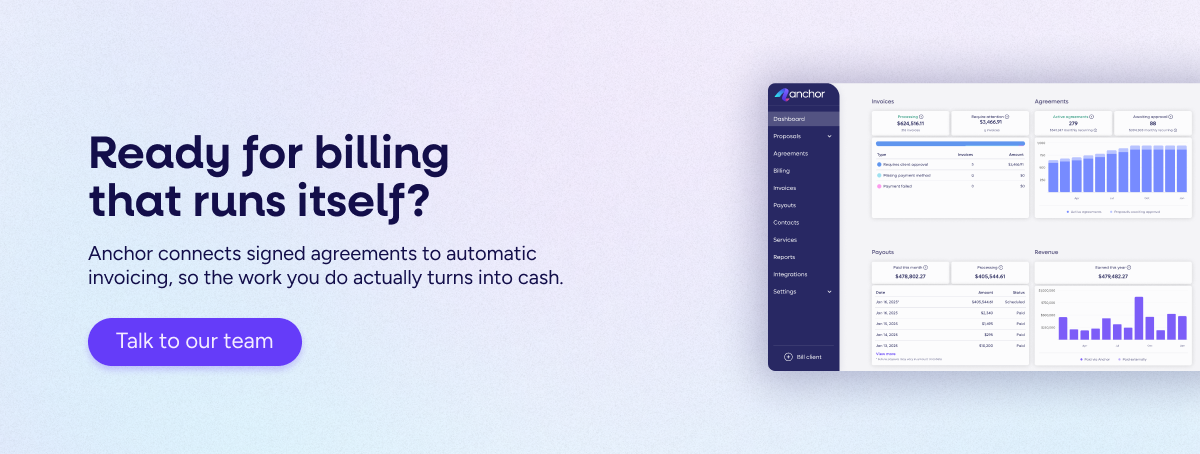
This is the operating model Anchor supports. Anchor connects agreements, invoicing, payments, and amendments into a single flow, removing the manual steps between completing the work and getting paid. The point is to reduce the conditions that create AR and escalation in the first place.
If payment is a separate process that begins after delivery, you’ll continue to pay the AR tax. If payment is part of the engagement, the tax shrinks.
Let’s estimate your AR “tax”
If you'd like, we can help you estimate your AR “tax” using this bottom-up model. Book a quick call with an Anchor advisor, and we’ll help you identify key process changes that will reduce late payments, escalations, and leakage.
If you’re not ready for that, build the worksheet with conservative inputs and rerun it after the season with real numbers. The direction will be obvious either way.