


Late clients don’t just create awkward back-and-forth. They create overtime, quality risk, and a scheduling mess that pulls partners into work they shouldn’t be doing.
The same pattern plays out every tax season. A client is quiet in January, then suddenly urgent in February. The issue isn’t only that they’re late. It’s that they’re unpredictable. And unpredictability is what breaks operations.
If late clients consistently disrupt your team’s flow, this article will show you how to set expectations up front using deadlines, late fees, premium pricing, and capacity limits, without jeopardizing client relationships.
Key takeaways
- Late clients don’t just show up late: They compress your timeline, break your schedule, and push work into nights and weekends.
- Unpredictability is the real operational risk: When work arrives in spikes, partners and managers get pulled into exception handling and last-minute production.
- The fix has to be set before the rush: Put deadlines, premium timing, and late-submission terms in writing while everyone’s calm.
- Protect relationships with clarity, not exceptions: Frame the rules as capacity and quality control, so you’re enforcing a process, not picking a fight.
The client timeline mismatch that creates chaos
You know the client. They go quiet in January. They “mean to send everything.” Then they show up in mid-February with urgency, as if the deadline just moved.
That shift is more than a timing issue. It forces you to react rather than execute a plan.
Here’s what typically happens:
- Your team’s workload is scheduled based on expected inflow.
- Late clients arrive in clusters, not evenly.
- Your staff is already stretched.
- The “urgent” client pushes everything else back.
And the uncomfortable part is this: even if you tell yourself you won’t start until you’re paid, many firms still submit the return before payment because they don’t want friction or fear losing the client.
So now you’ve got two problems at once:
- The work arrives at the worst possible time.
- Payment becomes uncertain after the work is done.
That’s why “late clients” are an operations problem. They impact everything from staffing and timing to cash flow and AR. Downstream, they also affect quality because rushed work is almost always risky.
The next question is why this escalates and drains valuable time from senior staff.

How late clients bring partners into the fray
Late work doesn’t land gently. It lands like a fire drill.
When a client shows up late, you don’t just add work. You add work at the exact moment your system has the least slack. That’s when firms start making compromises they wouldn’t make in a calmer month.
Here are a few common ways this shows up:
Your team can’t absorb the spike
If your staff is fully loaded, there’s no room to accommodate the late return. Someone needs to reshuffle the plan, renegotiate deadlines, and manage client communication.
That “someone” is often an account manager or a partner.
Late clients create exception work
Late clients tend to come with exceptions:
- Missing or messy documents
- Scope questions you didn’t price for
- “Can we also do this?” add-ons
Exception work pulls senior team members in, because junior staff usually can’t and most often shouldn't be making these calls.
You end up doing the work yourself
When your team is maxed out, partners and managers do the work just to get it out the door. Not because it’s the best use of their time, but because it’s the only way to meet the deadline.
This is one of the hidden tax-season costs that don’t appear on a P&L. It shows up as nights, weekends, and disappearing partner bandwidth.
And then there’s the payment side.
If the client is already late on engagement and documents, they’re often late on payment too. So now the partner isn’t only doing work they’re not supposed to be doing, they’re also pulled into awkward money conversations.
It’s a lose-lose.
The way out isn’t more effort. It’s better to set expectations before the rush begins.
Setting upfront expectations
Rules work when they’re clear, agreed upon early, and consistently applied. The goal isn’t to punish anyone; it’s simply to make your season more predictable and fair, for both your team and your clients.
You don’t need a complex policy document. You need a simple operating model that clients can understand. That model should include:
1. Deadlines that actually mean something
A deadline without consequences is just a suggestion.
Select a realistic “documents received by” date that aligns with your capacity. Then define what happens if the client misses it.
That “what happens” can be one or more of these:
- Their return moves to a later delivery window
- They pay an expedited premium to stay on the earlier timeline
- They move to extension by default
The key is clarity. Clients don’t need a lecture. They need a decision tree.
You can say:
“If we receive everything by [date], we file by [date]. If we receive it after [date], we’ll file on extension or apply an expedite fee depending on capacity.”
Simple. Calm. Operational.
2. Late fees tied to late inputs, not late payment
Most firms try late fees as a billing move: the client pays late, and you add a fee later. That often fails because it requires more chasing, more invoices, and more debate.
Here’s a better approach:
Tie the fee to behavior that creates cost: late documents.
If documents arrive after a certain date, the work is more disruptive. That’s the cost. That’s what the fee is for.
This also keeps the conversation cleaner. You’re not saying, “you were bad, pay me.” You’re saying, “late inputs change the work and the schedule.”
3. Premium pricing for urgent work
Premium pricing isn’t about charging more. It’s about capacity.
When someone asks for February work that should’ve been January work, the real request is: “Please reorder your line.”
Reordering a line has a cost. Premium pricing makes that cost explicit.
You can offer two lanes:
- Standard lane: lower price, clear deadline, predictable delivery
- Urgent lane: higher price, only available if capacity allows
That gives clients control without letting them control your calendar for free.
4. Capacity limits you’re willing to defend
This is the part firms avoid because it feels uncomfortable. But capacity limits are what protect quality.
You can set a simple cap: “We take X late returns for expedited filing, first come first served.” Once it’s full, it’s full.
That does two things:
- It prevents the whole team from being dragged into constant exceptions.
- It creates a fair system that clients can respect.
If you’re thinking “but what if they get upset,” that’s where tone and framing matter.
Which brings us to the part everyone struggles with: implementing this without damaging the relationship.
How to implement with process, not emotion
Clients don’t mind structure. They mind surprises. If the first time they hear about your “late” policy is when they’re already behind, it’ll feel like a penalty, even if it’s fair.
The goal is to sound like a professional with a process, not a bouncer at a club. That means calm language, clear options, and rules that show up in writing before anyone’s stressed.
Here’s the positioning that works in real life.
Lead with planning and quality
When clients understand that you’re trying to protect turnaround time and accuracy, they’re less likely to take it personally.
So, instead of leading with, “If you’re late, we charge you,” try:
“We plan our team’s capacity to protect quality and turnaround times. To do that, we set a clear document deadline and a clear process for late submissions.”
That frames your policy as service quality rather than punishment.
Make it about fairness, not control
Late clients don’t just affect you. They affect the clients who were on time.
With that in mind, one of the easiest ways to reduce pushback is to show that your process protects on-time clients too, not just your team.
You can say:
“When documents arrive late, it forces us to reshuffle work. That isn’t fair to clients who submitted on time, and it increases risk. Our policy keeps things fair and predictable.”
You’re not being hostile or unfair. You’re explaining.
Use “options,” not “ultimatums”
Psychology also plays a role here, and on a subconscious level, people resist being cornered. However, they’ll usually accept a boundary when it comes with clear choices.
Give two or three outcomes, and let the client choose:
- Submit by the deadline for standard pricing and timeline
- Submit later and file on extension
- Submit later and request expedited pricing if capacity is available
Options reduce defensiveness. They also keep you from negotiating in the moment.
Put it in the agreement, not a terse email
The best time to set these terms is before the work begins, when expectations still feel like planning instead of enforcement.
You also want this decided when everyone’s calm, not when everyone’s stressed.
With that in mind, your agreement should include:
- The document deadline
- The late submission premium or fee
- Any capacity rules
- How scope changes are handled
In my experience, the worst time to introduce rules is after the work is done. That’s when firms start discounting just to get paid, and it teaches clients the wrong lesson: pay late, get a deal.
Early structure avoids that trap.
So, what actually happens when clients can’t treat “late” as free?
What changes when clients know late has a cost
When “late” is vague, clients treat it like a minor inconvenience. When “late” has a clear outcome, behavior changes.
Here’s what usually changes once the rules are well-defined:
Clients decide sooner
Some clients will commit earlier when they see that waiting has a downside. That can be an “early bird” discount for committing early, or simply the loss of standard pricing if they wait.
The psychology is straightforward: people hate losing a benefit they could’ve had.
You stop doing last-minute negotiation
When your policy is clear, you don’t have to invent pricing in a frantic moment or “make an exception just this once.” You refer back to the process you already agreed to and present the defined options.
That’s not cold. That’s professional. It keeps the conversation about timing and capacity, not personalities or pressure.
You reduce the silent AR risk
When clients pay through a defined process, you reduce the risk of completing the work only to hope the invoice is paid.
A lot of firms say they won’t submit the return until they’re paid. In reality, they often submit anyway to avoid friction. A better operating model makes payment part of the workflow, not a separate, awkward step at the end.
Your team’s workload gets more predictable
Even if some clients still come in late, the outcomes are known:
- They go on extension, or
- They pay for the disruption, if you can take them
Either way, you’re not improvising. And that’s the whole point: make late expensive and predictable, not chaotic.
At this point, it’s fair to ask: how do you operationalize this without adding more admin work?
How to make “late” predictable, and collect automatically
Policies fail when they rely on perfect follow-through.
Most firms already have enough to manage during tax season: documents, workflows, client questions, and deadlines. If your “late policy” requires manual invoicing, follow-ups, and negotiations, it won’t stick.
This is where a connected system matters.
At Anchor, we focus on eliminating the manual steps between doing the work and getting paid by connecting agreements, billing terms, invoicing, and payments in a single, connected flow.
Here’s what that looks like in practice:
Set expectations in the agreement, then let the system run
Start with an interactive proposal or engagement agreement that includes:
- Document deadlines
- Premium pricing or late fees tied to late submissions
- A clear scope and what happens when scope changes
Once it’s signed, invoicing can trigger automatically from the billing schedule you set.
Use automatic payments to remove the “now we chase” phase
When you configure automatic payments, most reminder work disappears because collection isn’t dependent on someone clicking “send invoice” and then hoping the client pays.
For credit cards, fees are collected from the client when configured. For ACH, you can offer a no-fee option with typical transfer timing.
The point isn’t the payment method. The point is that you’re not stuck doing the work first and negotiating payment later.
Handle scope changes with amendments instead of debates
Scope changes are normal in tax work. Businesses grow. New schedules show up. Complexity changes.
The problem arises when scope changes become a messy conversation and a separate invoice that may or may not be paid.
With one-click amendments, you can update the agreement and billing terms in real time, so the change is documented and billed without starting from scratch.
Keep the financial picture visible
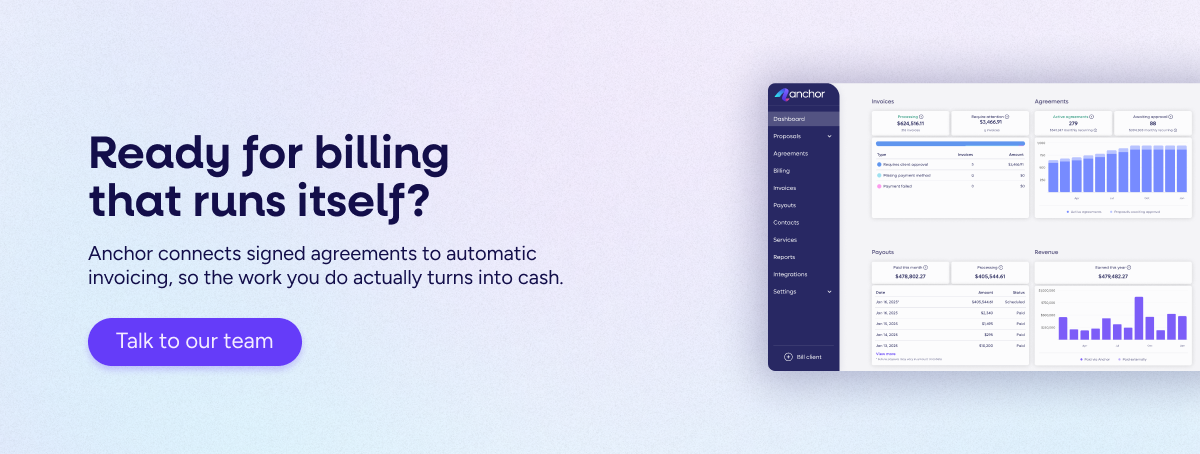
When agreements, invoices, and payments are connected, you can see what’s expected, what’s outstanding, and what cash flow looks like ahead of time.
That visibility matters in tax season because it reduces surprises and helps you plan capacity.
Integrate where your team already works
Many firms live inside their practice management and accounting systems. When payments sync and reconcile automatically into tools like QuickBooks or Xero and connect with practice workflows, you reduce the administrative drag that usually shows up in February.
That’s the operating model shift: less chasing, fewer awkward conversations, and fewer late nights caused by chaos you didn’t choose.
Now let’s bring it back to the promise of this post.
Turn “late clients” into a predictable process
You don’t have a “late client” problem. You have a system that leaves too much to chance.
Late clients will always exist. The win is making their lateness predictable across your operations and pricing.
If you do nothing, you’ll keep paying the same hidden tax:
- Partners doing last-minute work
- Teams burning out
- Quality risk rising
- Revenue delayed or discounted
If you set expectations up front and use a system that enforces them, tax season gets calmer. Not easy. Just calmer and more controlled.
If you want to make “late” expensive and predictable, not chaotic, book a 15-minute call with one of our advisors to see how Anchor ties agreements, automated invoicing, automatic payments, and amendments into one operating model.
If you’re not ready for a call, start by rewriting your engagement terms to include a document deadline and a clear late-submission process.