


If you’ve ever wrapped up a return and then found yourself negotiating when you’ll get paid, you’ve seen the problem up close. In too many firms, billing isn’t a system. It’s a conversation. And during tax season, that conversation tends to get longer, messier, and more expensive.
In my experience, firms don’t choose this dynamic on purpose. It comes with being a service business. Clients want flexibility. Firms want to protect relationships. The result is predictable: exceptions, scope disputes, and partners pulled into collections when they should be leading the work.
Below, I’ll break down why this negotiation dynamic shows up in tax firms, why it’s so hard to resist in tax season, and how to replace it with a commercial layer that protects relationships while making cash collection more predictable.
Key takeaways
- Service billing invites negotiation: When terms feel flexible, clients test boundaries on price, timing, and scope.
- Relationship pressure changes decisions: Firms bend rules to avoid friction and reduce churn risk.
- Scope and payment are linked problems: When expectations aren’t set early, extra work turns into late-stage money conversations.
- A commercial layer reduces conflict: Put pricing, timing, and change rules in writing and automate collection so you’re executing terms, not renegotiating them.
SaaS pricing vs service pricing: why negotiation shows up
To understand why billing turns into a conversation, it helps to compare two worlds your clients live in every day: buying software and buying professional services.
When a client pays for software, the transaction is designed to be non-negotiable. Pricing is usually fixed. You pick a plan, you pay, and the product doesn’t negotiate back.
Professional services don’t work that way. It’s human to human. There’s history, trust, and room for judgment. That changes how people behave.
When a client hires a tax firm, they’re not buying a boxed product. They’re buying judgment, attention, and responsibility. Because that feels personal, clients often treat the terms as flexible, even if you didn’t mean them to be.
You’ll hear it in everyday language:
- “Can we keep this at the same price?”
- “Can we pay after filing?”
- “We’ll send the docs soon. Can you start now?”
- “We’ve been with you a long time. Can you help us out?”
None of it is shocking. In fact, it’s normal in relationship-based services. The risk is what it turns billing into: a series of decisions, not a set of terms. And the more billing depends on decisions, the more it depends on willpower, which gets particularly thin in February and March.
That’s when negotiation shifts from “small asks” to “big operational cost.”
Next, let’s talk about the imbalance baked into the relationship that makes it even harder to hold the line.

The relationship leverage problem
Tax and accounting work has a strange shape.
On one hand, you know everything about the client’s business. Their numbers, their risks, their sensitive details. You’re trusted in a way most vendors aren’t.
On the other hand, you still need their business.
That creates tension. Not because the client has the expertise. You have the expertise. But because the relationship is valuable, and both sides know switching is possible.
So the client can lean on the relationship when they want flexibility. And the firm can feel pressure to accommodate even when it’s not operationally sound.
You see it in common moments:
- Starting work after a verbal “yes,” without signed terms
- Accepting late documents, then scrambling to meet deadlines
- Treating the original price as “final,” even when scope changes
In my experience, accountants care deeply about their clients, they want them to succeed, and they’ll protect them from missed deadlines, even when the client is the one creating the delay.
That’s admirable. It’s also why the roles flip. Instead of the client chasing the firm to get things done, the firm ends up chasing the client for documents, then chasing again when it’s time to pay.
Once billing becomes conversational, exceptions multiply, and that’s where firms start caving.
Why firms cave: churn fear and relationship preservation
Most firms have a quiet instinct to avoid conflict. Not because they’re weak, but because they’ve learned that financial conversations can get emotional, and churn is expensive.
So they compromise.
They say, “We won’t file until we’re paid.” Then they file anyway because the deadline is real and they don’t want a blow-up.
They say, “Late fees are the policy.” Then they waive them because it’s easier than another round of back-and-forth.
They say, “This is the scope.” Then the scope expands, and they don’t adjust because they don’t want the conversation.
Over time, clients learn the real rules. Not from the fine print. From what happens when they push.
If late payment results in discounts or waived fees, the delay begins to look like leverage. If scope expands without a clean adjustment, the price starts to feel flexible. If deadlines are enforced inconsistently, clients learn to test them.
None of this means you should treat clients like adversaries. It means you need a structure that protects the relationship while safeguarding your firm's business interests.
That’s where an important protective layer comes in.
Build a commercial layer that protects the relationship
You don’t need to be tougher. You need fewer moments where someone has to decide what’s “fair” in the heat of the moment.
A commercial layer is simply your business rules, made explicit and consistently executed:
- What you charge
- When you charge it
- What happens when scope changes
- What happens when documents arrive late
- What happens when a client wants urgency
- What happens when payment timing slips
When those rules aren’t clear, every situation becomes a negotiation. When they are clear, the conversation shifts from “Can you make an exception?” to “Which option are we using?”
That shift often improves relationships instead of harming them. Why? Because it lowers the temperature. You’re not making a personal call. You’re following a process the client already agreed to.
Here are a few ways to build that layer without making your firm feel rigid.
Put timing rules in writing before the work starts
If payment terms show up after the work is done, you’re negotiating under pressure. Instead, define what triggers billing and when payment is collected in the agreement, in plain language.
The goal is simple: fewer surprises.
Make scope change normal, not a confrontation
Scope changes are part of tax work. New schedules appear. Complexity changes. Businesses evolve.
If scope change feels like a confrontation, you’ll avoid billing for it, or you’ll delay the adjustment until it’s harder to collect. Instead, define how changes get handled so it’s a step in the process, not a debate.
Keep incentives on the front end, not the back end
An early bird or limited-time discount is a choice you control up front to encourage commitment and help you plan. That’s different from discounting after the work is done just to get paid.
The first is a planned business decision. The second teaches the wrong behavior.
Don’t rely on memory and discipline in peak season
If your process depends on someone remembering to enforce it during the busiest weeks, it won’t hold. The commercial layer must continue to operate even when the team is overloaded.
Once you have that layer, the outcomes start to shift.
Outcome: fewer negotiations, clearer boundaries, more predictable cash
When billing stops living in conversation mode, a few things change.
Decisions move earlier because “later” has defined consequences. Your team stops improvising because pricing and timing aren’t being invented on the fly. Partner time comes back because fewer situations require escalation into collections and pricing debates.
Cash becomes steadier as well. Not because every client becomes perfect, but because the path from agreement to payment is less negotiable.
The practical question is how to make this real without adding admin work. That’s where a connected workflow matters.
Put the business side of your firm on rails
Many firms have the ingredients: proposals, engagement letters, invoices, payment links, and a spreadsheet tracking who paid.
The trouble is they’re disconnected. That disconnect is where billing slips back into conversation.
At Anchor, we focus on connecting the full flow so the commercial layer isn’t just a policy document. It’s how work turns into cash.
Start with interactive proposals and clear agreements
Instead of starting work on a loose confirmation, start with an agreement that includes the terms that usually become conflicts later:
- What’s included
- What triggers billing
- When payment is collected
- How late submissions are handled
- What happens when scope changes
That sets expectations while everyone’s calm.
Trigger automated invoicing from the agreed schedule
Once the agreement is signed, invoices can trigger automatically from the billing schedule you set. That closes a common gap: work starts, but billing gets delayed because the firm is busy.
Use automatic payments to reduce “payment as a conversation.”
Many firms spend time on reminders today. Automatic payments eliminate most reminders because collection is built into the flow.
For credit cards, fees are collected from the client when configured. For ACH, you can offer a no-fee option with typical transfer timing.
The point isn’t to pressure clients. It’s to remove the ongoing negotiation about when payment happens.
Handle scope changes with amendments, not rework
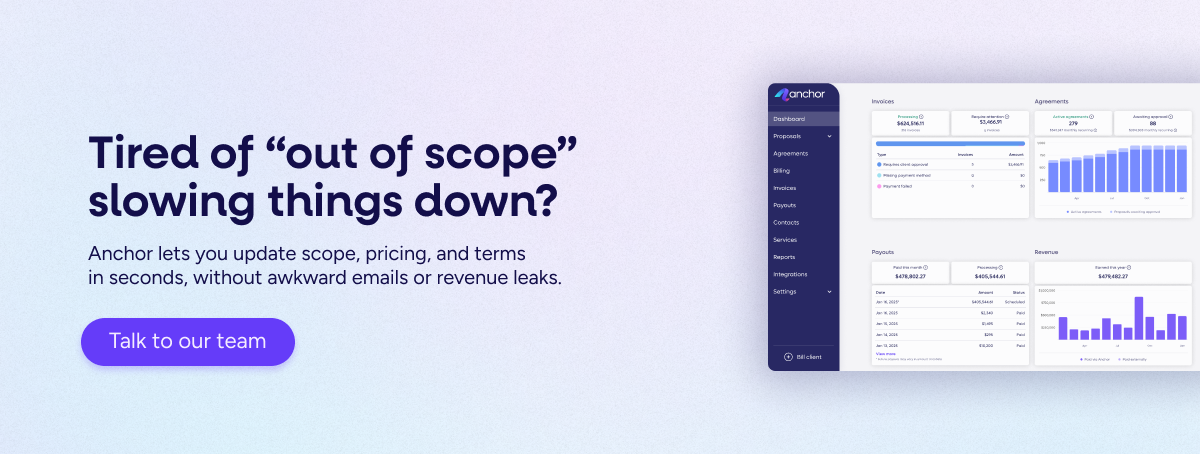
Scope changes shouldn’t require starting over or opening a brand-new negotiation thread. With amendments, you can update terms and billing so the change is documented and billed without a reset.
Keep visibility with dashboards and synced reconciliation
When agreements, invoices, and payments are connected, you can see what’s expected, what’s outstanding, and what cash flow looks like ahead.
And when payments sync and reconcile automatically into the systems your team already uses, you reduce administrative workload during the busiest weeks.
This is the core shift: the firm stops treating every engagement as a fresh negotiation. The firm operates with clear terms and consistent execution.

The bottom line
Tax firms don’t run billing as a conversation because they want to. They do it because service relationships invite negotiation, and firms often trade boundaries for short-term peace.
The fix isn’t being tougher. It’s building a commercial layer that protects the relationship and protects the business.
You can start by revising your engagement terms to define scope changes and payment timing up front.
If you want help, book a 15-minute call with an Anchor advisor to see how our platform connects agreements, automated invoicing, automatic payments, amendments, integrations, and dashboards into a single operating model.