


Most firms don’t lose money because clients refuse to pay. They lose money because billing turns into a chain of tiny tasks.
Copy the scope into an invoice. Double-check the deposit amount. Set up recurring billing. Update the client record. Fix the invoice when the scope changes. Mark things paid. Reconcile later.
None of it is hard. That’s what makes it risky. It’s easy to delay, easy to miss, and easy to push to “after we start the work.” But you don’t have to accept that as normal.
Instead, let’s break down where proposals stall, what it costs, and what it looks like when the agreement carries the billing and payment setup from the start.
Key takeaways
- Your proposal isn’t the finish line: It’s the handoff from selling to getting paid, and that handoff needs a system.
- PDFs slow everything down: Edits, versions, and rework turn “yes” into “we’ll sort it out later.”
- The payment step shouldn’t be an afterthought: The more separate steps you add, the longer cash stays stuck.
- A connected flow fixes the gap: One agreement can trigger billing, payment collection, and clean reconciliation.
Why proposals stall when momentum matters most
When a client says yes, they’re at their most motivated. They’re focused on results, not paperwork. That’s your best moment to set clear expectations and make the next steps painless.
But most firms hand clients a process that feels like a scavenger hunt.
First, the proposal arrives as a PDF. The client has to print it, sign it, scan it, or use a separate e-signature tool. After that, there’s a pause while everyone waits for the next step. If the scope needs a tweak, you send a revised version. Now there are multiple copies floating around, and someone has to confirm which one is the real agreement. If it changes again, you’re back to editing and resending.
By the time you get the signature, you’ve lost the clean momentum you earned in the sales conversation.
And then comes the awkward part.
Payment becomes a separate ask in a new email, in a new system, with new steps. Even clients who like you will procrastinate if it’s not simple. They get busy. They forget. They put it off until “next week,” which turns into “next month.”
This is how a promising agreement turns into slow cash, extra admin, and a quiet sense of “why is this so hard?”
That stall leads straight into the next problem: the tools don’t talk to each other.
The hidden cost of the tool gap
Most firms don’t choose a messy workflow on purpose. It’s usually the result of stacking tools over time.
You’ve got one tool for proposals. Another for signatures. Another for invoicing. Another for payments. Another for the books. Maybe another for practice management.
While it may be working day-to-day, each handoff between tools creates work.
Line items get copied into an invoice. The billing schedule gets double-checked. The deposit amount gets confirmed. The client record gets updated. The invoice gets marked paid. The payment gets reconciled. And when something doesn’t match, it gets tracked down and fixed.
Even when it goes “fine,” it’s still time you didn’t plan to spend. And when it doesn’t go fine, you get the worst kind of task: the one that feels small, but eats your day.
This is also where trust gets quietly tested.
Clients may not say it out loud, but they notice friction. If the billing process feels scattered, they wonder what else is scattered. They start expecting confusion. They become harder to onboard. They ask more questions. They hesitate on the next upsell.
Nobody wants their billing to send that signal.
So what’s the alternative? A proposal that isn’t just a document. A proposal that behaves like an agreement and a billing plan from the start.
That’s where a “self-driving” proposal comes in.
What a “self-driving” proposal really means
Let’s drop the fantasy for a second. Your proposal can’t do the client work. It can’t run payroll. It can’t clean up a messy chart of accounts.
But it can do the part that usually steals your evenings: turning a yes into a clean, predictable payment flow.
A self-driving proposal is one connected agreement that does three things:
- It captures scope and terms in a way that’s easy to approve.
- It includes a clear, enforceable billing schedule.
- It sets up payment so billing doesn’t depend on a follow-up email and a good memory.
In other words, it closes the gap between “signed” and “paid.”
This is the point where most systems give up. They stop at the signature and leave you to build the rest by hand. Anchor is built to continue the flow.
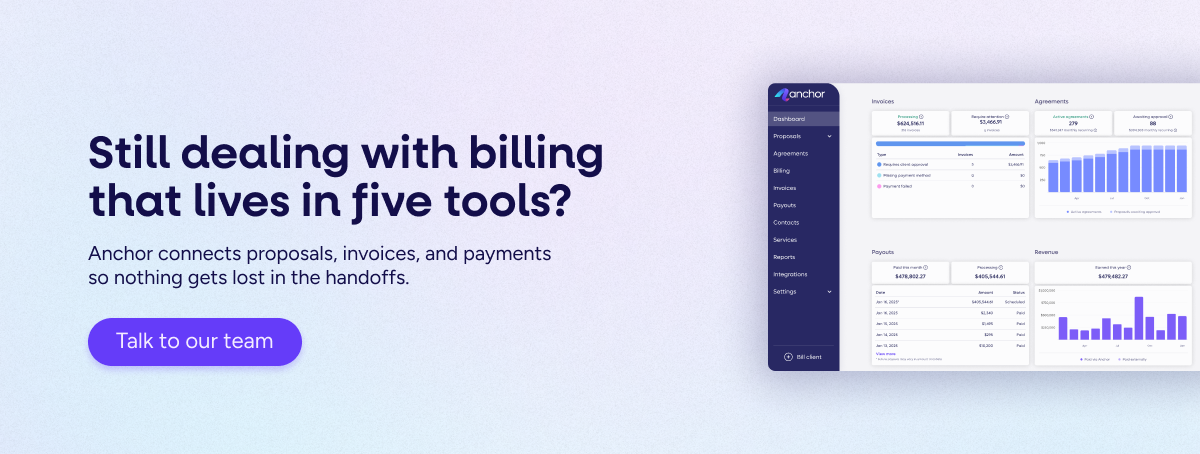
Anchor is a billing and collections platform for accounting, bookkeeping, tax, and professional service firms that connects proposals, agreements, invoices, payments, and reconciliation so you don’t have to stitch it together every time.
The Anchor approach: proposal to payment, connected
Anchor’s core idea is simple: the agreement should carry the billing plan inside it, and billing should happen automatically as agreed.
Here’s how that flow works:
Start with a proposal that’s also a billing plan
Instead of creating a proposal and then rebuilding the same details elsewhere, you set up the scope, terms, and billing schedule together.
That matters because it prevents the “now I have to make an invoice” moment.
The proposal becomes the source of truth. The client sees exactly what they’re agreeing to and when payments will happen. No surprises. No side emails to clarify timing.
This is also where you protect your future self. If you’ve ever had to dig through old versions to answer “what did they sign,” you know why one clean source matters.
Once the client approves, you shouldn’t have to copy anything into a new tool. That leads to the next step.
Approve in one place, without jumping between tools
Clients don’t want to hunt across systems. They want to read the agreement, agree to it, and move on.
A web-based proposal experience helps keep approval simple. It also helps you avoid the version-control spiral, where “final final” is followed by “final final 2.”
When approval is easy, clients sign faster. And faster signing is nice, but it’s not the real win.
The real win comes immediately after the signature.
Set up payment at the moment of agreement
This is the biggest shift.
Instead of signing now and handling payment later, the client can provide payment details within the same flow. That can be ACH or a credit card, depending on what you offer.
When payment is set up up front, billing stops being a follow-up task. It becomes part of the agreement.
Anchor supports free ACH and immediate credit card payments. When configured, credit card fees are collected directly from the client.
The goal isn’t to “chase” anyone. The goal is to make payment the default, so you don’t end up in chase mode at all.
Now, what happens when it’s time to bill?
Invoices trigger automatically from the agreement
Once an agreement includes a billing schedule, invoices can trigger automatically based on that schedule. That includes recurring billing and one-time charges.
So instead of someone remembering to create an invoice on the first of the month, it happens because the agreement requires it.
That’s how you protect cash flow without adding more admin.
And when the scope changes, you need the billing plan to change cleanly as well. That’s where amendments come in.

Amendments update the billing terms without chaos
Real-life clients change their minds. Projects expand. Timelines shift. You add a service midstream.
The billing should keep up without you having to rebuild the whole deal.
Anchor supports one-click amendments that update billing terms, scope, and amounts in real time.
That helps prevent the most common “free work” problem: you start doing the expanded scope, but the billing change lags behind because it’s a hassle. Then you’re trying to collect for work you did weeks ago.
Clean amendments keep the agreement and billing aligned, which keeps the relationship cleaner, too.
Finally, once money moves, you need the books to reflect reality without manual cleanup.
Reconciliation should be boring. That’s the point.
The best billing system is the one that doesn’t create a second job at month-end.
Anchor integrates with tools many firms already use, including QuickBooks and Xero, as well as practice management tools like Karbon, Keeper, Client Hub, Financial Cents, and monday.com. Payments can sync and reconcile automatically.
That means fewer “Did this hit the right invoice?” moments. Fewer payment mysteries. Fewer late-night cleanup sessions before you close the month.
Reconciliation won’t make you feel heroic. It’ll feel quiet.
Now, let’s bring this home with what to do next.
How to build proposals that lead to predictable cash
You don’t need to rebuild your whole firm to fix this. You need one change in mindset:
Stop treating the proposal like a document. Treat it like the start of the payment lifecycle.
Here’s a practical way to do that:
- Make the billing schedule part of the agreement, not a separate follow-up.
- Make payment setup part of approval, not a later email.
- Make amendments easy, so billing keeps up with scope.
- Keep reconciliation connected, so payments don’t become cleanup work.
If you do those four things, you’ll spend less time on admin and more time delivering the work clients actually pay for.
You’ll also have fewer awkward money conversations, because the agreement is clear and the system follows it.
And if you’re thinking, “We’ve lived with this mess for years,” you’re not alone. Manual billing builds character. It also builds late nights.
You can pick which one you’d rather keep.
Ready to stop babysitting billing?
Anchor is built to eliminate the manual steps between doing the work and getting paid by connecting proposals, agreements, invoices, payments, and reconciliation into a single flow.
If you want to see what a self-driving proposal looks like in your firm, start a free Anchor account and send your first interactive proposal.
Or, book a quick call with one of our advisors. We’ll help you map your current proposal-to-payment flow and find the leaks.
Either way, you’ll get a system that helps you get paid on time, without turning you into the collections department.