


NASA doesn't launch on hope. Neither should firms.
Hope shows up when the process is fuzzy, and ownership is unclear. The steps might exist, but no one knows what happens next, who owns it, or what "done" actually means. In spaceflight, that kind of ambiguity gets engineered out. In firm operations, it often gets baked in.
You've probably experienced this first-hand: a proposal looks right, scope and pricing make sense, but there are lingering questions about...everything else. Who approves it? When does billing start? What happens when the client asks for changes two weeks later?
Those questions don't live inside the proposal. They live in the handoffs. And that's the point: proposal management isn't a document problem. It's an operational one.
If this sounds familiar, the fix is simple. Stop treating proposal management like a one-off document. Treat it like a system that connects approvals, signatures, scope, and billing. In the following sections, we'll show you how to build that system, with a few cues from NASA along the way.
Key takeaways
- Treat proposals as infrastructure, not paperwork: A proposal is only "done" when it reliably triggers the next step, from kickoff to billing, payment, and renewal. Designing the full life cycle up front removes gaps where work starts, but billing doesn't.
- Design for handoffs, not heroics: Most breakdowns happen between stages, not inside them. Define ownership, make transitions explicit, and build a system that doesn't depend on memory, reminders, or the same person pushing everything forward.
- Make change safe and billable by default: Scope will shift. A strong proposal system makes amendments easy, keeps every update tied to a single centralized agreement, and keeps billing aligned automatically, so changes don't turn into awkward conversations or unpaid work.
- Reduce cognitive load with automatic execution: When signatures, payment authorization, and billing are connected, forecasting becomes more stable and revenue leakage drops. The win isn't just speed. It's fewer unknowns, fewer follow-ups, and more confidence in what's committed and collectible.
Why proposal management breaks down in growing firms
Proposal management often breaks down for the same reason small systems fail everywhere. They grow organically. A workaround becomes a habit. One spreadsheet becomes five. What used to live in someone's head gets spread across inboxes, docs, and side conversations.
A firm with $2M in revenue might muscle through that sprawl. A firm pushing toward $5M or $10M starts to feel the drag: delays, scope confusion, uncomfortable billing conversations, and revenue that never seems to arrive in full. The work gets delivered, but the process around it remains fragile.
One firm owner we spoke to put it simply:
"We were winning work, but every proposal felt like the start of a guessing game."
If that's an experience you can relate to, it's not a people problem. It's a systems problem. When there's no clear owner, no single source of truth, and no defined handoff from proposal to delivery to billing, things slip.
NASA learned this decades ago: complex work often breaks at the transition points. So they engineered clarity into the process. Clear roles. Checkpoints. Checklists. Documented procedures that reduce guesswork and mistakes. The point wasn't to slow work down. It was to ensure missions moved forward the same way every time, even under duress.
That's the same shift growing firms have to make when it comes to managing proposals. It's not about exerting more effort; it's about implementing better design.
What the NASA Systems Engineering Handbook actually says
While it may seem counterintuitive, the NASA Systems Engineering Handbook isn't about rockets or spaceships. It's about designing systems that work under pressure, change, and uncertainty.
While the entire handbook is helpful, three ideas stand out as particularly applicable to proposal management:
1. Define stakeholder expectations up front, then baseline them.
NASA starts by clarifying what stakeholders expect and how the system will actually be used, often through a Concept of Operations (ConOps) and specific use cases. Those expectations are then validated and set as a baseline so everyone is aligned on what "the system" is supposed to do and what "done" really means.
In a firm, that's the difference between "we'll take care of it" and a proposal that clearly defines deliverables, timing, responsibilities, and what triggers out-of-scope work. When expectations aren't baselined, scope creep and billing confusion aren't anomalies. They're outcomes.
2. Treat handoffs as interfaces, and manage them on purpose.
NASA treats interfaces as first-class parts of the system and emphasizes defining interface responsibilities and controlling internal and external interfaces, including how changes will be managed.
For firms, your interfaces are the transitions that occur across an engagement: proposal → signature, signature → kickoff, kickoff → recurring billing, and client requests → scope change. Most breakdowns happen here because no one "owns" the handoff. The work starts, but the next step doesn't.
3. Assume change will happen, and control it with a disciplined process.
NASA relies on configuration management to keep track of what's current, what's approved, and what changed, so the system doesn't drift away from what was agreed upon. The goal isn't perfection. It's preventing untracked changes from turning into surprises downstream.
This is the proposal version of "Which doc is the latest?" and "Did we agree to include that?" A simple change control mechanism, even if it's lightweight, protects margins and prevents awkward billing conversations later.
NASA learned that complexity doesn't require more control. It requires a clearer structure: shared expectations, managed interfaces, and controlled change.
When viewed through this lens, proposal management becomes much more straightforward.
Proposal management isn't a document; it's a life cycle
Most firms treat proposal management as a moment: draft, send, wait, follow up. NASA treats complex work as a life cycle with clear phase gates. You don't move forward until the system is ready for what comes next.
Proposal management deserves the same respect. A proposal isn't "done" when it's sent. It's done when it creates a clean, repeatable handoff into what comes next: kickoff, billing, payment, delivery, changes, and eventually renewal.
When you map proposal management as a system, a few stages show up almost every time:
- Intent clarity: What are we selling, to whom, and why does it matter?
- Agreement structure: Scope, terms, pricing, and payment method, written in a way both sides understand.
- Commitment: Clear acceptance without friction or back-and-forth.
- Execution trigger: Work starts, and billing and payment begin as specified in the agreement.
- Change handling: When something shifts, the agreement updates without chaos, and the billing stays aligned.
Most breakdowns happen between stages, not inside them. The proposal itself can be solid, but the process around it is where breakdowns show up.
As one tax firm owner told us:
"Our proposals were fine. Everything after them was where things got messy."
That mess isn't accidental. It's the predictable result of a system that was never designed to carry the work from "yes" to "paid" without relying on memory, reminders, and heroic follow-up.
Proposal management through a systems engineering lens
NASA insists on traceability. Every requirement ties back to a mission objective, and every downstream decision can be explained in terms of that original intent.
In a firm, traceability is simpler but just as important: can you connect what the client approved to what gets delivered, what gets billed, and what gets paid?
When proposal management is disconnected from billing, that chain breaks. Firms end up relying on follow-ups, one-off coordination, and someone remembering to push it forward. The proposal might be accurate, but the system around it is fragile.
A systems approach to proposal management holds a few principles worth noting here:
- Every proposal must be executable. If the team can't start cleanly, the agreement isn't ready.
- Every agreement must be billable by design. Billing and payment terms should translate directly into what happens in the system.
- Every change must update the system. Changes should create a new agreement state, not side work and private exceptions.
This is operational simplicity. Not fewer steps, but fewer unknowns. Fewer places where someone has to remember.
It's also where proposal management evolves. When agreements behave like systems, acceptance becomes a trigger, not an endpoint. The next steps can be automatic: kickoff, recurring billing start dates, payment collection, and clean amendments when scope changes.
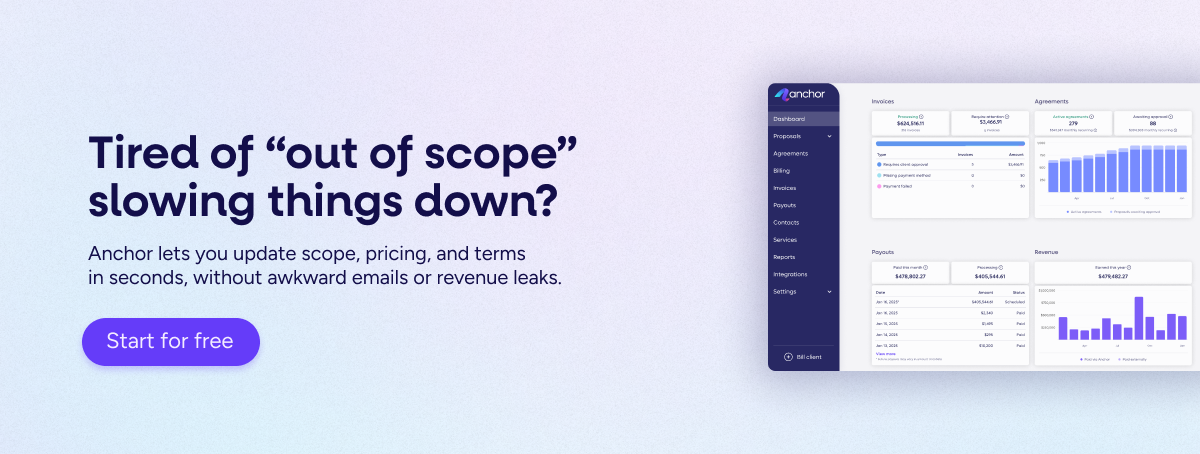
That's the idea behind Anchor's approach to proposals. We treat the proposal as the engine of the client relationship by combining the service agreement, digital signature, and payment authorization into one interactive workflow.
Once the client signs and links a payment method, billing can proceed as the agreement specifies, from recurring invoicing to payment collection and reconciliation.
If you'd like to see what this looks like in practice, you can find out more here or book a call with our team to walk through it live.
Why operational simplicity beats operational control
A lot of firm owners chase control. More checks. More approvals. More reviews. The intent is good, but in practice, "more control" often creates more places for work to stall.
NASA learned this the hard way. You can't manage complexity by adding friction everywhere. Overly rigid layers slow execution and can make handoffs more fragile, because people start working around the process to keep things moving. Simplicity does the opposite. It creates clarity, so fewer interventions are needed.
In proposal management, operational simplicity isn't "less process." It's a cleaner chain from agreement to action:
- Clear pricing structures that are easy to approve and repeat
- Payment method agreed upfront, so there's no scramble later
- Billing is tied directly to the agreement, so the system does what was promised
- Changes are handled in real time, so scope updates don't turn into side work
A founder at a restaurant accounting firm recently told us: "I didn't realize how much energy proposals were taking until they stopped being a thing I had to think about."
And that's the real metric. Not speed. Not volume. Cognitive load. If your proposal process requires constant attention to keep it from breaking, it won't hold up under pressure.
Operational simplicity means the same work can move forward with fewer decisions, fewer follow-ups, and fewer opportunities for something to slip through the cracks.
Proposal management and change: The overlooked failure point
NASA plans for change because change is inevitable. The system has to absorb it without losing track of what's true.
Most firms don't plan for change inside the agreement. They treat the proposal as the finish line, then handle updates through one-off emails, hallway conversations, and "we'll fix it on the next invoice."
But clients change. They add services. Pause work. Expand scope. Adjust timelines. When the agreement can't adapt, you get a predictable outcome: awkward conversations, unbillable work, or billing that drifts away from what the client thinks they approved.
This is where amendable agreements matter, not as a feature, but as a design principle. Anchor offers an example of this approach in action, where proposals, amendments, and service updates all live within a single centralized agreement.
A solid system keeps everything tied to one source of truth. The client agrees up front on how changes and out-of-scope work will be handled. When pricing changes or a new service gets added, the update runs through the same approval flow, with a clear window for acceptance so it doesn't stall.
And when an invoice needs a correction, adjustments stay inside the engagement, so credits and add-ons remain compliant and synced. Every change is logged, so you can always answer the question that matters in a dispute: what changed, when, and who approved it.
Change should update the system, not break it. That's how proposal management supports trust instead of straining it.
From proposal management to financial certainty
NASA missions rely on dashboards: real-time visibility into system health. Firm owners deserve the same kind of clarity around their work in progress, what's been approved, and what's actually going to get paid.
When proposal management is tied directly to billing and payment, forecasting becomes more stable. You're no longer guessing which clients signed, which services are truly active, or whether someone remembered to start billing on the correct date.
The agreement becomes the source of truth, and the numbers follow it. Revenue leakage drops because fewer steps depend on memory, and fewer invoices fall through the cracks.
A managing partner at a professional services firm said it best:
"We stopped arguing about whether something was billable. The system already knew."
That's what happens when proposals become part of the operating system, not a standalone task. It creates shared visibility across the team, reduces "status-check" meetings, and helps owners make decisions based on what's committed and collectible, rather than on what someone thinks will happen.
The quiet shift firms don't notice at first
When firms bring clarity to their proposal management process, the most significant change we see isn't operational. It's emotional. Owners stop bracing for payment conversations. Teams stop improvising to keep work moving. Clients get clarity without feeling managed.
That's what happens when the agreement becomes the system of record, and the system does what it says it will do.
NASA would call this readiness. Not because everything is perfect, but because the process can handle pressure without falling apart. Proposal management fades into the background. And that's the point. When it's working, no one has to think about it.
If this way of thinking resonates, it may be time to treat proposal management as a core workflow rather than a one-off chore. Anchor was built to support that shift, quietly and reliably. You can explore it here, or book time with our team if you'd rather talk it through.

FAQs
What is proposal management in an accounting firm?
Proposal management is the process of creating, approving, accepting, and operationalizing client agreements. In modern firms, it extends beyond documents into billing, payment, and lifecycle management.
Why does proposal management become harder as firms grow?
Growth increases complexity. More services, more pricing models, and more changes expose gaps between proposals and execution.
How does systems engineering apply to proposal management?
Systems engineering focuses on clear inputs, triggers, and outcomes. Applied to proposal management, it ensures proposals reliably trigger billing, payment, and delivery without manual intervention.
What causes revenue leakage in proposal management?
Disconnected systems, manual handoffs, and unclear change management often lead to missed billing or unpaid work.
How can firms simplify proposal management without losing control?
By designing proposal management as a connected system where agreements, billing, payments, and amendments work together automatically.