


Most proposal advice tells you to bury pricing late, build value first, and frame your fees as an investment. That advice isn't wrong. It's incomplete.
The problem with treating the pricing section as a persuasion problem is that you've already lost the deal six weeks later, when the first invoice ages past 30 days and you're emailing the client you had dinner with last week. Pricing in a marketing agency proposal does two jobs. It presents fees, and it locks billing terms. Most agencies treat it as one. The proposals that close fastest also collect fastest because they handle pricing as a commitment moment, not a sales reveal.
This guide covers the structure, the section-by-section moves, the way pricing should be positioned, and the specific mistakes that turn 8-out-of-10 proposals into ghosts.
Key takeaways
- Pricing placement is a billing decision, not a persuasion decision. Agencies that close faster also collect faster. Both come from treating pricing as where payment terms get locked, not where fees get revealed. Intuit QuickBooks' 2025 Small Business Late Payments Report, which surveyed 2,487 US small businesses, found that 56% are currently owed money from unpaid invoices, an average of $17,500 per affected business. Most of that starts with a proposal that never locked the terms.
- Most proposals lose the deal before the pricing page. Generic templates, late delivery, and proposals that lead with the agency are the deal-killers. Pricing is rarely the actual problem.
- Length follows deal complexity, not best-practice copywriting. RAIN Group's research on 472 sellers found top-performing sellers win 72% of proposed deals versus 47% for the rest. . Mechanics matter, but page count isn't the lever.
What is a marketing agency proposal?
A marketing agency proposal is a document an agency sends a prospective client to convert a discovery conversation into a signed engagement. It defines scope, pricing, timeline, and terms in one place. Unlike a quote, it includes strategy and trust signals. Unlike a pitch deck, it's structured to be signed.
Drew McLellan, who runs Agency Management Institute and works with more than 250 small-to-mid-sized agencies a year, frames the proposal as the agency's first real deliverable to the client. The pitch got the prospect to the discovery call. The proposal earns the signature.
Marketing agency proposal vs. quote
A quote is a fee number. A proposal is the full case for the engagement. Quotes price work. Proposals price the work, sell the agency, and set the terms of the relationship in one document.
Marketing agency proposal vs. scope of work (SOW)
The SOW defines deliverables, change-order process, and out-of-scope billing rules. For retainers under roughly $5K a month, merging them into one document works fine. Above that, separating the SOW protects both sides when scope expands mid-engagement.
Marketing agency proposal vs. pitch deck
A pitch deck is for the room. A proposal is for the inbox after the room. Agencies that confuse them send 40-slide decks no one reads, then wonder why the deal stalled.
| Document | Purpose | Length | Includes pricing | Designed to be signed |
|---|---|---|---|---|
What should a marketing agency proposal include?
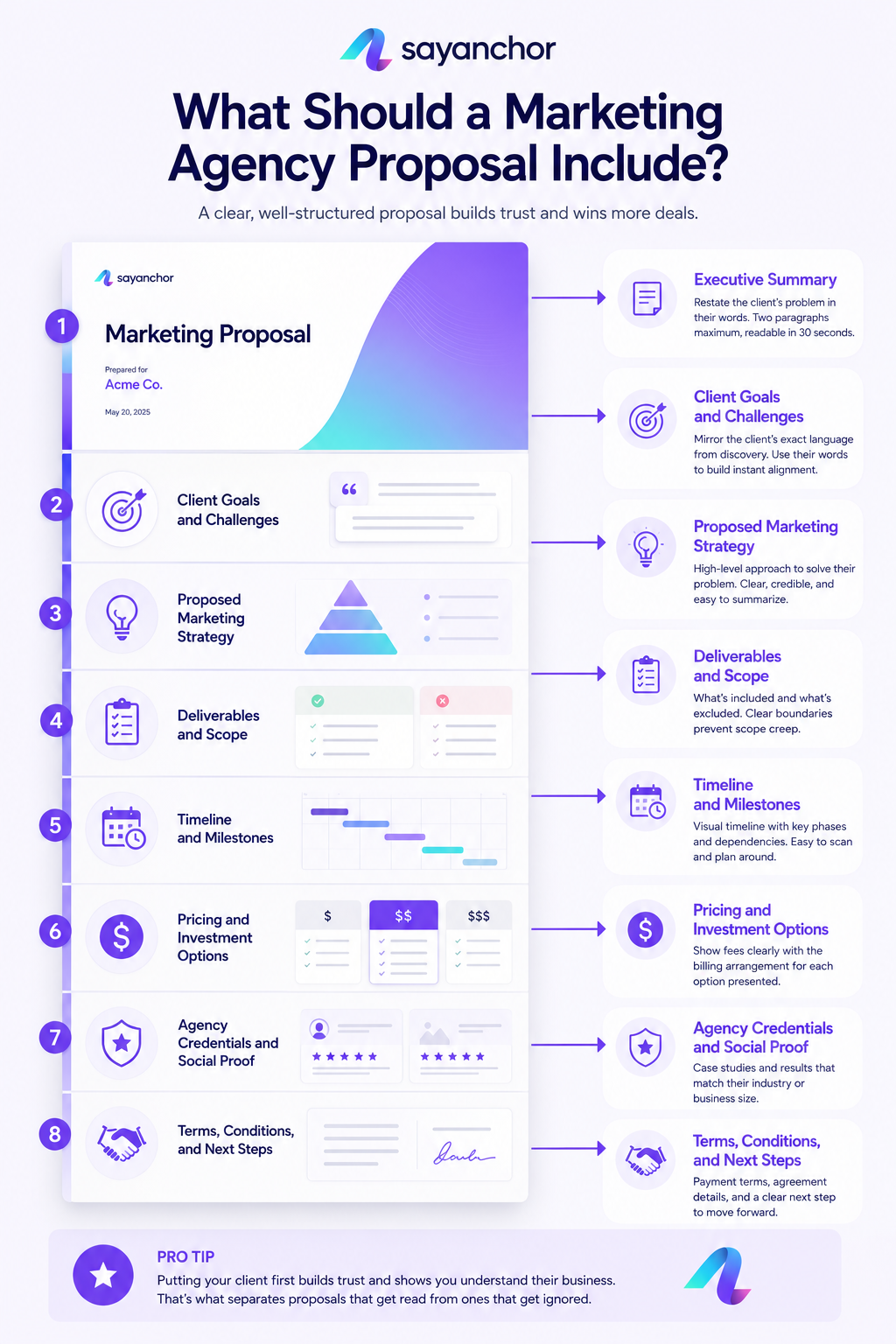
A marketing agency proposal should include eight sections: executive summary, client goals and challenges, proposed strategy, deliverables and scope, timeline and milestones, pricing and investment options, agency credentials, and terms with next steps. The order matters as much as the contents. Proposals that put credentials before client goals close less often than ones that put the client first.
- Executive summary
Restate the client's problem in their words. Two paragraphs maximum, readable in 30 seconds. For many decision-makers it's the only section they'll read before forwarding the document for input.
- Client goals and challenges
This is where mirroring the client's exact language back to them earns its weight. Pull verbatim phrasing from the discovery call. If the client said "we're losing pipeline visibility," that's the phrase. Drew McLellan's AMI peer groups treat listening as the core credibility marker.
- Proposed marketing strategy
The high-level approach to solving the problem you just restated. Specific enough to be credible, not so detailed it reads like a delivery plan. A CMO with 15 minutes should be able to summarize your approach in their own words.
- Deliverables and scope
List what's included and what's explicitly excluded. The exclusion list is what prevents scope creep later. Most agencies skip it because writing exclusions feels negative during the sales motion. The agencies that don't write it pay for it in unbilled hours every month.
- Timeline and milestones
Visual or table format. Show dependencies between phases. Buyers process visual timelines faster than prose, and a Gantt-style view also surfaces resource conflicts during proposal review.
- Pricing and investment options
Brief mention here. The full thesis lives later in this guide. For now: show fees clearly, present them tied to scope, and never present a number without the billing arrangement that goes with it.
- Agency credentials and social proof
Case studies tailored to the client's industry. Two case studies that match the client's vertical or revenue size beat ten generic ones.
- Terms, conditions, and next steps
This is where the deal actually closes. Payment schedule, billing method, cancellation terms, IP transfer, and a single clear signature block. Treat this section as the close, not as legal boilerplate. Most agencies write it last, in 10 minutes, and it shows.
How to structure a marketing agency proposal
A marketing agency proposal should be structured to align deliverables with client goals while clearly defining the scope of work. Effective proposals include an executive summary, a detailed situational analysis, a strategic roadmap, and a transparent pricing structure to ensure mutual expectations are met before the contract is signed.
Section structure is the boring part. Section order is what closes the deal.
The reading order matters more than the contents. Lead with the client's problem, build credibility before pricing, present pricing as a commitment moment, and end with a single low-friction next step. This order maps to how prospects actually evaluate proposals, not how agencies prefer to present themselves.
Lead with the client's problem, not your agency
The classic mistake is opening with "About [Agency Name]" or a founder bio. The prospect doesn't care yet. They care after they see you understand them. The first two pages should be about them.
Build credibility before you show pricing
Case studies and credentials sit between the problem statement and the price. Going straight from problem to price reads transactional. Skipping credibility entirely loses the deal to whoever did include it. RAIN Group found top-performing sellers are 39% more likely than others to know and strongly highlight the results they've achieved for similar buyers. The agency that skips credentials loses to the one that included two matched case studies, regardless of which quoted lower.
Present pricing as a commitment, not a cost
This is where the standard advice gets it wrong. "Investment, not cost" is the framing every proposal template has been pushing for a decade. The frame that closes faster is "commitment, not reveal." Locked rates. Locked billing schedule. Locked payment method. The next section covers this in depth.
End with a clear, low-friction call to action
One signature block. One next step. Not a six-step process. The proposal itself is the next step. Anything that adds friction between the prospect's decision and the signature is friction the agency added voluntarily.
How long should a marketing agency proposal be?
A marketing agency proposal should run as long as the deal complexity requires and no longer. Retainer proposals tend to be shorter than project-based ones because retainer scope gets renegotiated monthly. Project proposals need to lock scope up front. The right length is the shortest version that resolves the client's open questions, not a number copied from a template. RAIN Group's research on 472 sellers found the close-rate gap between top performers (72%) and the rest (47%) came from specificity, language mirroring, and clear ROI cases, not document length.
Retainer proposals vs. project-based proposals
Retainers can usually run 6 to 8 pages because scope settles every month. Projects often need 10 to 14 because scope locks up front and renegotiation is expensive.
When a short proposal closes faster
When the prospect already trusts the agency, the proposal is paperwork. Referrals, repeat business, expansion engagements: a 4-to-6-page document that confirms scope, locks the start date, and captures the signature is faster than a fully built case for the agency. The credibility work is already done.
When a long proposal is worth the effort
Cold prospects, RFP responses with mandatory sections, and multi-stakeholder buying committees all earn the longer document. Length signals seriousness in those contexts. The risk is writing long out of habit when the deal doesn't require it.
How to price a marketing agency proposal without losing the cash-flow battle
Most pricing advice for marketing agency proposals is about how to frame fees. Frame as investment, anchor with a high tier, build the value stack first. None of that is wrong. It's just incomplete. The pricing section isn't only where fees get presented. It's where billing terms get set, or left ambiguous and bitten by six weeks later.
Pricing in a marketing agency proposal does two jobs: it presents fees, and it locks billing terms. Most agencies treat it as one. The proposals that close fastest also collect fastest because they handle pricing as a commitment moment, with locked rates, a locked schedule, and a locked payment method, not as a sales reveal.
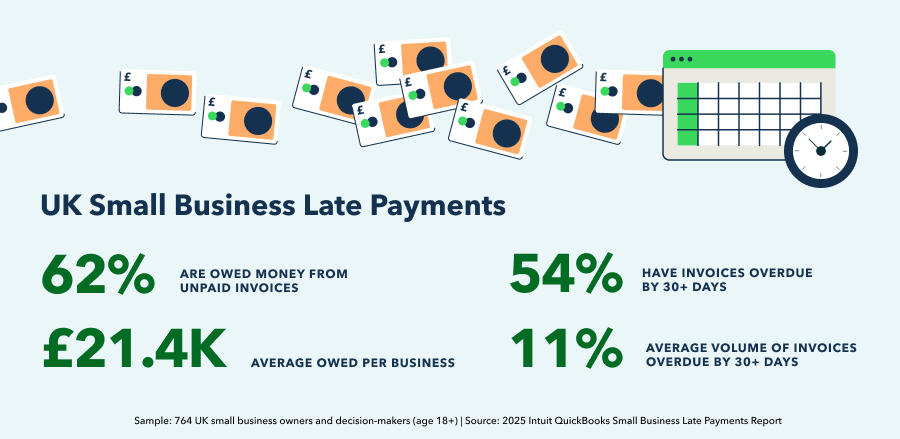
The connection between proposal pricing and downstream collection is empirical. Intuit QuickBooks' 2025 Small Business Late Payments Report, which surveyed 2,487 US small businesses, found that 56% are currently owed money from unpaid invoices, with $17,500 outstanding per affected business on average and 47% reporting invoices overdue by more than 30 days. AgencyAnalytics' 2023 Marketing Agency Benchmark Survey found 13% of agencies cite cash flow as their primary challenge. Late payment isn't a billing problem. It's an agreement problem that surfaces as a billing problem six to eight weeks after the proposal got signed.
Credit to QuickBooks
Tiered pricing vs. single-option pricing
Tiered pricing (good, better, best) closes faster on average than single-option pricing because it shifts the buyer's question from "should we hire them?" to "which tier fits?" The middle tier is where most clients land, which is why it should be the one the agency actually wants to deliver. Single-option pricing works fine for repeat clients and referred deals where price isn't the live question. RAIN Group found top-performing sellers are 81% more likely than others to excel at overcoming price pressure, and the tier structure is part of how that happens.
How to justify your rates in the proposal
Don't itemize the receipt. Buyers don't read line-item breakdowns sympathetically. They read them adversarially, looking for things to cut. Tie rates to outcomes the client already named in discovery. Marcel Petitpas, CEO of Parakeeto and host of the Agency Profit Podcast, argues pricing should be calculated from delivery margin, not cost-plus, which means the proposal anchors on what the engagement is worth to the client, not what it costs the agency to deliver.
Monthly retainer vs. project fee structures
Retainers are aspirational for most US agencies under $1M. Project fees are still the operational reality at that size. Hybrid (retainer base plus out-of-scope hourly) is the dominant pattern at $1–5M because it acknowledges that scope creeps and gives both sides a structured path to bill the overage. Whichever model the proposal uses, it has to specify the billing schedule, not just the fee amount. "$8,000 a month" is a fee. "$8,000 a month, billed on the first, charged to a card on file authorized at signature" is a billing arrangement. The first closes the proposal. The second closes the cash-flow loop.
What to do when you don't know the client's budget
Don't guess. Ask before you write. Agencies that send pricing without a budget signal end up at the wrong tier most of the time. If the client genuinely won't share, anchor with the tier the agency would actually want to deliver and label the others clearly.
Common marketing agency proposal mistakes that cost you the deal
The five mistakes that cost marketing agencies the most deals at the proposal stage are: making the proposal about the agency instead of the client, using generic templates without customization, sending pricing before establishing value, burying the next step at the bottom, and waiting too long to send the proposal after the discovery call.
None of these are pricing problems. All of them are process problems.
Making the proposal about your agency instead of the client
A proposal is a solution map for the client, not a brag sheet for the agency. The diagnostic test: count first-person agency mentions versus second-person client mentions in the first two pages. If the agency outnumbers the client by more than two to one, rewrite the opening.
Using generic templates without customization
Templates are scaffolding, not content. Sending an obviously templated document to a $50K-a-year prospect signals the deal isn't worth the time it would take to customize. Customization means swapping the case studies, mirroring the discovery-call language in the goals section, and naming the client's specific competitors.
Sending pricing before you've established value (and why this is more nuanced than it sounds)
Most proposal advice says "build value before pricing." The principle is right. The implementation most agencies use is wrong. The mistake isn't pricing's position in the document. The mistake is presenting pricing as a number rather than as a billing arrangement. Position the pricing section late if it fits the document's flow, but lock the terms wherever it lands. A buyer who sees a clear billing arrangement reads it as confidence. A buyer who sees a fee with no terms reads it as something to negotiate.
Burying the next step at the bottom
The signature should be findable in 5 seconds. If the prospect has to scroll through three pages of legal copy to find it, the agency added friction voluntarily. The "Next steps" page convention used by most modern proposal tools exists because buyers consistently fail to find the signature without it.
Waiting too long to send the proposal after the discovery call
The 24-hour window is real. The prospect's enthusiasm peaks during and immediately after the discovery conversation. Every day the proposal doesn't arrive, the conversation cools and competing proposals from other agencies arrive. RAIN Group found it takes an average of 8 touches to get an initial meeting in the first place. After investing that effort, losing the deal because the proposal arrived four days later is an unforced error. AMI peer-group consensus: 24 hours, ideally next morning.
How to write a winning executive summary
A winning executive summary mirrors the client's exact language back to them, names the specific outcome they're hiring for, and runs no longer than half a page. It's the section most decision-makers read before forwarding the document for input. If a CMO can't grasp the engagement from the executive summary alone, the rest of the proposal won't recover the deal.
What to include in the first paragraph
The client's problem in their words. The outcome they want. The agency's role in delivering it. The first paragraph isn't where the agency proves it can solve the problem. It's where the agency proves it understood the problem the client described in discovery.
How to mirror the client's language
Pull verbatim phrasing from the discovery call. If the client said "we're losing pipeline visibility," that exact phrase should appear in the executive summary. Drew McLellan's AMI peer groups treat listening as the credibility marker that separates agencies the client trusts from agencies the client tolerates.
What length works best
Half a page. One screen on a laptop. Anything longer becomes a second body section the buyer will skip.
How to personalize a marketing agency proposal
Personalization in a marketing agency proposal isn't about putting the client's logo on the cover. It's about referencing specific things from the discovery call, naming the client's actual competitors by name, and tailoring case studies to the client's industry. These are the signals that tell a CMO the proposal was written for them, not adapted from a template.
Using discovery call notes in your proposal
Specific quotes from the discovery call do the heaviest lifting. "When we spoke on Tuesday, you said the team is spending 12 hours a week on reporting that nobody actually reads. Here's what we'd change." That sentence does more proposal work than three pages of agency credentials.
Referencing the client's competitors
Naming competitors signals research. "We've reviewed [Competitor 1, 2, and 3]'s positioning and identified three angles they're not occupying" beats "We've analyzed your competitive landscape." The first reads as work already done. The second reads as work that might happen if the engagement begins.
Tailoring case studies to the client's industry
Two industry-matched case studies beat ten generic ones. If the agency doesn't have a vertical-specific case study, admit it directly and explain the structurally similar engagement. A CMO at a B2B fintech doesn't gain confidence from a DTC fashion brand logo. They gain confidence from a case study showing the agency understands long sales cycles, compliance friction, and committee buying.
Marketing agency proposal templates and formats
Marketing agency proposals come in four common formats: PDF, interactive proposal software, Google Docs or Word, and slide deck. Each has tradeoffs for tracking, signing speed, and impression. The format that closes fastest is the one that lets the client sign and authorize payment without leaving the document. Get some marketing proposal templates for your inspiration >>
PDF proposals
Polished and controllable, but no analytics on whether the prospect opened it, no native signing, no payment capture. Fine for low-volume agencies sending fewer than 5 proposals a month. Above that, the lack of tracking becomes a real handicap.
Interactive proposals and proposal software
Tools like PandaDoc, Qwilr, and similar platforms track opens, time on page, e-signature, and in some cases payment authorization at signature. They close faster than PDFs in most agency contexts because they reduce friction at the signature moment. Cost is typically $25 to $80 per seat per month.
Google Docs and Word proposal templates
Free, fast, easy to update collaboratively. The downside is that they look unfinished to higher-end clients. Fine for $1K to $5K projects. Underwhelming for $5K-plus engagements where the proposal itself is read as a sample of the agency's work.
What format closes faster
Interactive, in most agency contexts. The reason isn't aesthetics. It reduces friction at the signature moment. Anything that requires the prospect to print, scan, sign, scan, and email closes slower than something they can sign with two clicks.
| Format | Tracking | Signing | Payment capture | Typical cost | Best for |
|---|---|---|---|---|---|
How to follow up on a marketing agency proposal
The right follow-up cadence is a check-in within 48 hours of sending, a soft nudge at day 5, and a direct close at day 7 to 10. Most deals don't die from being chased too hard. They die from going silent because the agency was afraid to seem pushy. Silence on the agency side reads as low confidence, not high class.
When to follow up after sending
48 hours is the standard. Earlier feels pushy. Later loses the conversational momentum from the discovery call.
How to follow up without seeming desperate
Don't ask "did you get a chance to review it?" Ask a specific question that requires a specific answer. "Does the timeline work for your Q3 launch?" is materially better than "Just checking in." The first signals confidence and forward momentum. The second signals the agency has nothing else to do.
Example: A follow-up that works: 'Hi [Name], quick question on the proposal I sent Tuesday. Does the Q3 start date still work on your end, or would pushing to [alternate date] give you more runway? Happy to adjust the timeline if that helps.' Specific. Requires a specific answer. Moves the conversation forward without asking for permission to exist.
How to handle silence after a proposal
After day 10, change the question. "I want to respect your time. If this isn't the right fit, I'd appreciate knowing so I can plan accordingly." This closes more deals than another nudge because it gives the prospect permission to say no, which paradoxically makes them more likely to say yes. Ebsta's B2B Sales Benchmarks found that 61% of deals are lost to buyer indecision, not to competitors. The silence isn't usually a no. It's an unmade decision.
Using proposal tracking to time your follow-up
Proposal tracking, whether built into proposal software or layered on top of email, shows when the prospect opens the document and what pages they spend time on. Following up an hour after the prospect re-opens the proposal to review the pricing section is materially different from following up on a fixed cadence.
Here's the deeper move most follow-up advice misses: the cadence problem disappears if the proposal closed itself. When the prospect signs, authorizes a payment method, and locks the start date in a single workflow, the agency isn't following up on a proposal anymore. It's onboarding a client. Anchor's proposal-to-billing workflow captures payment authorization at the signature point, which means the proposal stops being a document waiting for a separate billing step. That's the structural fix. Everything before it is tactics.
Frequently asked questions
How long should a marketing agency proposal be?
A marketing agency proposal should run as long as the deal complexity requires and no longer. Retainer proposals typically run 6 to 8 pages. Project proposals run 10 to 14. The shortest version that resolves the client's open questions is the right length.
Should a marketing proposal include pricing?
Yes, but the question matters less than how. Pricing without locked billing terms is half a deal. The proposal should specify the fee, the billing schedule, the payment method, and the cancellation terms in the same section.
What is the difference between a marketing proposal and a marketing plan?
A marketing proposal is a sales document. A marketing plan is an operational document. The proposal closes the deal. The plan executes the work after the deal closes. For project engagements, separating them protects both sides when scope expands mid-engagement.
How do you price services in a marketing agency proposal?
Three patterns dominate US marketing agencies: tiered (good, better, best), retainer (monthly recurring), and project (fixed fee). Hybrid (retainer base plus out-of-scope hourly) is the dominant pattern at $1M to $5M in revenue. Whichever model the proposal uses, it should specify the billing schedule and payment method, not just the fee amount.
What makes a good marketing proposal stand out?
Mirroring the client's language from discovery, industry-matched case studies, locked billing terms in the pricing section, and speed to send (within 24 hours of the discovery call). None of these require better copywriting. They require better process. RAIN Group found top-performing sellers win 72% of proposed deals versus 47% for the rest, with the gap driven by execution discipline.
The agencies that close faster aren't writing better executive summaries. They're treating the proposal as the moment billing actually starts, not as a sales document that hands the deal to invoicing later. Lock the terms in the proposal. The rest follows.
See how Anchor handles the proposal-to-billing handoff