


You can grow a firm and still feel like you’re losing.
More clients, more revenue, more work. But somehow you’re still the one answering messages at night because a client can’t find the invoice, wants to “quickly ask” for something that was never included, or expects your team to follow a custom process just for them.
That kind of growth gets expensive fast. Every new exception adds complexity, more mental load, and more ways to do the same work. Your team feels it day to day, and your margins absorb more of it than they should.
If profitability and scalability matter, adding more leads won’t solve much on its own. A tighter ideal client profile gives you a better chance to standardize delivery, protect scope, and run a billing workflow that doesn’t depend on memory, workarounds, or late-night cleanup.
Key takeaways
- Custom clients quietly cut your margins: When every engagement needs exceptions, your team spends more time managing the work than moving it forward.
- A vague ideal client profile leads to bespoke delivery: Without clear fit criteria, onboarding, communication, and billing start changing from client to client.
- Scope creep often starts before the work begins: Clients who resist process and boundaries usually reveal that pattern early, if you screen for it.
- Scalability depends on fewer exceptions: Clear anti-profiles and a gatekeeper intake process make it easier to protect margin and standardize delivery.
The hidden leak in your firm’s P&L
Most firm owners are trained to think revenue is revenue.
But in professional services, margin tells the real story. Two clients can pay the same amount and create completely different realities inside the firm.
One fits your process, moves quickly, respects boundaries, and pays cleanly. The other requires constant clarification, extra calls, special billing requests, and ongoing cleanup.
On paper, they look identical. In practice, one supports growth while the other quietly consumes time, attention, and operating capacity.
When you say yes to bad-fit clients, you don’t just add work. You add:
- More exceptions for your team to manage
- More handoffs and rework
- More owner involvement
- More administrative back-and-forth
If the firm feels busy without feeling properly profitable, this is often part of the reason. The revenue is there, but too much of it is being absorbed by complexity and cleanup that the firm shouldn’t have to carry.
Vague ICPs are how firms become custom shops
A vague ideal client profile (ICP) usually sounds harmless. It shows up in language like:
- “We work with small businesses.”
- “We help founders.”
- “We do a little bit of everything.”
That kind of positioning feels flexible. It keeps the door open. It makes the firm sound adaptable.
But it also makes it easier for the wrong kinds of clients to enter the business. And once they do, the variation they bring begins to shape your operations.
Instead of refining a single strong delivery model, the firm bends to whoever said yes most recently. That’s how a service business slowly turns into a custom shop.
The customization trap
When you can’t describe your best-fit client clearly, your team starts customizing things that should stay consistent:
- Onboarding steps
- Communication norms
- Document collection
- Review and approval
- Reporting cadence
- Billing schedules and terms
Most of those changes look reasonable in the moment. They look like flexibility. They look like responsiveness. They can even look like good service.
But over time, they create workflow debt.
Every exception has to be remembered. Every special request creates another branch in the process. What started as a one-off becomes the way the team handles that client, and then another client needs a slightly different version.
Before long, the firm is running on tribal knowledge and patchwork habits instead of a delivery model anyone intentionally designed.
Why vague ICPs break automation
Automation works best when the underlying process is stable.
That’s where a lot of firms get stuck. They try to automate a workflow that still changes from client to client, then wonder why the tool never quite sticks.
When clients require special handling, the workflow starts breaking in predictable ways:
- Manual workarounds get introduced “just this once.”
- Invoices and terms get edited midstream
- Separate follow-up loops appear to clarify what should already be clear
- More human steps get added to patch the gaps
The process may still function, but it stops functioning cleanly. More work shifts back onto the team, more details have to be tracked manually, and more of the owner’s attention gets pulled into things that should have been settled earlier.
Anchor works best when a firm can run a consistent agreement-to-payment loop: clear terms up front, billing that follows the agreed schedule, and a clean path from signed agreement to paid invoice. When the client mix forces constant exceptions, that loop gets dragged back into one-off admin.
How to quantify how “custom” your client base is
If you want to stop running a custom shop, measure where customization is coming from. What feels like “just being flexible” client by client often adds up to a delivery model that’s much harder to run, delegate, and standardize than it looks from the outside.
Identify the high-maintenance 20%
Most firms have a small slice of clients generating most of the noise.
Audit the last 30 to 60 days and list the clients who create:
- The most internal messages.
- The most “quick calls.”
- The most rework, confusion, or missed steps.
- The most billing exceptions and “can you change this” requests.
- The most owner involvement.
Then estimate the time cost:
- hours per month spent on admin and back-and-forth.
- hours spent on out-of-scope extras.
- hours pulled from managers or partners to calm things down.
This is where “good revenue” starts turning into weak profit.
Measure the emotional load
Bad-fit clients don’t just cost time. They cost focus, morale, and retention.
Ask your team privately:
- Which client makes your week harder than it should be?
- Which client breaks our process the most?
- Which client makes you dread opening messages?
This isn’t about inviting complaints. It’s about identifying patterns that are making your firm harder to run.
A single chronically disorganized or high-friction client can accelerate burnout and put pressure on good people. That cost belongs in the same conversation as profitability.
Calculate the stolen hour
Every hour spent hand-holding a bad-fit client gets taken from something better:
- A high-value client who would gladly follow your process.
- Process improvements that reduce future work.
- Training your team.
- Business development that actually compounds.
This is one reason vague ICPs limit scale. The firm gets so busy managing exceptions that it fails to improve the system.
Scope creep often starts as a fit problem
Scope creep is usually framed as a boundary problem.
You’ll hear things like:
- “We need tighter engagement letters.”
- “We need to enforce scope more consistently.”
- “We need to push back sooner.”
Those things matter. But they usually enter the story after the real problem is already within the firm.
Some clients are simply more likely to test, stretch, or ignore the way your firm works. When that happens, scope creep is less of a surprise and more of a pattern.
The symptom
It usually sounds familiar:
- “While you’re in there, can you also…”
- “This should be quick.”
- “Can you add this one thing to the monthly work?”
- “We thought that was included.”
None of those lines is remarkable on its own. The issue is the repetition behind them.
When they keep showing up, they usually point to a mismatch in expectations. The firm sees scope expansion. The client sees normal access, informal flexibility, or an open-ended relationship.
That mismatch is what makes scope creep so draining. You’re not just managing extra work. You’re managing a client relationship that was never aligned in the first place.
The reality check
Clients who repeatedly push for “one more thing” usually share one or more of these traits:
- They don’t value process.
- They ignore documentation and agreements.
- They treat boundaries like negotiation.
- They want a concierge service, not a professional model.
That doesn’t make them universally bad clients. It does make them expensive clients for a firm that relies on clear scope, documented terms, and repeatable workflows.
You can keep managing scope creep one request at a time. Many firms do. But that turns the team into a permanent enforcement layer for a problem that started upstream. Filtering for better-fit clients does more to reduce scope creep than fighting every request after the fact.
Evaluating client fit before the sale
The shift is simple, but it changes how the firm grows.
Stop asking, “Can we do this work?”
Ask, “Does this client fit how we deliver this work profitably?”
Those are two different questions. Most firms can technically do a wide range of work. The harder question is whether the client fits the way your firm operates when delivery is clean, well-scoped, and financially healthy.
That’s the standard that matters if you want consistency, not just top-line growth. It’s also what keeps the owner from becoming the default exception handler every time a new client wants something slightly different.
Build a hard “no” list
One of the most useful things you can do is name the traits that reliably create friction after the sale.
Not vague red flags. Specific patterns that tend to lead to onboarding issues, scope drift, billing friction, or delivery slowdowns.
Common anti-profile traits include:
- Tech-averse and unwilling to follow a digital process
- Slow communicators who respond late and demand urgency
- Chronic price shoppers who treat your work like a commodity
- Disorganized records with no intent to improve
- Constant exception requests like, “Can we do it our way?”
This isn’t about judging people. It’s about protecting the delivery model your firm depends on. A prospect can be perfectly reasonable and still be the wrong fit for how your firm works best.
Install a gatekeeper before discovery calls
Fit evaluation shouldn’t begin in a live discovery call while your team is also trying to build rapport and win the business.
A better approach is to install a gatekeeper before the calendar ever gets involved.
That gatekeeper might include:
- An intake form mapped to your ICP criteria
- A short pre-call questionnaire
- Required documents must be submitted before booking
- Clear expectations about process and timelines
These steps do more than gather information. They test whether the prospect can engage the way your firm needs them to. If someone can’t complete a basic intake step or follow a straightforward pre-sale process, they’re often giving you a preview of what onboarding will feel like later.
From “yes to anyone” to “yes to growth”
When a firm stops operating like a custom shop, the benefits show up across the business.
You get more than a cleaner sales process. You get a delivery model that’s easier to run, easier to delegate, and less dependent on the owner stepping in to smooth over mismatches.
The outcomes usually look like this:
- More predictable margins
- Cleaner onboarding
- Less rework and fewer internal handoffs
- A billing-ready workflow from day one
- A firm that scales without the owner becoming the bottleneck
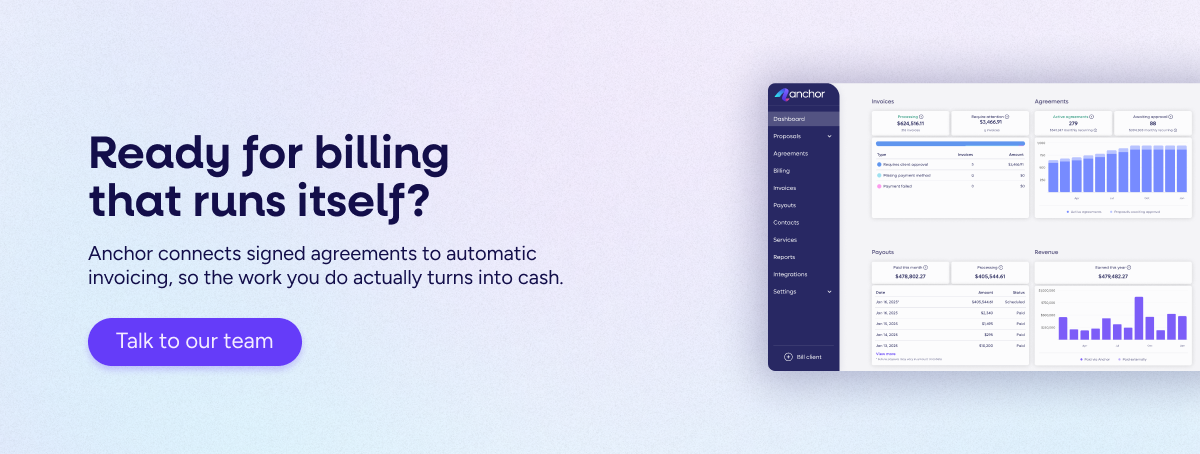
This is where Anchor fits naturally. Anchor runs the proposal-to-paid pipeline across agreement, billing, payments, and reconciliation. But that system works best when the firm is onboarding clients who can operate inside a defined model. A tighter ideal client profile creates the consistency that lets the workflow run cleanly.
You don’t need more leads. You need fewer exceptions.
If the firm feels like it’s constantly rebuilding the process, you’re not imagining it. Too much of the client base requires special handling after the sale.
The way out starts with clarity about who the firm is built to serve, which clients create friction, and where your process is being bent to accommodate the wrong fit.
Start here:
- Define your ideal client profile more narrowly.
- Document the traits that create exceptions.
- Filter earlier with a gatekeeper intake process.
- Standardize delivery so your systems can do their job.
That’s how you build a firm with healthier margins, cleaner operations, and more room to grow without the business getting heavier every time it expands.
Download the Ideal Client Profile Template and start pre-qualifying leads with clearer fit criteria.
FAQs
What is an ideal client profile?
An ideal client profile is a clear definition of the clients your firm serves best, based on traits that predict smoother delivery, healthier margins, and less operational friction.
How do I evaluate client fit before onboarding?
Use a gatekeeper system before discovery calls. Intake forms, criteria-based screening, and required pre-call steps make it easier to assess fit before a prospect reaches your calendar.
Why do vague ICPs hurt profitability?
Because they create more variation in onboarding, communication, delivery, and billing. That variation increases rework, administrative back-and-forth, and owner involvement, which reduces effective margin.
Is scope creep always a contract problem?
Not always. Strong engagement letters help, but repeated scope pressure often reflects a fit problem earlier in the relationship. Clients who resist process and boundaries usually create more scope friction over time.