


A client churns, and your firm immediately starts telling itself a story.
“They were price shopping.”
“They were disorganized.”
“They never really valued what we do.”
Sometimes that’s true. Most of the time, it’s incomplete.
Clients rarely leave because of one big blow-up. They leave because the relationship slowly racks up small “promise breaks.” Not returning a message when you said you would. Billing that feels confusing. Scope that changes without a clear “yes” from them. Long stretches where they don’t know what’s happening.
Think of it like a promise ledger. Every good experience is a deposit. Every surprise or silence is a withdrawal. When withdrawals pile up, the client stops trusting the system. And once trust is gone, the exit is only a matter of time.
Key takeaways
- Churn is a system problem: If the same breakdowns keep happening, it’s because the process isn’t designed to hold up under heavy load.
- The “silent exit” starts early: Clients usually decide to leave months before they actually say it out loud.
- Most churn comes from the work-to-cash chain: weak agreements, unclear scope, and messy billing create the most friction for clients.
- Track why people leave, then fix that first: A simple exit log turns churn into something you can actually reduce.
Why churn hurts more than revenue
When a client leaves, the obvious hit is revenue. But the real damage is what happens around it, before and after.
First, replacing a client costs more than most firms want to admit. You spend time selling, scoping, onboarding, and cleaning up the early-stage mess that comes with any new relationship. Even when the new client is a good fit, there’s always a ramp-up period where your team works harder for the same dollars.
Second, churn wipes out institutional knowledge. With an existing client, you know their patterns. You know their preferences. You know which things they forget, and how to get what you need without a ten-email chain. When they leave, all that shorthand disappears. The next client is a reset to zero.
Third, churn often creates a “final invoice problem.” The client who’s on the way out is the least motivated to address loose ends, including paying the last bill promptly. That can turn into write-downs, awkward follow-ups, and more admin work for your team.
And here’s the part that sneaks up on you: churn creates pressure. When you lose clients, you tend to sell from a place of urgency. You take on work that isn’t a great fit just to plug the gap. That decision often leads to more churn later, which creates even more pressure. It’s a loop, and it’s exhausting.
The trust ledger model
Most firms think churn is about satisfaction. It’s not. It’s about trust.
Trust is built when a client feels like your firm has a system. They know what they’re paying for. They know what happens next. They know you’ll do what you said you’d do, when you said you’d do it.
A one-off mistake usually doesn’t break trust. People understand that humans miss things. The problem is when friction becomes normal. When the client has to follow up constantly. When every invoice feels like a question mark. When scope changes feel random. When the client starts thinking, “If I’m managing this relationship, why am I paying for it?”
That’s the ledger going negative.
To fix churn, you can’t just tell a better story about why people leave. You need a way to record what actually happened, especially the boring stuff that repeats. That’s where a “black box” mindset helps. Not to blame anyone, but to see the pattern clearly enough to change the system.
Because if you don’t log the real reasons, you’ll keep solving the wrong problem. You’ll spend energy on “better marketing” when the real issue is billing surprises. Or you’ll chase “higher-quality leads” when the real issue is scope control.
The top 5 reasons clients churn (and how to fix them)
Most churn isn’t random. It comes from the same few breakdowns that make clients feel surprised, ignored, or unsure what they’re paying for. The good news is these problems are fixable once you treat them like system issues, not personality flaws.
1. Billing surprises
This is the fastest way to create distrust.
It usually looks small at first. A line item the client wasn’t expecting. Time billed for a “quick call.” A fee they thought was included. Even if the amount isn’t huge, the feeling is. The client starts wondering what else might show up later.
Billing surprises don’t land like a financial issue. They land like a fairness issue. And fairness is personal. If they feel like they have to police your invoices, they’re already halfway out the door.
The fix is simple, but it takes discipline: tie billing to something clear. Every dollar should connect to a defined trigger, milestone, or agreement. When scope changes, don’t let it drift into the invoice. Make the change visible before the work happens.
That’s the whole point of agreement-first billing. The client should never be learning new terms from a PDF invoice.
2. Chronic ambiguity (scope drift)
Scope drift isn’t one big mistake. It’s a hundred tiny “sure, we can do that” moments that never get written down.
Over time, the client assumes more is included. Your team assumes the client understands it’s extra. Nobody says the uncomfortable thing early, so it gets saved for later. Then later shows up as either a surprise bill or a sudden boundary, and the client feels blindsided.
This is where firms get stuck. If you bill for the extra work, the client feels nickel-and-dimed. If you don’t bill for it, your team feels resentful, and margins shrink. Either way, the relationship takes a hit.
The fix is to make scope control normal, not dramatic. Define what’s included and what’s not in plain language. Then set a rule your team can actually follow: no new work without a written change.
That doesn’t have to mean a 12-page document every time. It can be a quick amendment that says, “Here’s what changed, here’s the cost, here’s when it starts.” Fast enough for your team to use. Clear enough that the client doesn’t feel tricked.
3. The “black hole” experience
Clients can handle bad news. What they can’t handle is silence.
This churn reason usually shows up as a rhythm problem. The client sends what you asked for, then hears nothing for two weeks. Then you reappear with urgency and a tight deadline. From the client’s view, it feels like chaos. And it makes them anxious.
Anxious clients shop. Not always because they want to leave, but because they’re trying to reduce uncertainty. If they don’t know what’s happening, they assume the worst.
The fix is an operating cadence your clients can feel. Acknowledge requests quickly. Set expectations for when they’ll hear from you next. Close loops. If something will take a week, say that. If you’re waiting on something, say that too.
You don’t need more meetings. You need fewer open tabs in the client’s head.
4. Payment friction
This is where the relationship gets tense, fast.
Manual billing creates manual payment problems. Invoices go out late. Payments come in late. Someone has to follow up. That follow-up feels awkward. And over time, “money conversations” start coloring everything else in the relationship.
Even if your service is great, constant payment friction changes the vibe. It makes the client feel like the relationship is transactional and stressful. It also puts your team in a role they didn’t sign up for.
The fix is to remove friction before it starts. Get clear on payment terms upfront. Make billing predictable. Make payment methods part of onboarding. Build a system where “getting paid” is the default outcome, not a monthly project.
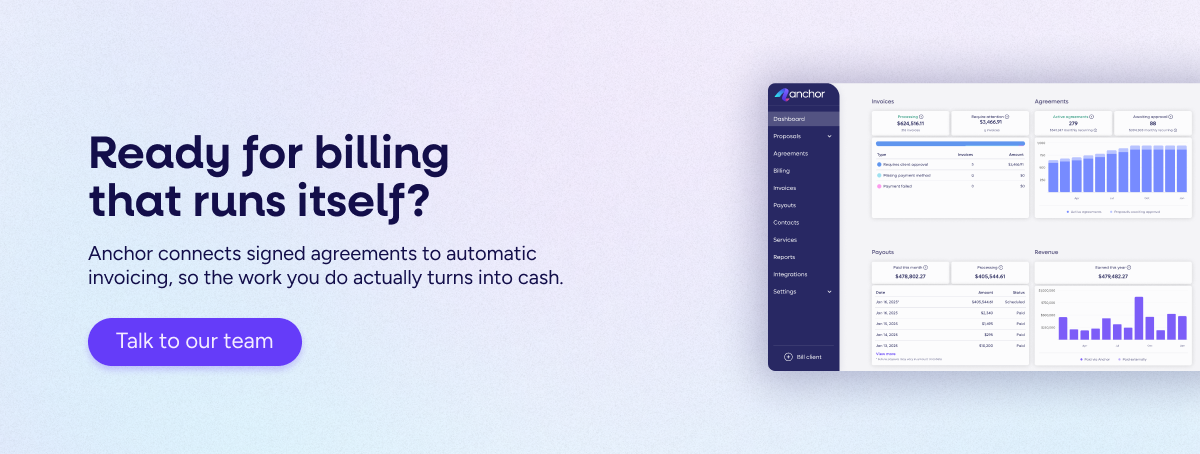
This is also where Anchor can be game changer. It automates the steps between doing the work and getting paid by connecting agreements, billing schedules, invoicing, payments, and reconciliation in one flow. That reduces the number of moments where a client can get confused, delay, or turn payment into a negotiation.
5. Invisible value
Sometimes clients leave even when you’re doing solid work.
Not because the work isn’t good, but because they can’t see it. The only visible touchpoint becomes the invoice. And when that’s the main thing they notice, your service starts to feel like a cost instead of a partnership.
This gets worse during tight months. If a client is looking to cut expenses, they’ll cut the things that don’t feel clearly tied to outcomes. If value is invisible, you’re vulnerable.
The fix is to make your value easy to recognize. You don’t need glossy reports. You need simple, regular proof that connects back to what they hired you for.
That can be a monthly note with what got done, what risks you avoided, what decisions you helped with, and what’s next. Clients want to feel progress. When they feel progress, they stay.
The churn exit log: turning data into fixes
If you want churn to go down, you need to stop guessing.
Start a simple exit log. Every time a client leaves, the account lead selects a reason code and writes a single sentence explaining what actually happened. Not the polite reason the client said on the way out, but the operational trigger that broke trust.
Keep the reason codes tight. Eight to ten is plenty. Examples include: billing surprise, scope drift, missed deadlines, poor responsiveness, payment friction, unclear outcomes.
Then review the log quarterly. You’re not looking for drama. You’re looking for repeats.
If most churn is coming from billing surprises, the solution isn’t “better client communication.” It’s clearer agreements and cleaner billing triggers. If churn is coming from the black hole experience, the solution isn’t “more hustle.” It’s a reliable cadence and better follow-through systems.
The exit log turns churn into something you can intentionally improve.
Stop client churn with a better operating model
Healthy client relationships aren’t built on good intentions. They’re built on a system that holds up when your team is busy.
Here’s the chain that keeps the promise ledger positive:
Clear agreements → defined triggers → automatic invoicing → seamless payments → visibility for the firm and the client.
When that chain is strong, you spend less time explaining, defending, or chasing down details. Clients feel steady, and steady clients don’t churn.
If you’re trying to grow without adding chaos, this is one of the highest-leverage places to start. Not with a new pitch deck. Not with more leads. With fewer broken promises.
Want help tightening your work-to-cash chain so churn drops and cash flow gets predictable? Book a quick call with one of our advisors, and we’ll help you map the process and find the first weak link.
Or, if you’d rather start small, build an exit log this week and review it at the end of the quarter. The patterns will show up faster than you think.