


A lot of firms treat renewals like administrative maintenance.
The work is ongoing. The client is still active. Nothing appears broken. So the engagement rolls forward, the price stays mostly the same, and the team moves on.
That feels efficient until you look at what actually gets carried forward with that quiet renewal.
Old scope. Old assumptions. Old payment terms. Old pricing. Old exceptions no one meant to preserve. What looks like a stable client relationship is often just a backlog of unreviewed decisions.
This is where revenue discipline either holds or breaks.
In this article, we’ll look at why renewals matter more than firms think, what usually gets missed, and how a better renewal system protects margin, cash flow, and client clarity.
Key takeaways
- Passive renewals preserve old problems: When firms let engagements roll forward untouched, they often carry underpriced scope, weak terms, and unnecessary exceptions into another cycle.
- Margin erosion starts quietly: Most renewal-related profit loss doesn’t come from one bad decision, but from small changes that keep compounding without a structured review.
- Renewal should review more than retention: The right process checks scope, pricing, payment setup, and relationship quality before another service period begins.
- Agreement-first systems make renewals usable: When renewals connect directly to billing and payment execution, the firm can turn decisions into action without manual cleanup.
Why passive renewals create expensive problems
Renewals rarely fail all at once.
They fail by carrying yesterday’s logic into today’s delivery model.
A client who started at one level of complexity is now asking for more. A service that used to be profitable now takes more team time. A once-reasonable fee is now badly out of step with the work. Payment terms that were tolerated during onboarding have quietly become the default.
None of that looks dramatic in isolation.
But when firms let engagements renew without a structured review, they lock those decisions in for another cycle.
That’s how underpriced work survives. That’s how scope drift becomes normal. That’s how partner frustration shows up months later as, “We’re doing too much for this client,” when the real problem was that the renewal moment passed without a reset.
Renewals are not just a client-retention event.
They are a revenue-control event.
The firm usually notices margin erosion too late
Most firms don’t wake up one day and decide to undercharge.
It happens gradually.
A few extra deliverables get absorbed. Response expectations tighten. Reporting becomes more complex. More stakeholders get involved. A service that once ran clean now depends on more exceptions, more context, and more senior oversight.
By the time the pain is obvious, the underlying process failure has usually been in motion for months.
The renewal window matters because it gives you a natural point to pause and ask better questions:
- Is this still the right scope?
- Is this still the right price?
- Is this still the right billing structure?
- Is this still the right client relationship to keep in its current form?
Without that pause, firms tend to keep selling continuity while absorbing change.
That’s where revenue leakage gets its foothold.
What a real renewal review should cover
A useful renewal process does more than ask whether the client wants to continue.
It checks whether the current agreement still reflects reality.
That means reviewing four things.
1. Scope drift
Has the work expanded since the last agreement?
Have new asks become standard?
Is the team doing recurring work that never made it back into the engagement?
If the work changes, the agreement needs to change with it.
2. Pricing fit
Does the current fee still make sense for the actual delivery burden?
Did complexity rise?
Did turnaround expectations tighten?
Is the firm carrying more advisory weight than before?
Renewal is the cleanest time to reprice because the client expects a formal conversation.
3. Payment terms and execution
Is the billing cadence still right?
Is the payment method still current?
Are there unnecessary delays between agreement, invoice, and collection?
This is where many firms preserve avoidable friction just because no one revisits the setup.
4. Relationship quality
Is this a healthy client to continue serving?
Do they respect timelines, process, and boundaries?
Does the work fit how your firm wants to operate?
A renewal shouldn’t just preserve revenue. It should improve revenue quality.
Why interactive agreements change the renewal conversation
The hardest part of renewals is operational follow-through.
In a manual workflow, renewal changes often live across documents, email threads, spreadsheets, invoicing tools, and someone’s memory. Even when a firm decides to update pricing or scope, the execution can get messy fast.
That’s where the model matters.
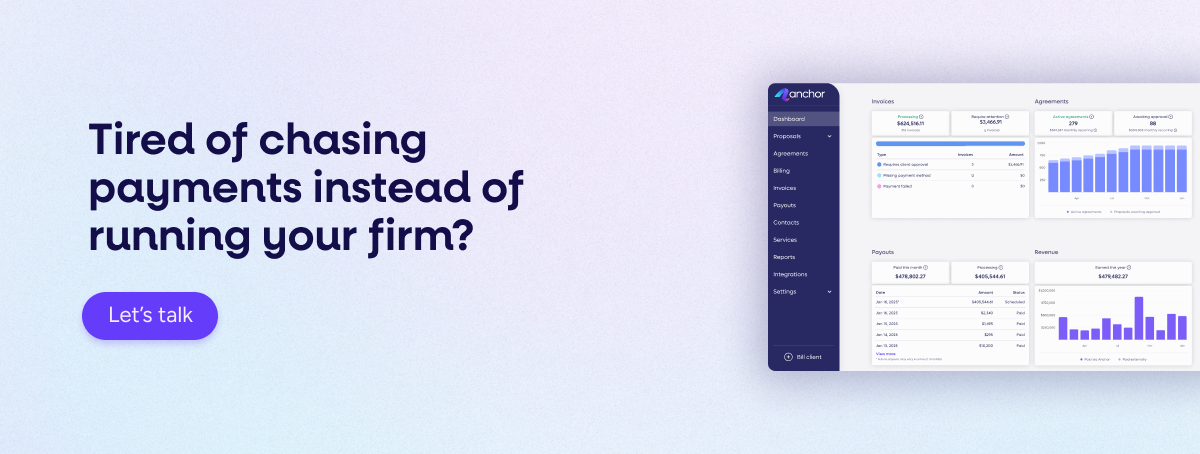
Anchor starts at the agreement, not the invoice. The signed agreement becomes The Brain for everything downstream. When scope changes, renewals, or price increases happen, they don’t need to sit outside the system as one-off administrative work. They can be reflected in the same governed financial relationship that runs billing, payments, and reconciliation.
That changes the renewal conversation from, “Did we send the right notice?” to, “Does the operating reality now match what the agreement will execute?”
That’s a much stronger place to run the business from.
A better renewal process is a control system, not a courtesy
Some firms still treat renewals like a polite client touchpoint.
They are that, but they’re more than that.
A renewal process is one of the few recurring moments when you can restore alignment before another cycle begins. It lets you reset expectations, update value, confirm fit, and remove old friction before it compounds again.
Done well, renewals protect more than revenue.
They protect delivery quality. Team capacity. Client clarity. Cash flow predictability. And the firm’s ability to grow without carrying a larger pile of unexamined exceptions every year.
That’s why renewal discipline matters.
It’s not administrative neatness.
It’s operational self-respect.
Treat renewals as your point of control
If your firm treats renewals as paperwork, you’ll keep extending problems you should be solving.
If you treat renewals as a control point, you get a natural chance to tighten scope, correct pricing, improve payment execution, and raise the quality of the revenue you keep.
That’s the difference between revenue that merely repeats and revenue that stays healthy.
If your renewal process still depends on scattered documents and follow-up work, see how Anchor turns agreements into a system that governs billing, payments, changes, and renewals from one source of truth.
Or, book a call with one of our team members, and we’ll walk you through it.