


Eliminating AR feels good for a simple reason: billing stops relying on manual handoffs. Cash flow gets steadier. Billing gets calmer, and your team stops treating invoices like a negotiation.
But chasing more work, hunting for “perfect clients,” or insisting on “tougher follow-up” is performance thinking, and it’s not how you get there. Performance matters, but it only works once your workflow is built to handle change. Otherwise, you’re asking people to compensate for a system that can’t keep agreements, billing, and payments aligned when scope shifts.
AR elimination comes from designing for change: building a system that stays true as the work shifts. It means a proposal-to-payment workflow where invoices go out on schedule, changes are captured automatically, and payments follow the agreement with minimal manual intervention.
This article shows where AR is created upstream, why pushing harder often creates more friction, and what a change-ready workflow looks like in practice, with executable agreements, automated invoicing, and payments built in from the start.
Key Takeaways
- AR elimination is a design problem: Reduce AR by removing the gaps between agreement, billing, and payment, not by asking people to “stay on top of it.”
- AR often begins as untracked change: When scope or timing shifts but the workflow does not update, invoices become debatable and payments slow.
- Performance fixes can become performance theater: More speed and more monitoring look productive, but they create rework when the system cannot reflect what changed.
- Designing for change reduces emotional load: When acceptance triggers billing and payment expectations, and changes follow a clear amendment path, billing becomes predictable rather than personal.
AR Isn’t “Money Owed,” It’s Unresolved Change
AR rarely shows up as one big problem. More often, it shows up as a cascade of small shifts that nobody has time to formalize.
A client adds a “quick” request on a call. A deadline moves. A deliverable changes shape. Someone says yes to keep things moving. Everyone is being reasonable. The work gets done.
Then you get to billing, and the mood changes.
Not because billing is hard (in theory), but because the agreement and the work are no longer the same thing. The system is still pointing to the original plan, while the engagement has quietly evolved across three side conversations and two hallway decisions.
That is where AR is created. It piles up when scope, timing, or expectations change, but the agreement and billing workflow stay frozen. The exhaustion isn’t sending an invoice. It’s the mental effort of reconstructing what is true after the fact, often with partial context and competing memories.
You end up running the same questions every time: What did we agree to? What changed? Who approved it? What are we actually billing for?
If AR feels emotionally heavy, you’re not being dramatic. Your system is asking you to carry too much context, right when you want billing to be automatic and straightforward.
The Performance Trap That Quietly Creates More AR
Most firms respond to AR the same way they respond to any operational pain: they push harder.
They try to move faster. Tighten internal checklists. Add more monitoring. Encourage the team to “just get it out.”
This can create a brief sense of control. You see activity, responsiveness, and urgency. Sometimes you even see AR dip for a month. Then scope shifts again, and the same pattern returns, usually with more frustration.
Here’s why: speed doesn’t help if the system can’t update cleanly. It just moves confusion downstream faster. When the work evolves, but the agreement and billing terms don’t, firms begin improvising to keep invoices defensible. Managers stitch together what changed. Senior staff rewrite invoice language to make it feel less surprising. Owners get pulled in to approve exceptions and decide what’s “fair.”
Instead of removing the cause of AR, performance fixes increase the coordination required to bill with confidence. That coordination is expensive, and it lands on the people you can least afford to distract.
Design for Evolution, Not Performance
So, how do firms avoid the performance trap without neglecting performance?
By designing for change first, and then improving execution. Performance helps when the workflow is stable. When the workflow can’t absorb scope shifts, performance turns into faster rework and more internal debate about what’s billable.
A useful frame comes from this Harvard Business Review piece on building organizations for “constant evolution.” The point worth borrowing is simple: systems should be able to sense, learn, and respond as conditions change.
For firms, that means billing shouldn’t require a special meeting every time the work shifts. Change needs a defined path that updates what’s approved, updates what gets billed, and keeps payment expectations intact.
When change has nowhere official to go, it leaks into side conversations. Then, billing slows down as teams try to translate scattered decisions into a clean invoice. That translation is where AR grows.
When change is captured inside the workflow, billing stays predictable. Invoices go out when they should. Clients see charges that match what they approved. Payment follows the agreement more consistently, and invoices don’t feel surprising.
Where AR is Born: The Three-Week Gap Nobody Sees
Most AR is created long before an invoice is overdue. It’s made in the quiet gap between “the client said yes” and “the system consistently bills and collects the way we intended.” That gap tends to show up in three places.
First, billing starts late, not on purpose. It happens because the start date isn’t operationalized. It lives in someone’s head, or it depends on a kickoff that slips, or it gets delayed because the team wants to avoid a conversation. Every delayed start is a cash flow decision made by accident.
Second, changes are approved in side channels. The work evolves, but the terms don’t. So billing becomes a reconstruction exercise: someone has to decide what counts, what’s fair, and what language will make it “go down easier.” That’s when invoices stop feeling inevitable and start feeling negotiable.
Third, payment expectations aren’t part of the agreement. If payment setup occurs after delivery, you’re relying on timing, attention to detail, and goodwill. Even good clients pay more slowly when the process is unclear or inconsistent.
AR elimination is mostly about closing these gaps. Not with more checks and micromanagement, but with a workflow that makes billing start dates explicit, makes change updates structured, and makes payment the natural next step of an approved agreement.
What “Built for AR Elimination” Feels Like Day to Day
When you close these gaps, the most significant shift isn’t financial. It’s emotional.
Billing stops feeling like a judgment call. Your team stops debating what’s fair, rewriting invoice language to preempt questions, or waiting for an owner to bless an exception. Invoices go out on schedule because the start is defined. When scope changes, it gets captured in the same place the agreement lives, so billing stays aligned with what’s currently approved.
Clients feel the difference, too. Charges match what they saw and accepted. Fewer invoices come as a surprise. Payment moves more consistently because the process is transparent and predictable.
Once you’ve designed for change this way, the question becomes practical: what mechanisms keep it running without manual handoffs?
Built for Change: How Anchor Supports AR Elimination
AR elimination doesn’t come from trying harder. It comes from removing the fragile steps between agreement, billing, and payment, especially when scope changes.
Anchor supports that by connecting the proposal-to-payment workflow so the system carries the engagement forward without relying on manual handoffs.
It starts at acceptance. Anchor’s interactive proposals and engagement letters are designed to capture scope, billing cadence, and payment expectations in a format clients can approve quickly.
That matters because speed isn’t the goal. Clarity is. When acceptance is clear and executable, billing stops waiting on interpretation.
From there, invoicing is automated based on the signed terms and billing schedule. That reduces missed billing starts and the re-entry mistakes that create delays, disputes, and “let’s fix it on the next invoice” cleanups.
Payment is built into the lifecycle by collecting payment authorization at proposal acceptance. When payment expectations are established up front, fewer invoices become exceptions later. The result is less back-and-forth because the system already knows what should happen next.
When the work changes, Anchor supports one-click amendments, so scope and pricing updates can be approved in a structured way and reflected in billing. That’s the core of designing for change: updates don’t live in side channels, and billing stays aligned with what’s currently approved.
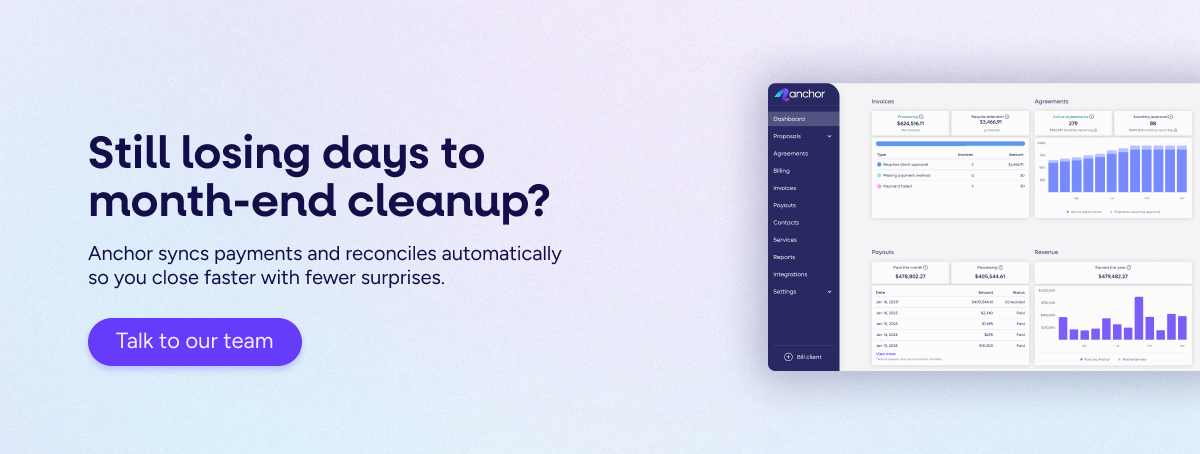
Finally, integrations and reconciliation help reduce cleanup. Anchor connects with tools firms already use, including QuickBooks and Xero, syncing payments and simplifying reconciliation. Dashboards provide visibility into outstanding payments and forecasts so owners do not have to “check on everything” to feel confident.
If change is where your AR starts, AR elimination requires a workflow in which change updates the agreement and billing continues automatically.
A Practical Path to AR Elimination for Growing Firms
This is the doable part. You don’t need a big overhaul to make progress on AR elimination. You need a few standards that remove ambiguity and keep billing moving even when the work changes.
Here’s your step-by-step guide to eliminating AR for your firm:
Step 1: Make acceptance the true starting line
Before work begins, make sure the agreement answers four questions in plain terms: what’s included, when billing starts, how billing repeats (if it does), and what the client should expect for payment. Most firms have the “what.” AR shows up when the “when” and “what happens if it changes” are fuzzy.
A practical standard is: if a new team member joined tomorrow, they should be able to tell when billing starts and what triggers the first invoice without asking you or digging through email. If they can’t, the agreement isn’t operational yet.
Close this step by assigning ownership for the transition from signed to live. Not “the team.” One role. One person. That single choice prevents a surprising amount of delayed billing.
Step 2: Standardize how change is approved and recorded
Scope changes are normal. The problem is how casually they get captured. If changes can be approved in side channels, they will be. Then, billing becomes a reconstruction exercise later on, which is when invoices start to feel negotiable.
Define a simple rule your whole firm can follow: changes that affect scope, timeline, or price must update the agreement through a consistent amendment path. This doesn’t need to be heavy. It just needs to be official. You’re not trying to create paperwork. You’re preventing “ghost scope,” where the work is real but the terms are not.
Step 3: Tie invoicing and payment behavior to the agreement
AR drops fastest when invoicing is triggered by terms, not memory. If someone has to remember to start billing, confirm a date, re-key amounts, or rebuild invoice descriptions from context, you’re inviting delays and inconsistencies. Those inconsistencies create client questions, which slow payment.
Aim for two outcomes here: invoices go out when the agreement says they should, and payment expectations aren’t introduced as a surprise after delivery. When payment authorization and timing are part of acceptance, you remove much of the friction that firms mistakenly treat as inevitable.
Step 4: Use visibility to prevent drift
Most AR becomes hard only after it’s old. The earlier you see misalignment, the less emotional the fix needs to be.
Visibility means you can spot patterns like: billing that never started, work expanding without an updated agreement, or engagements that are being “held” because the invoice language isn’t settled. This is where forecasting and outstanding payment visibility actually matter. Not for dashboards. For early correction. You can’t fix what you only see after month-end.
If you want fewer awkward money conversations, design fewer surprises.

Self-Audit: Are You Set Up for AR Elimination, or Just Managing Around It?
A firm can look efficient until the first real scope shift. This quick audit will help you understand if and where issues are being created upstream.
Here are the signals that your workflow is manufacturing AR:
- Billing starts “when someone gets to it,” not on a defined trigger.
- Scope changes are approved conversationally, then billed later by interpretation.
- Invoices get delayed because the team is trying to wordsmith away client questions.
- Payment expectations are clarified after delivery, not before work begins.
- Month-end reconciliation includes surprises that should have been visible earlier.
If you recognize two or more of these, don’t default to more monitoring. That will increase pressure without fixing the root cause. Instead, try this simple rule: if you can’t point to the current, approved version of the work and confidently say, “this is what billing will follow,” AR will keep returning.
The next “push for efficiency” won’t fix this. A workflow designed for change will.
FAQs
What is AR elimination for an accounting or bookkeeping firm?
AR elimination reduces or removes outstanding invoices by designing workflows so that billing and payment follow the agreement automatically, including when scope changes.
Why does scope creep turn into late payments?
When scope changes aren’t captured in the agreement, invoices feel surprising or debatable. That slows approval and payment.
What does “design for change, not performance” mean?
It means optimizing for alignment over speed. A change-ready system keeps agreements, billing, and payments synced as work evolves.
Where should proposal management connect to AR elimination?
Proposal management shouldn’t end at the signature. It should trigger the billing cadence, payment setup, and a clear amendment path to keep terms current.
How does Anchor reduce AR without adding admin work?
By connecting proposals, engagement letters, invoicing, payments, amendments, integrations, and dashboards into a single flow, the system carries the lifecycle forward.
Book a free 15-minute call with an Anchor advisor to map your proposal-to-payment workflow and pinpoint where change becomes AR.