


If you run a service firm, you’ve seen this play out before: a client asks for a “quick favor,” someone on your team handles it, and then it never shows up on an invoice. Or you raise rates, a client agrees, and the next invoice still goes out at the old price because the update got lost in the handoffs.
These are classic examples of revenue leakage: the quiet drip of earned money that never gets billed. It happens for many reasons, but it’s most often the result of manual billing steps that rely on memory, emails, and someone being in the right place at the right time.
While it may not be an obvious choice, Mel Robbins’ The Let Them Theory offers surprisingly helpful guidance here. The best-selling book on mindset and boundaries provides a simple way to stop managing client reactions in the moment, so you don’t make exceptions you’ll regret later.
Let them ask. Let them negotiate. Let them react. Then follow your process. If it’s tight enough, you won’t have to rely on willpower to protect your margins. Ready to operationalize this? Read on to see how a simple mindset shift can help you hold the line on pricing, scope, and terms.
Key takeaways
- Revenue leakage is earned money that never gets billed: It’s usually a pile of small misses caused by manual handoffs, not one big mistake.
- “Let Them” is a mindset shift, not a billing strategy: It helps you stop making exceptions under pressure so you can route requests through clear terms.
- Your engagement letter should function like an operating manual: When scope, rates, and changes are defined up front, billing becomes more consistent and less personal.
- The cleanest fix is removing manual dependencies: Connecting agreement terms to invoicing, payments, and reconciliation is how you plug leaks for good.
Drip, drip, drip: What is revenue leakage, in plain English?
In simple terms, revenue leakage is earned revenue that never appears on an invoice or in your bank account.
It’s hard to spot because it’s rarely one giant mistake. Instead, revenue leakage often manifests as a series of small misses that accumulate over time.
In service businesses, margins are often tight. If a typical business runs on 10 to 15% margins, losing 1 to 5%of top-line revenue to leakage isn’t a rounding error. It can be the difference between a decent year and a great year. It can also be the difference between feeling stable and feeling like you’re always behind.
A simple example shows why it matters. Imagine a business doing $1M in revenue. If 5% leaks, that’s $50K that never gets billed or collected. If you can plug that leak without cutting staff or working more hours, your profit jumps fast because you’re keeping money you already earned.
That’s why revenue leakage is so frustrating. You’re not asking for a miracle. You’re trying to get paid for the work you already did.
Why leaks happen when billing is manual
Most revenue leakage stories sound personal. Someone forgot. Someone didn’t update the rate. Someone didn’t know a task was billable. Someone didn’t catch a failed payment.
But there’s a common thread: the billing cycle has manual dependencies built into it.
Manual billing is any process in which a person must push each step forward. You create the proposal or engagement letter. You send it. You wait for a signature. You build the invoice. You check the line items. You email it. You track who paid. You follow up when someone doesn’t. When payment arrives, you record it and reconcile it.
That’s a lot of handoffs. And every handoff is a chance for an error.
A patchwork approach makes it worse. Proposals in a doc, tracking in a spreadsheet, conversations in email, invoices in accounting software, and none of it is truly connected. When tools don’t talk to each other, your team becomes the integration. That’s not a knock on your team. It’s just a risky design.
If your process relies on perfect memory and perfect follow-through, leaks are going to happen. Not because people are careless, but because they’re human.
The places revenue quietly disappears
Most leaks show up in the same handful of moments. The details change from firm to firm, but the pattern stays the same.
Unbilled scope creep
One common scenario is unbilled scope creep. A client asks for a small add-on. The work gets done quickly, often by someone trying to be helpful. Then no one posts the time, or it never gets flagged as billable, or it’s assumed that someone else handled it. But when invoice time comes around, it’s gone.
Rate increases
Another source of leaks is rate increases that never make it into the system. You have the conversation, you justify the value, and the client agrees. Then the new rate lives in someone’s inbox or in someone’s head. If the contract or engagement letter isn’t updated right away, the next invoice will be issued at the old rate. You might notice later, but by then it feels awkward to bring up, so you let it slide.
Urgent requests
Urgent requests are another classic. You work late, or you jump in outside normal hours, and the contract says there’s an urgency rate. But because the billing process is manual, the invoice gets built from memory or from a template. The urgency rate never gets added. When someone catches it later, it can feel petty to bring it up. So it stays unbilled.
On top of these (and other) leak-causing scenarios, there are also payment failures that slip through. A card expires, a charge fails, a bank transfer doesn’t go through, and the revenue quietly stalls. If you’re handling everything by hand, it’s easy to miss until weeks later. That can turn a stable, recurring relationship into a turbulent one..
None of these are “bad client” problems. They’re workflow gaps. The leak is built into the process.
Where “Let Them” fits, and where it doesn’t
Mel Robbins’ The Let Them Theory is basically permission to stop over-functioning. You don’t have to manage other people’s emotions and behavior. You can let them be disappointed. Let them negotiate. Let them try to change the plan midstream.
Here are some of the key takeaways, as framed in the book:
- You can’t control other people: The moment you stop trying, you get your time and energy back.
- “Let them” isn’t passive: It helps you unhook from emotion so you can handle the situation effectively.
- It’s not about letting people walk all over you: It’s about holding your boundary and letting them have their feelings about it.
- The real shift is “Let them… and let me”: Let them do what they’re going to do, and let you do what you need to do next.
- Focus on what’s yours to own: Your choices, your standards, and the systems you use to protect them.
That mindset matters because it keeps you from making exceptions you’ll regret later.
But Let Them isn’t a billing system. It won’t update your engagement letter. It won’t connect your agreement terms to your invoices. And it won’t catch an unbilled add-on or a missed rate change.
The best way to use Let Them in a service business is as a gatekeeper. It can help you keep your footing in the moment. Then your process takes over.
That’s why “Let them… then bill them” works as a practical framework. You’re calm and professional when requests come in. You don’t argue. You don’t cave to pressure. You route the request through the rules you already set.
When your rules are clear, and your workflow is connected, you don’t have to be a different person to protect your margins. You just have to follow the process.
The “Let Them” moments that should run on rails
Discount requests, scope changes, and billing timing are the moments where people tend to improvise. Improvisation is where leaks are born.
Discount pressure → conditional discounts
Discount pressure is a good example. A client asks for a lower price. You might feel the urge to smooth things over, especially if you like the client or don’t want to create tension. Let them ask. That’s fine. Then bring it back to structure.
This is where conditional discounts help. A discount can exist, but it shouldn’t be a random haircut because a client asked loudly. It should be tied to something that reduces risk or workload. Maybe the client commits to a longer term, prepays, or chooses a smaller scope. You can stay respectful and still protect your pricing integrity because the trade is clear.
Price objections → value selling
Value selling belongs here, too, not as a speech, but as a simple reminder of what the client is buying. They’re not paying for keystrokes. They’re paying for an outcome and for fewer headaches. When you can explain the scope clearly, discounts get less emotional and more practical. The client can choose what they want to pay for.
Budget shoppers → tier pricing
Tier pricing does the same job in a different way. Some clients truly don’t need your highest-touch option. That’s fine. The problem is that “cheaper” becomes “same scope, lower price.” Tier pricing lets the client pick a level without turning your work into a negotiation every time. You’re not defending your price. You’re offering choices that map to scope and access.
Scope changes → one-click amendments
Scope creep is where contract management becomes a lifesaver. When a client says, “Can you just add this?” you don’t need a long explanation. Let them ask. Then route it through the engagement letter. If it’s outside the scope, it becomes an amendment. The important part is that the scope change updates the terms and the billing, not just the conversation.
Collections stress → automatic payments
Payment timing works the same way. Clients will sometimes ask to delay payment. Let them have the ask. But your billing schedule shouldn’t turn into a monthly debate. When payment and invoicing are tied to agreed terms, the process is neutral. It’s not you being strict. It’s you doing what both sides agreed to.
If your team has to remember these rules each time, you’ll continue to leak revenue. If the rules are baked into your workflow, you’ll get consistency without extra stress.
Your engagement letter is your anti-leak playbook
Most firms view their engagement letter primarily as a legal document. It is, but it’s also an operational document. It’s the place where you remove ambiguity, so the billing cycle doesn’t depend on memory.
A strong engagement letter doesn’t try to predict every weird edge case. It just makes the basics clear enough that the system can follow them.
It names what’s included and what isn’t. It defines how scope changes are handled so you’re not renegotiating in email threads. It sets the billing schedule so nobody is surprised. It explains how rate changes work and when they go into effect, so “we agreed to the new rate” doesn’t get lost.
If you offer a discount, it states the condition that makes that discount real, like prepaying or committing to a longer term. It also makes clear how amendments happen and how they affect billing.
When those things are vague, you end up relying on social skills to keep revenue intact. Social skills are useful, but they’re not a substitute for clear terms.
This is also where client relationship health improves. Clear terms prevent resentment. Clients don’t feel like you’re changing the rules midstream because the rules were written down from day one.
Connect the dots from proposal to payment to reconciliation
If revenue leakage comes from human error and manual handoffs, the fix is simple in concept: remove as many handoffs as you can.
What you want is a connected lifecycle. The proposal or engagement letter should drive the billing schedule. The billing schedule should drive invoicing. Invoicing should drive payment. Payment should appear in your books without anyone re-keying it.
When those steps live in different tools, your team has to stitch them together repeatedly. That’s where things slip:
- Someone updates the contract but forgets the invoice template.
- Someone agrees to a new rate but doesn’t tell the admin.
- Someone does extra work but doesn’t flag it.
- Someone assumes a payment went through, but it didn’t.
A modern billing system reduces those failure points by making the agreement the source of truth. When terms change, the billing changes with it. When invoices go out, they match what was signed. When payments happen, they sync back into your accounting process.
This is the heart of contract management, in a practical sense. It’s not just storing a PDF in a folder. It’s keeping your terms current and connected to what you bill.
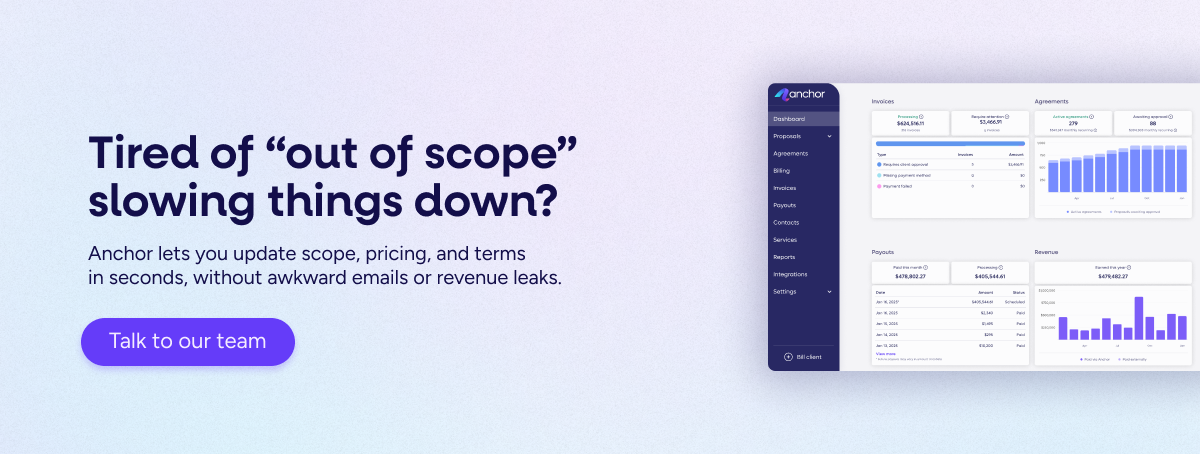
Anchor was built around that idea. It’s an autonomous billing and collections platform that connects the flow from proposal to signed agreement to invoicing to payment and reconciliation in one connected system.
For firms, that means fewer manual steps between doing the work and getting paid. It also means fewer quiet leaks caused by forgotten updates, missed scope, and slow handoffs. In fact, firms that switch to Anchor have reduced revenue leakage from 5% to 1%.
If you’re already using tools like QuickBooks or Xero, or practice tools like Karbon, Keeper, Client Hub, Financial Cents, or monday.com, the point is to keep your financial workflow from becoming another spreadsheet project.
This is also where the day-to-day relief shows up. When the system runs the rules, you’re not carrying the whole billing cycle in your head. You don’t have to rely on “I’ll remember later.” Later is when revenue disappears.
You don’t need more willpower, you need fewer failure points
Most firm owners don’t struggle with effort. They struggle with drag. Billing drag, follow-up drag, and the constant mental load of trying to keep everything from slipping.
Let Them helps because it stops you from bending your pricing and scope just to keep things comfortable in the moment. It supports pricing confidence and integrity. It also protects the relationship because you’re not building quiet resentment.
But the real win comes when your process makes leakage hard. When agreements, billing terms, and payments are connected, human error loses a lot of its power. You get a more predictable cash flow. You keep more of what you earn. You spend less time cleaning up little mistakes that never should’ve happened.
If you started your firm to do good work and build a stable business, plugging revenue leakage is one of the cleanest ways to get there. It’s not about being tough. It’s about being clear, consistent, and set up to get paid for the work you already do.
If you want to see what “Let them… then bill them” looks like in a real proposal-to-payment workflow, book a call with one of Anchor’s advisors.
Or, if you’d rather start on your own, audit your current billing cycle and circle every step that depends on a person remembering something. Those are your leak points.
FAQs
What is revenue leakage in a service business?
It’s earned revenue that never gets billed or collected. It usually happens through small misses, like unbilled scope changes, missed rate updates, invoice errors, or payment failures that go unnoticed.
What causes revenue leakage in billing and invoicing?
Most leakage comes from manual processes and human error. When billing depends on spreadsheets, email threads, copy/paste, and handoffs between people and tools, it’s easy for billable work or updated terms to slip through.
How do engagement letters prevent scope creep and underbilling?
A clear engagement letter defines scope, exclusions, billing schedule, and how changes are handled. When the rules are written down and followed, “small favors” don’t quietly become free work.
What are conditional discounts, and when should you use them?
A conditional discount is a discount tied to a clear trade, such as prepaying, committing to a longer term, or reducing scope. It lets you stay flexible without training clients to ask for price cuts as the default.
How does tier pricing reduce pricing pressure and exceptions?
Tier pricing gives clients choices that match scope and access. Instead of negotiating down your standard package, clients can select a lower-tier package with fewer deliverables or a higher-tier package with more support.
What does contract management mean for a firm like mine?
In plain terms, it means keeping client terms current and connected to billing. When the scope or rates change, your system should reflect it right away so invoices and payments stay aligned with what was agreed.
Ready to put a better process in place?
Book a free 15-minute call with one of our advisors. No subscription or credit card required. Ever.