


If you only bill at the end of a project, here’s a hard truth: you’re basically loaning your time to clients and hoping they pay quickly.
Sure, sometimes it works without issue, but more often than not, it’s how firms end up with uneven cash flow, awkward payment conversations, and a pile of accounts receivable right when work is heaviest.
Milestone billing fixes this with one simple idea: get the payment plan agreed to up front, and tie payments to real progress. It’s especially helpful during tax season, but it’s just as useful during the rest of the year for extensions, amended returns, cleanup work, and advisory projects.
Want to see how easy it is to implement? Here’s the simple version of milestone billing, plus two ways firms use it in real life.
Key takeaways
- Milestone billing stabilizes cash flow by design: When payments are tied to progress, you’re not waiting until delivery to learn when you’ll be paid.
- Two simple models cover most firm work: Use 50/50 milestones for predictable work, or upfront payment + a range when scope tends to change.
- Agreement-backed billing keeps everything clean: When billing terms live in the approved agreement, fewer things fall through the cracks.
- Consistency is the real multiplier: The firms that reduce AR don’t “chase harder,” they standardize terms and run billing the same way across engagements.
Why cash flow gets shaky when you bill at the end
When you wait until delivery to bill, your cash flow depends on everything going perfectly. The work must be completed on time. The invoice must be sent promptly. The client has to pay quickly. And nothing can change along the way.
But real life doesn’t work that way.
Tax and accounting work almost always involves delays, missing documents, scope changes, and last-minute “small questions” that quickly escalate. When billing lags behind the work, your firm carries the risk. That’s how you end up working hard now and getting paid later.
It’s also why the playbook for fixing late payments keeps coming back to structure: clear expectations, early client commitment, and systems that keep billing and approvals on track from day one. Once that structure is in place, cash flow stops feeling like a guessing game.
That brings us to the simplest structure most firms can adopt without changing how they do the work: milestone billing.
What milestone billing means for a firm
Milestone billing is a simple way to connect payments to progress. Instead of billing only when the work is done, you use clear, pre-agreed terms that specify when payments occur and what each payment covers.
The goal isn’t to make billing complicated. It’s the opposite.
When you set payment expectations early, each signed engagement becomes a more predictable, time-bound revenue stream rather than an open-ended promise. Clients know when they’ll be charged and why, and your team stays funded as work moves forward.
That matters in tax season because the volume is high and deadlines are tight. But it matters year-round, too. Any time you’re doing work that can stretch or shift, milestone billing keeps your cash flow from fluctuating.
Next, let’s look at the two milestone billing models that cover most of the work firms do.
Two milestone billing models firms use (and how to choose)
Both of these models do the same job: they replace “bill at the end and hope” with a structure that keeps work and payment in sync.
The difference is what you’re trying to protect against.
If the work is relatively straightforward, a clean milestone split is usually enough. If the scope tends to drift, you’ll want a model that protects you from underbilling without forcing a new negotiation every time things change.
Model 1: 50/50 milestones
This is the model most people understand right away. Clients pay half up front to reserve their place in your queue, then they pay the rest when the return is filed or the project is marked complete.
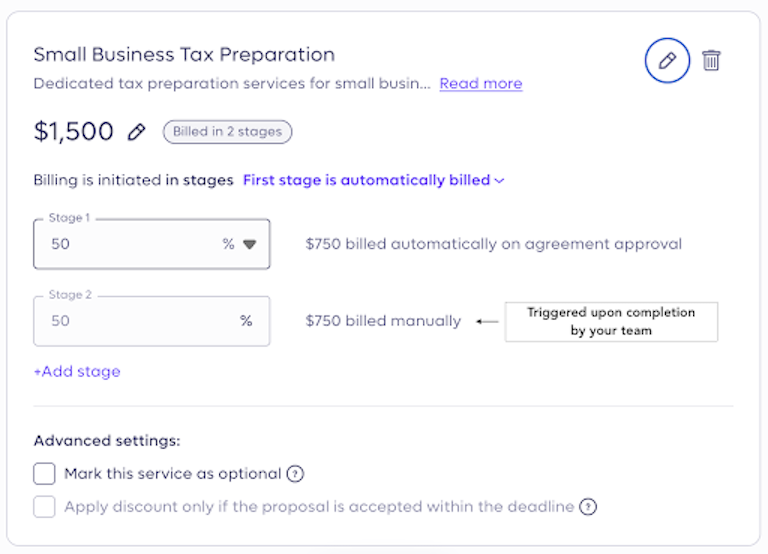
Here’s what that looks like: the client approves the agreement, and 50% is charged automatically.
Upon completion, the remaining 50% is charged.
This works well for things like straightforward 1040s outside peak season, entity returns with clean books, and other projects where you can feel confident about the work you’re walking into.
During tax season, it’s even more powerful because it helps you avoid the classic problem of post-filing collections. Instead of waiting until after the rush to see cash come in, you’re collecting as the engagement progresses.
The main limitation is also obvious: 50/50 assumes the scope is reasonably stable. If you anticipate the work might expand, you need a model that can accommodate it without creating friction.
That’s where the second model shines.
Model 2: Upfront payment + pricing range
Some tax and accounting work looks simple until you start. Then the books are messy, documents are overdue, notices arrive, or a “small” issue escalates into a larger cleanup.
In those cases, the problem isn’t just when you get paid, it’s whether you can bill fairly for the real scope.
That’s where upfront payment with an agreed-upon pricing range shines, because it does two important things at once:
- It collects an agreed-upon amount up front, automatically at acceptance.
- It includes a pre-approved pricing range in the proposal (for example, $600–$1,000).
When the work is complete, you bill the final amount within that range based on what the work actually required.
Clients usually prefer this more than you’d expect because it’s transparent. They see the range up front. They understand what could move the final number. And they know you’ll stay within the band they already approved.
For firms, it reduces write-offs and helps prevent those quiet losses from doing extra work without billing for it.
A quick way to pick the right model
If you want the simplest rule: use 50/50 milestones when the scope is predictable. Use an upfront payment and a pricing range when the scope is likely to change.
Either way, you’ve moved from reactive billing to clear, pre-agreed terms. And that’s where the cash flow stability comes from.
Now comes the part that trips firms up: not choosing a model, but running it consistently without creating more admin.
How to set up milestone billing in Anchor (without adding admin)
At this point, the models are the easy part. The hard part is running them consistently across dozens (or hundreds) of clients without turning your team into a billing help desk.
Anchor makes milestone billing easier by connecting the entire flow: proposal, agreement, payment method, invoicing, and collections. Instead of juggling tools and hoping nothing falls through the cracks, you set the terms once, and billing runs as agreed.
Below are the two setups most firms use.
Set up 50/50 milestones with Anchor
The goal of 50/50 is simple: collect half of the fee upon client commitment and the rest upon completion. Using Anchor, this starts within the proposal: the client approves the terms and provides payment details during acceptance, so billing runs automatically.
What this looks like with Anchor:
- Build the proposal and set the billing schedule to two milestones.
- Milestone 1 triggers automatically on acceptance (50%).
- Milestone 2 triggers when the return is filed or the engagement is marked complete (remaining 50%).
- Invoices and payments run from the approved agreement, so you’re not recreating terms each time.
To roll this out quickly for a group of clients, Anchor’s bulk proposals let you apply the same structure at scale without rebuilding each engagement from scratch.
That covers the simplest, most predictable work. But not every engagement remains predictable once the work begins.
Set up an upfront payment + pricing range with Anchor
This model is built for the reality of tax and accounting work: scope changes. Books are messy. Documents arrive late. “Quick questions” become real-time. And if your billing is fixed, you either eat the overage, or you start a tough conversation midstream.
With an upfront payment and a pricing range, you get paid to start and protect your margin by having the client approve the range before work begins.
What this looks like with Anchor:
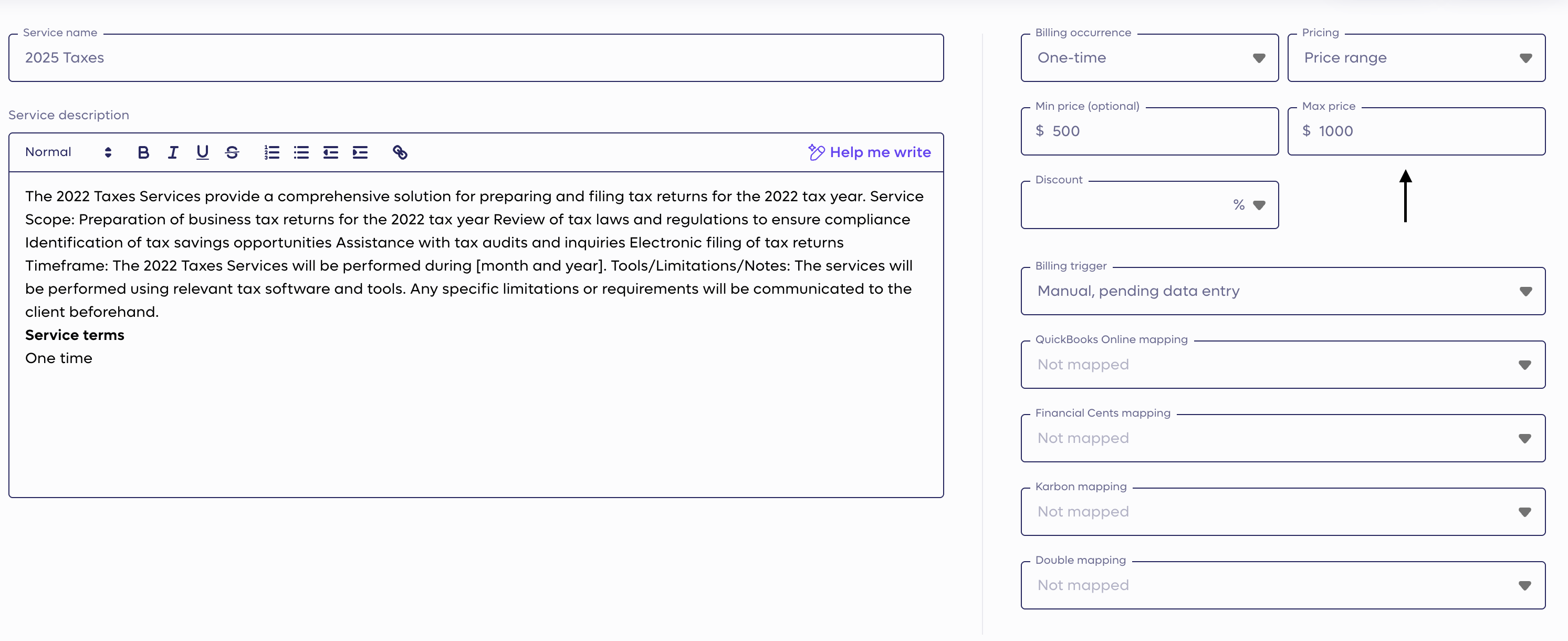
- Add an upfront charge that runs automatically at acceptance.
- Add a pricing range to the proposal (e.g., $600–$1,000) so the client can approve the band in advance.
- When the work is complete, you bill the final amount within the approved range based on the actual scope.
- If scope changes require a service add-on, Anchor can route the update through the same agreement flow to keep the engagement clean and auditable.
This setup helps you avoid write-offs without surprising the client. They already approved the boundaries. You’re simply billing inside them.
Why Anchor makes both models easier to stick with
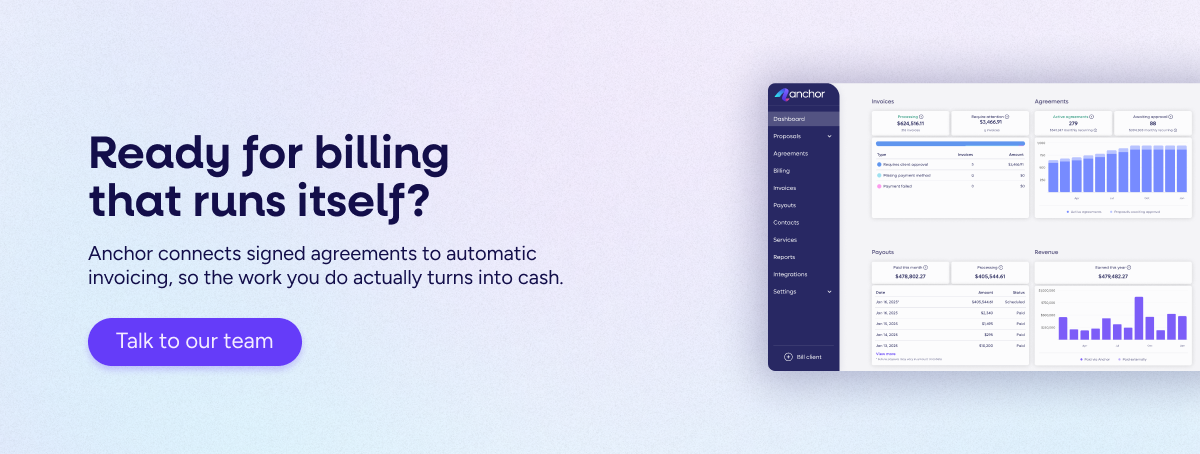
Most firms don’t struggle with knowing what they want to do. They struggle with keeping it consistent. That’s what Anchor solves by turning billing into a connected system rather than a series of manual steps.
A few things that matter in practice:
- Agreement-backed billing: Your billing terms are set in the approved agreement, so invoices don’t deviate from what the client accepted.
- Automatic invoices tied to your terms: Invoices can be generated based on milestones or completion, so billing doesn’t depend on someone remembering.
- Payment details connected during approval: Billing can run automatically according to schedule without awkward follow-up loops.
- Bulk rollout: The same milestone structure can be applied across client groups, enabling standardization rather than building a custom approach for each engagement.
Once you’ve got a system you can repeat, the benefits show up fast. Here’s why milestone billing holds up even outside the peak-season rush.
Want to see this applied to your clients and services? Book a quick call with a member of our team, and we’ll show you what Anchor’s milestone billing can do for your firm.
Why milestone billing works year-round
Once you tie payment to progress, you create certainty at every stage of the engagement. Clients know what to expect. Your team knows when cash is coming in, and the engagement stops feeling like a leap of faith.
With 50/50 milestones, you stop waiting for post-filing payments. You’re not hoping clients pay after delivery. You’ve already collected part of the fee, and the remainder is contingent on completion.
With upfront payment and a pricing range, you’re protected from the other big problem: scope creep. You can bill for the real work without awkward conversations or surprise invoices.
Tax season is basically a stress test. Deadlines, volume, and complexity all hit at once. If your billing structure holds up there, it tends to hold up for the rest of the year as well. And once you feel that stability, it’s hard to go back.
With the “why” covered, the last big hurdle is client acceptance. Let’s make that simple, too.
Common client questions (and how to answer them)
Most pushback doesn’t come from the model itself. It comes from how it’s explained. When you position milestone billing as a clear, professional way to keep work on track, it tends to land well.
“Do clients really agree to pay 50% upfront?”
Yes. When you frame it as reserving their spot in your queue and keeping the work moving, most clients see it as fair. They’re committing to progress, not paying for uncertainty.
“Can we adjust this by service or client type?”
Yes. You can choose 50/50 milestones or upfront + range, and adjust percentages and ranges depending on the work.
“Won’t pricing ranges scare people?”
Most clients prefer transparency. They see the range up front, understand what could change the final amount, and know you’ll bill within the band they already approved. It reduces surprises for them and write-offs for you.
“Why not just bill at completion?”
Because billing at completion creates delay and risk. Work and payment stop moving in sync, resulting in gaps and follow-up cycles after delivery. These models keep things aligned.
To bring it home, it helps to show that this isn’t a theory. Firms are already doing it.
What this looks like in real life
One practitioner put it simply: “For my tax clients, it’s helped get payment in advance as well as have them sign my client service agreement in advance.”
That’s the heart of milestone billing. It’s not about being strict. It’s about being clear. When the agreement, scope, and payment plan are aligned up front, the rest of the engagement runs more smoothly for everyone.
Now let’s close the loop on what you get when you run this all year.

The year-round payoff
Milestone billing isn’t a tax season trick. It’s a way to make cash flow predictable in any month by tying payments to progress and setting terms before work starts.
Tax season is still the primary use case because that’s when uncertainty hurts the most. But the same structure works for the rest of the year as well, especially for work where scope tends to drift, or timelines can stretch.
If you want to stabilize cash flow without turning your team into bill collectors, this is one of the simplest changes you can make.
Want to see how 50/50 milestones or upfront payment + pricing range can run automatically from agreement to payment? Book a 15-minute call with an Anchor advisor, and we’ll walk you through it.