


Recurring revenue shouldn’t require recurring effort. The best leaders automate what distracts them from thinking, and in most firms, billing admin is one of the biggest distractions.
Automated invoicing turns a repeatable process into background noise, so your team can deliver at a higher capacity without piling on nights, weekends, or headcount.
If you run an accounting or bookkeeping firm, this may sound familiar. Work gets delivered. Clients are happy. But internally, invoicing is dreaded by all. Someone has to build invoices, double-check details, send them out, answer questions, and ensure the books are cleaned up later on. Even when it’s “quick,” it still eats your best hours.
Automated invoicing is one of the rare changes that gives you time back every single month. Keep reading to find out how it works.
Key takeaways
- Recurring revenue shouldn’t require recurring effort: If your team is rebuilding invoices every month, you’re paying an “admin tax” forever. Automatic invoicing turns that repeated work into a system that runs on schedule, so you can keep your best hours for client work and leadership.
- Invoice automation creates real time leverage and capacity: The win isn’t just speed. It’s fewer interruptions, less context switching, and a calmer month-end. When billing runs in the background, your firm can deliver more without adding nights, weekends, or headcount.
- Manual invoicing quietly drives errors, delays, and scope drift: Late invoices, inconsistent billing, and missed add-ons don’t happen because people are sloppy. They happen because the process depends on memory and manual steps. Automation reduces those failure points and keeps billing aligned with what was agreed.
- Start small to get big results fast: You don’t need a full overhaul. Automate one recurring service first, tighten up the agreement and billing schedule, and let that slice run cleanly. Once it’s stable, expand to the rest of your client base.
The real problem? Operational gravity
Operational gravity is the pull of small tasks that keep you stuck in the day-to-day. None of them are particularly hard, which is what makes them dangerous. They feel harmless, so they stay forever.
Billing admin is a classic example. It starts as a simple habit. You send invoices, clients pay, and the firm moves on. But as you grow, invoicing turns into a monthly event that steals focus from the work that actually grows the firm: reviewing quality, training staff, improving processes, and having better client conversations.
Operational gravity shows up in little ways. You’re halfway through a review, and someone pings you because an invoice doesn’t match last month. You’re planning staffing for next quarter, and remember, you still haven’t billed the cleanup project. You tell yourself you’ll fix billing “when things slow down,” but then they never do.
Automated invoicing is how you stop treating billing like a recurring fire drill and take back control.
What “automated invoicing” means in a firm
Automated invoicing means invoices are created and sent based on rules you set in advance. You’re not rebuilding the same invoices every month. The system follows the schedule, uses the right amounts, and keeps the record straight.
In a firm, there are usually a few common cases.
Monthly clients get billed on a set cadence. Maybe it’s the first of the month, maybe it’s the 15th, maybe it’s tied to a service period. Project work can be billed on a milestone. Add-ons can bill when they’re approved. The key is that invoicing happens because the rules say it should, not because someone remembered.
If you’ve ever felt like billing lives in someone’s head, you already understand the pain. When one person “knows how we do it,” the firm is fragile. Automatic invoicing forces clarity. It turns a habit into a system.
Some platforms help connect agreements, billing schedules, and payments into a single flow. For example, Anchor can trigger invoices from signed agreements and billing schedules, helping keep billing consistent without you having to repeat the same steps each month.
That kind of setup matters because it keeps the billing process tied to what the client agreed to in the first place.
Why recurring revenue shouldn’t require recurring effort
Here’s the simple truth. If you do monthly work for a client, and you manually touch their invoice every month, you’re repeating the same task forever.
A few minutes per client doesn’t sound like much until you multiply it across your whole book. Then you add the interruptions. Then you add the cleanup. Then you add the mental load of keeping it all straight.
Manual invoicing also has a sneaky effect on leadership. It breaks your attention into smaller pieces. You can’t get into deep work when you’re constantly switching between client delivery and billing admin. You end up doing everything halfway, and the day feels busy but unproductive.
The firms that scale without chaos usually have one thing in common. They’re careful about what gets to steal attention. Billing is an easy place to draw the line because it’s predictable work. Predictable work should be automated.
Time leverage is the capacity you can feel
Time leverage isn’t a fancy concept. It’s the difference between you pushing every action forward versus the firm moving forward because the system is doing its job.
When invoicing is automated, you feel leverage in three ways.
First, your best hours stay intact. You’re not losing prime time to invoice creation, invoice edits, and payment follow-ups. That protects the time you need for review, planning, and leadership.
Second, your team’s capacity becomes more real. Capacity isn’t just headcount. It’s uninterrupted time. When the admin drag drops, your team can deliver more without rushing. That’s how quality goes up without adding pressure.
Third, you get steadier cash flow. When billing happens as agreed, you’re not guessing what this month will look like. You can make decisions earlier. You can invest with more confidence. You can stop treating cash flow like a monthly surprise.
Time leverage is what turns recurring revenue into something you can build on.
The hidden costs of manual invoicing
Most firm owners don’t need convincing that manual invoicing takes time. They live it. What’s easy to miss is how many other problems ride along with it.
Manual invoicing creates delays. Even if the client pays fast, you’re still waiting for the invoice to go out. When you’re busy, billing is often the first thing that slips, because it feels like “admin,” not “client work.” That delay stretches your cash cycle for no good reason.
Manual invoicing also creates inconsistency. One client is billed correctly, another is billed late, and a third is billed with the wrong description. It doesn’t happen because your team is careless. It happens because humans are juggling too much.
Then there’s scope drift. Extra work slips in, nobody updates the bill, and you absorb it. Sometimes you notice, and you feel awkward bringing it up later. Sometimes you don’t notice at all. Either way, the firm pays for it.
Finally, there’s cleanup. When invoicing and payments aren’t cleanly tied together, someone has to reconcile the mess. That’s time you could’ve spent delivering value or improving the firm.
Manual invoicing is rarely one task. It’s a chain of small tasks that pile up and pull you away from the work that matters.
What to automate first
Some firms delay automation because they think it requires a “system overhaul.” It doesn’t. The trick is to start where the repetition is highest.
For most firms, that’s monthly work. Monthly bookkeeping, payroll oversight, advisory check-ins, and recurring sales tax work. If it happens every month, it’s the easiest place to build a clean billing rhythm.
When you start, you’ll usually discover you need a bit more structure. That’s a good thing. Automation doesn’t create complexity. It reveals the complexity you’ve been managing manually.
You’ll want your services to be clear enough that a system can bill them. You’ll want billing schedules that match reality. You’ll want a simple way to handle changes without starting over. That’s where a lot of firms get stuck, not because the tech is hard, but because the firm never wrote down what “normal” looks like.
Once you have that, the automation starts paying you back quickly.
Protecting focus starts with standardizing the basics
Standardizing doesn’t mean turning your firm into a factory. It means defining the few things you do over and over so the team can run them the same way every time.
When services are clear, invoicing gets easier. Clients understand what they’re paying for. Staff know what to bill. You spend less time answering “what is this charge?” and more time delivering work.
This is also where leadership shows up. If you’re the only one who can decide what a client should be billed, you’ll always be stuck in the middle. A simple service structure gives your team a safe default.
Then you can step in only when something is truly special. That shift alone can free up hours, even before you automate the invoice itself.
Keeping client changes from turning into billing chaos
In real firms, work changes. A client adds payroll. They fall behind and need to catch up. They want a second entity. They need an extra advisory call. None of that is unusual.
The chaos starts when the billing process can’t keep up. If every change requires manual edits, new invoices, or a round of awkward explanations, your team starts avoiding it. Then you either underbill or you delay billing. Both are bad.
A good automated invoicing setup gives you a clean way to adjust without tearing everything down. Changes should feel normal, not like a crisis. Clients should see what changed and why. Your team should know how to update the billing terms without guessing.
This is one reason some firms like a connected proposal-to-invoice flow. When your billing schedule is tied to the agreement, you’re less likely to drift away from what was sold. Anchor, for example, is designed to connect proposals, agreements, and invoicing so the billing stays aligned with the engagement as it runs.
Your client experience matters more than your dashboard
It’s tempting to judge billing tools by the admin dashboard they present. But clients don’t see your dashboard. They see the last step. They see how easy it is to review, approve, and pay.
When clients get confused at the finish line, they pause. When they pause, signing and payment slow down. It doesn’t matter how good your internal setup is if the client experience creates friction.
The simplest client flow wins. Clear terms. Clear totals. Clear payment options. No scavenger hunt to figure out what they’re agreeing to.
This matters even more when you’re selling recurring services. You want the monthly payment to feel like a normal part of the relationship, not a fresh negotiation every time.
Gut-check: Is your billing creating leverage or stealing it?
You can usually tell if billing is working by how it feels.
If invoicing day creates stress, if you’re always fixing issues, if you’re often behind, then billing is stealing time from the firm. It’s pulling you back into operational gravity.
If billing runs quietly, if exceptions are rare, and if the team isn’t asking you to approve every little thing, then billing is creating leverage. It’s doing what a good system should do. It supports the firm instead of draining it.
You don’t need perfection. You just need progress that repeats every month.
Automate invoices easily
If you’re ready to stop repeating billing work, the next step is simple: pick one recurring service and automate the invoicing flow end-to-end.
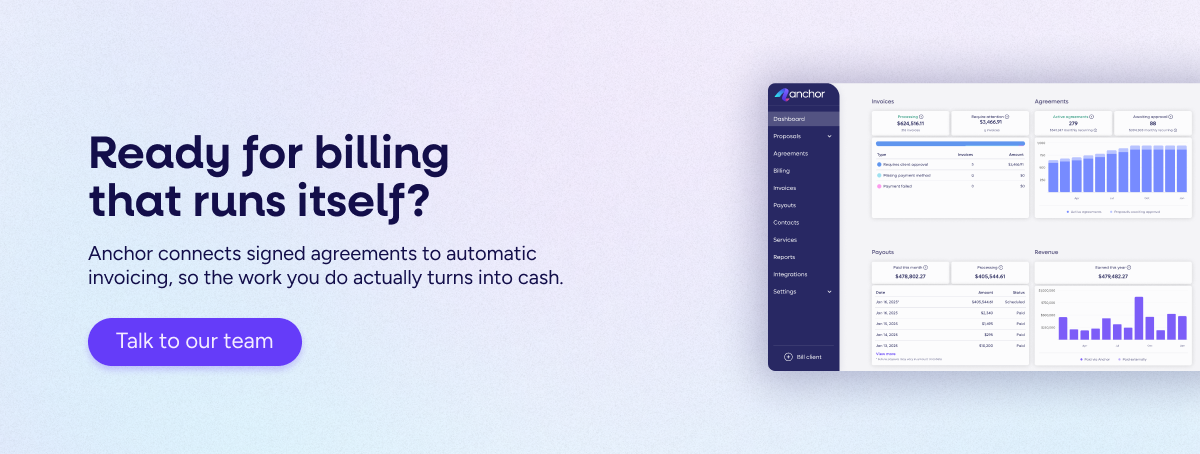
A platform like Anchor can help by tying invoices to your signed agreement and billing schedule, so invoices trigger automatically and the client has a straightforward path to sign and pay. The goal isn’t to add more software to your life. The goal is to remove the monthly billing scramble and give your team back its steady capacity.
Start small. Get one service running smoothly. Then expand.
Create recurring stability
Recurring revenue is one of the best parts of running a firm. It should create stability, not extra work. When invoicing is automated, you get back the time and attention that leadership actually needs. You’ll feel it in calmer weeks, cleaner month-end, and a team that can take on more without burning out.
If you want a simple place to begin, look at your last month of invoices and ask one honest question: which 20% of clients created 80% of the billing effort?
Automate that slice first, and you’ll see the leverage quickly.
If you’re ready to stop rebuilding invoices every month, Anchor is a great place to start. Automate one recurring service, stabilize the process, then expand.
Want to walk through what “proposal to paid” looks like for one of your real clients?
Book a free 15-minute call with one of our advisors. No subscription or credit card required. Ever.