


Invoice disputes rarely start as a crisis. They start with a small question: “Can you explain this line item?” “We didn’t approve this extra work.” “We need a PO number before we can process this.”
Then it stalls. A few emails go back and forth. A partner gets pulled in. The client goes quiet until you “clarify.” Work keeps moving because nobody wants the friction to turn into a relationship problem.
But weeks later, you’ve lost leverage, margin, and billing authority, and the dispute itself isn’t the real culprit. The damage comes from the drift: no clear owner, no clear proof, no clear next step. That’s decision drag, and it’s why DSO creeps up.
The good news is it’s fixable without a big overhaul. Instead of treating disputes as one-off conversations, treat them like a repeatable process with standard intake, labels, evidence, and a decision deadline. The sections below will show you exactly how.
Key takeaways
- Decision drag is the real cost: When a dispute lacks an owner or a deadline, it stretches DSO and eats into margin.
- Treat disputes like uncertainty: Most disputes come down to missing proof, missing approval, or a mismatch to the agreement.
- Structure beats inbox chaos: Reason codes, a clean intake, and an evidence packet turn disputes into routing, not negotiation.
- A better operating model prevents repeats: Clear agreements, automated invoicing, and automatic payments reduce the conditions that create disputes in the first place.
A dispute is an uncertainty problem, not an argument
When someone says “we’re disputing this invoice,” it usually sounds like conflict. In practice, it’s actually much simpler.
Payment is blocked because the client feels uncertain about something. Sometimes it’s real confusion. Sometimes it’s their internal process slowing things down. Sometimes it’s an internal power issue on their side. Either way, the fastest path isn’t more back-and-forth. It’s making the uncertainty measurable and solvable.
That uncertainty tends to fall into three buckets:
- Validity: Is the invoice correct? Are the dates, amounts, tax, and math right?
- Authority: Did the right person approve it? Do they need a PO, vendor setup, or sign-off?
- Alignment: Does it match what you agreed to? Scope, timeline, deliverables, and change control.
If you want disputes to end faster, don’t start by writing longer emails. Start by removing uncertainty quickly. And when a true judgment call is required, route it to the right decision-maker with a clean packet and a clear deadline.
That said, most disputes should close at the operator level with clear rules. Escalation should be reserved for the handful that truly need senior judgment, triggered by thresholds (dollars, scope, relationship risk) and supported by a structured record, not a messy thread.
To make that work, you need two things most firms don’t set up on purpose: a shared set of labels for disputes, and a shared clock for resolving them. Once you add those, you stop “discussing” and start closing.
Next comes the practical part: a dispute operating system you can run every time, with the same steps and the same expectations.
The six-step dispute operating system
Most firms handle disputes like one-off fires. That’s why they spread. Every invoice question becomes a custom email thread, and the outcome depends on who’s available, how busy they are, and how much the client pushes.
These six steps are a simple operating system for resolving invoice disputes. The goal is to keep disputes from turning into negotiations by doing three things every time: capture the issue the same way, respond with the right evidence fast, and force a decision on a timeline.
It’s all about being consistent. When clients see a clear process, they’re more likely to pay the undisputed amount, answer the right question, and move the issue to a real decision-maker on their side. And your senior staff only gets pulled in when there’s an actual judgment call, not because someone lost the agreement in an inbox.
Let’s walk through the system from intake to resolution.
Step 1: Replace vague emails with structured intake
Disputes start to sprawl the moment they’re unstructured. Without a standard intake, there’s no clear start time, no single owner, and no consistent record of what the client needs to proceed.
The rule: A dispute isn’t open until it’s logged with a reason code and a specific ask.
Your intake can be a portal form, a shared template, or a ticket. The tool matters less than the structure.
Capture:
- Invoice number and disputed amount: Is it the whole invoice or a line item?
- Reason code: The category of uncertainty (validity, authority, alignment, or commercial).
- The blocker: What do they need to move forward? PO number, backup, revised scope, corrected entity name, proof of delivery.
- Decision contact: Who can approve payment, not just who emailed you.
- Due date and terms: So you don’t lose track of what’s still enforceable.
Then close the intake with a short confirmation note that sets expectations. Not a threat. Just clarity.
Example:
“Thanks for flagging this. We’ve logged it as a scope mismatch, and we’ll send supporting docs or a proposed adjustment by Thursday. If only part of the invoice is in question, we’ll separate the undisputed amount so payment can proceed.”
Once every dispute enters through the same door, you can route it correctly.
The next step is to use a shared language so you can resolve issues faster and learn over time.
Step 2: Use reason codes, not notes
Freeform notes feel flexible until you want to fix anything.
If your team writes “client confused” in a notes field, you can’t trend it. You can’t train on it. You can’t tell if the issue is your scope language, your billing timing, or the client’s AP workflow.
Reason codes give you two wins:
- Faster resolution now: because people know what to do next.
- Fewer disputes later: because you can spot patterns and prevent repeats.
Keep it small. Most firms do well with 10–12 codes. Here’s a starting set:
Correctness
- Billing detail unclear
- Invoice error (date, tax, math)
- Duplicate charge
Authority
- Missing PO
- Vendor setup required
- Missing sign-off
Alignment
- Scope mismatch
- Change not approved
- Quality questioned
Commercial
- Payment timing request
- Budget cap exceeded
Make each code do real work. Don’t treat it as a label that sits there. Each code should trigger a default next step and a default set of evidence.
For example:
- Missing PO triggers: confirm the client’s PO workflow, confirm AP contact, and send vendor setup info if needed.
- Scope mismatch triggers: pull the signed agreement, amendment history, and the exact clause that covers the work.
Once disputes have consistent labels, the next bottleneck is proof. That’s where an evidence packet saves hours.
Step 3: Build the evidence packet once
Disputes get expensive when you rebuild the case from scratch.
Someone digs up an old engagement letter. Someone else searches for an approval email. A partner gets pulled in to “remember what we agreed.” Meanwhile, the client’s uncertainty remains, so the payment remains blocked.
An evidence packet should be something your team can assemble in 10 minutes, not an afternoon scavenger hunt. Keep it consistent so clients know what “good proof” looks like.
A basic packet includes:
- Signed agreement or SOW: The anchor document.
- Billing schedule and terms: What triggers invoices, payment method, and due dates.
- Approvals and change history: Emails, amendment records, scope changes.
- Proof of delivery: Meeting notes, completed deliverables, ticket history, file links.
- Invoice detail: Line items that map back to agreement language.
If you don’t have an agreement artifact you can point to, disputes turn into opinion. That’s where margin goes to die.
The evidence packet also keeps your tone calm. You’re not arguing. You’re documenting. That shift makes the next step easier because decisions become more consistent.

Step 4: Define decision rights before you need them
A dispute drags on when people can discuss it, but nobody can close it.
If your billing coordinator has to ask a partner every time a client pushes back, you’ve built a dispute escalator. It trains clients to wait you out. It also pulls senior people into admin work they shouldn’t be doing.
Write down decision rights. Keep them simple:
- Billing coordinator: Fixes clerical issues (typos, entity names, resend invoice, attach backup).
- Ops or AR owner: Approves one-time adjustments up to $X, and manages the dispute clock.
- Partner: Decides on pricing, scope, or relationship risk concessions.
The exact roles don’t matter. The clarity does.
A quick note of warning: if the person closest to the email thread can approve concessions without guardrails, you’ll accidentally create a discount machine. Clients learn that disputing is how they negotiate after the fact.
Decision rights keep outcomes consistent. Now you need one more control to stop the slow fade: a deadline.
Step 5: Put every dispute on a clock
Disputes sprawl because they don’t have deadlines. If you want decision drag to stop, you need internal SLAs that force movement. Not for the client’s sake. For yours.
Here’s a practical starting set:
- Intake acknowledged: Within 1 business day
- Evidence packet sent: Within 3 business days
- Decision reached: Within 5 business days (approve, adjust, or hold firm)
Notice what’s missing: “We’ll keep talking.”
Your decision doesn’t have to be harsh. It just has to exist. When you hold your team to a timeline, clients experience you as organized, not aggressive.
A clock also makes escalation cleaner. If the SLA says “decision by day five,” senior staff know why they’re being pulled in. It’s not random. It’s the system.
Even with SLAs, one rule protects cash flow more than almost anything else: partial payment.
Step 6: Use the partial payment rule to protect cash flow
This one’s awkward only if you spring it mid-argument.
If a client disputes a $1,000 line item on a $10,000 invoice, the remaining $9,000 still exists. Letting a minor dispute freeze the full invoice teaches the client that any question can become a pause button.
The partial payment rule is simple:
- Split the invoice into disputed and undisputed amounts, or
- Request payment of the undisputed amount immediately while you work on the disputed portion
Either way, you’re saying: “We can work through the question, and payment can proceed on what’s already agreed.”
This works best when your agreements and invoices support it. If your terms say undisputed amounts remain due, you don’t have to invent a policy in the heat of the moment.
When partial payment becomes the norm, disputes stop functioning as a freeze button.
Next comes the bigger win: preventing repeats.
Dispute prevention begins upstream
If you look at your top reason codes, you’ll usually see the same story:
- The scope wasn’t specific enough.
- Approval wasn’t captured cleanly.
- Billing timing didn’t match how the client buys.
- The invoice detail didn’t map back to the agreement in a way AP can process.
Those aren’t collection problems. They’re operating model problems.
If you want fewer disputes, you need fewer places for uncertainty to enter the system. That means tightening the steps before the invoice exists:
- Clear proposals and engagement letters with specific scope, terms, and billing schedules
- Clean change control so extra work becomes an amendment, not a surprise line item
- Automated invoicing rules tied to signed agreements, so billing happens as agreed, on time
- Automatic payments (where appropriate), so payment is the default outcome, not a monthly scramble
Most firms try to fix disputes at the end of the process because that’s where the pain shows up. But the inputs create the outputs. If the agreement is fuzzy, the invoice will be questioned. If approval is informal, authority will be contested. If billing timing is ad hoc, AP will slow-walk it.
A strong dispute system prevents damage. A better operating model reduces how often the damage happens in the first place.
Make agreements executable
Once your dispute workflow is under control, the next step is making your billing system harder to break.
A better model has one theme: the signed agreement becomes the source of truth, and everything downstream follows it. When agreements, invoices, and payments stay connected, uncertainty has less room to grow.
That’s what Anchor is built to support.
Anchor is a billing and collections platform for accounting, bookkeeping, tax, and professional services firms. It connects the pieces that usually live in separate tools and inboxes:
- Interactive proposals and agreements so terms are clear, signed fast, and easy to reference
- Automated invoicing that triggers from the signed agreement and billing schedule, including recurring and one-time billing
- Automatic payments, so most firms don’t have to rely on reminders at all. Firms do reminders today because they have to. Automatic payments reduce that need.
- One-click amendments so changes in scope, timing, or price get captured in real time, not buried in email
- Integrations and reconciliation with tools like QuickBooks and Xero, plus practice management systems, so payments sync and reconcile automatically
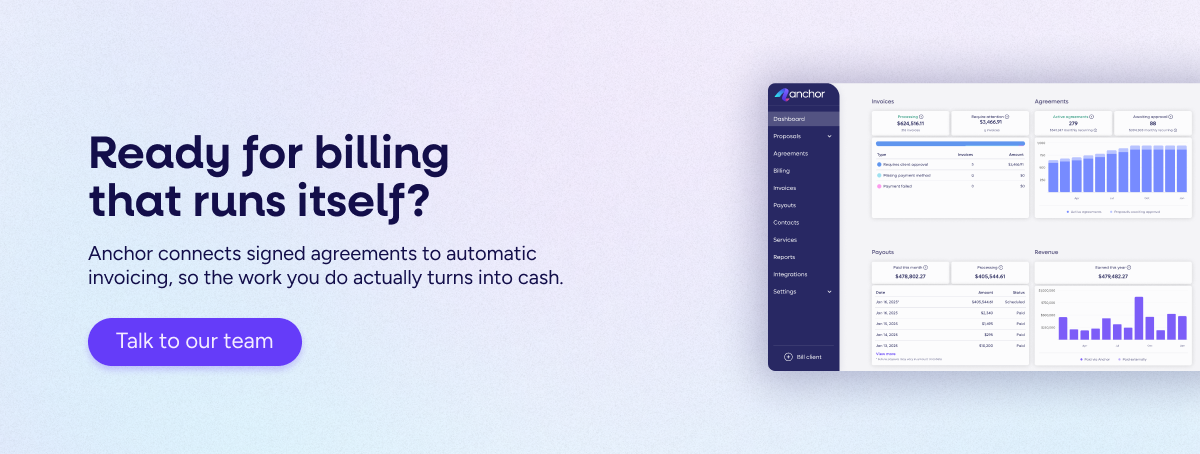
- Dashboards that show outstanding payments and projected cash flow so you can spot risk early
If clients pay by card, Anchor can be configured to collect fees from clients. That helps protect margin and reduces awkward back-and-forth about payment costs.
The point isn’t shiny features. It’s fewer opportunities for uncertainty. When a client questions an invoice, you can point to a signed agreement, the schedule that triggered billing, and any amendments that changed the scope. That turns a dispute into a quick resolution step, not a drawn-out negotiation.
What to do this week
You don’t need a big project to start. You need a few moves that close the gaps where disputes grow legs.
- Pick your reason codes. Start with 10–12. Train your team to log every billing question using one code and one specific ask.
- Write the evidence packet checklist. Make it fast. If it takes longer than 10 minutes, simplify it until it doesn’t.
- Set the clock. Commit to internal SLAs and track when you miss them. That data will show you what’s breaking.
Once those are in place, you’ll feel the difference. Fewer loose threads. Less partner interruption. More control over cash timing.
From there, go upstream. Tighten agreement language, normalize amendments, and connect invoicing and payments to the terms clients signed. That’s how you stop paying the ambiguity tax.
Ready to make disputes rarer and payments more predictable?
Book a call with one of our advisors to see how Anchor connects proposals, invoicing, payments, amendments, and reconciliation into a single flow, reducing decision drag and protecting margin.
Or, if you want to start on your own, pull your last 20 disputes, label them with reason codes, and fix the top one at the source. You can always reach out if you run into questions.