


There’s nothing more awkward than shifting from a trusted advisor to a bill collector. You’ve worked hard to build strong relationships with your clients, but the moment an invoice goes past due, that dynamic can change. Chasing payments puts a strain on client trust and can turn a positive partnership into a transactional headache.
The truth is, your billing process is a critical part of the client experience. A clunky, manual system filled with follow-up calls and reminders creates friction. This guide explores how to rethink your entire accounts receivable workflow, turning it from a potential point of conflict into a smooth, professional process that strengthens client relationships and ensures you get paid without the chase.
Key Takeaways
- Your manual AR process is costing you more than just time: Relying on spreadsheets and manual follow-ups leads to late payments, unpredictable cash flow, and strained client relationships, directly impacting your firm's financial stability.
- Control your cash flow by starting with a better agreement: The best way to guarantee timely payments is to secure a client's payment method upfront in an interactive proposal, which eliminates the need for collections entirely.
- Automate your workflow to get paid faster and gain clarity: A system like Anchor connects your proposals, invoicing, payments, and reconciliation, giving you a real-time view of your finances and freeing you from administrative work.
What Is Accounts Receivable?
Let’s keep it simple: Accounts receivable (AR) is the money clients owe your business for services you’ve already provided. It’s the balance sitting in that awkward gap between sending an invoice and actually getting paid. For any service-based business, from accounting firms to creative agencies, AR is a normal part of operations. You do the work, send the bill, and that amount becomes an entry in your accounts receivable ledger until the cash hits your bank account.
While it’s a standard business practice, managing AR can feel like a full-time job. Chasing payments, tracking who owes what, and forecasting your cash flow can quickly become a major headache. The efficiency of your AR process directly impacts your firm’s financial health. A streamlined system means you get paid faster, your cash flow is predictable, and you can spend less time on administrative tasks and more time serving your clients. This is where having a solid, automated process in place changes the game, turning AR from a source of stress into a reliable part of your business engine.
Why It's a Current Asset on Your Balance Sheet
On your firm’s balance sheet, accounts receivable is listed as a "current asset." This classification simply means it’s money you expect to collect and convert into cash relatively soon, typically within one year. Think of it as revenue you’ve earned that’s just one step away from being in your bank account. It represents the value of the work you’ve completed and billed for, making it a key indicator of your firm's short-term financial position.
However, the value of that asset is only realized when the payment is collected. An AR balance that keeps growing without being converted to cash can look good on paper but can strain your actual financial resources. That’s why managing it effectively is so important—it ensures your assets are working for you, not just sitting on a spreadsheet.
Its Critical Role in Your Cash Flow
Accounts receivable is the lifeblood of your cash flow. How well you manage the money coming in from clients determines whether you have the cash on hand to pay your team, cover expenses, and invest in growth. When clients pay on time, your cash flow is healthy and predictable. But when payments are delayed, it can create a domino effect, causing cash shortages that put a strain on your entire operation.
Effectively managing your AR isn't just about sending invoices; it's about creating a system that ensures prompt and reliable payments. When you automate this process, you take control of your cash flow. For instance, with Anchor, you can use interactive proposals that secure a client’s payment method upfront. This simple step transforms the entire dynamic, ensuring that once an invoice is due, the payment is processed automatically. It closes the gap between billing and getting paid, giving you confidence in your cash flow.
How Does the Accounts Receivable Process Work?
At its core, the accounts receivable process seems straightforward: you do the work, send a bill, and get paid. But as any firm owner knows, there are a lot of crucial steps in between that can make or break your cash flow. This isn't just administrative paperwork; it's the lifeblood of your business. A clunky AR process, bogged down by manual invoicing, forgotten follow-ups, and reconciliation headaches, creates a constant drag on your resources and introduces uncertainty into your financial planning.
Think about the time spent creating and sending individual invoices, tracking down payments, and then manually matching them in your accounting software. Each step is an opportunity for human error and delay. This friction doesn't just affect your bottom line; it can also strain client relationships. No one enjoys making or receiving those "just checking in on this invoice" calls.
Getting this process right means you spend less time chasing payments and more time serving your clients. By rethinking the traditional workflow and embracing automation, you can transform AR from a reactive chore into a proactive system that ensures you get paid on time, every time. Let's walk through the key stages of a modern AR process, from the initial agreement to the cash hitting your bank account.
The Journey from Sale to Payment
The AR journey begins the moment you make a sale on credit. Traditionally, this meant sending an invoice after services were rendered and then waiting for the client to pay. This gap between invoicing and payment is where things can get tricky, leading to delays and uncertainty. Today, you can start this journey on a much stronger footing. Instead of a reactive invoice, you can use interactive proposals that outline your services and capture payment details from the very beginning. This simple shift turns the agreement into the trigger for payment, putting you in control of the timeline from day one.
Recording AR Transactions Correctly
Once an agreement is in place, you need to record it in your books. When you provide a service on credit, you create an accounts receivable journal entry that increases your AR (an asset) and your sales revenue. AR is listed as a current asset on your balance sheet because it represents money you expect to receive soon. Accuracy here is non-negotiable. A single manual data entry error can throw off your financial statements and give you a misleading picture of your firm’s health. Automating this step ensures every transaction is recorded correctly, giving you a reliable view of your finances.
The Basics of the Collection Process
The final piece of the puzzle is collecting the cash. An effective collection process is all about making it as easy as possible for clients to pay you on time. This means offering convenient payment options and having a clear, consistent system. The old way involved sending invoices, waiting, and then making those awkward follow-up calls. A modern approach automates this entire flow. When a payment is due according to your agreement, the client’s saved payment method is charged automatically. There’s no chasing, no waiting, and no wondering—just a smooth, professional experience that ensures you get paid promptly.
What Are the Different Types of Accounts Receivable?
When you hear “accounts receivable,” you probably think of unpaid client invoices. And you're right! But AR is a bit more nuanced than that. It's not a one-size-fits-all category. Understanding the different types of accounts receivable is key to keeping your books clean and your cash flow predictable. Think of it like organizing your closet—you wouldn't just throw everything into one big pile. Separating your AR helps you see exactly where your money is coming from and what kind of follow-up each type might need. Let's break down the three main categories you'll encounter.
Trade Receivables
This is the most common type of AR and likely what you deal with every day. Trade receivables are the amounts your clients owe you for your core services—the accounting, bookkeeping, or tax prep work you do. When you finish a project and send an invoice, the amount due becomes a trade receivable on your balance sheet. Managing these is the lifeblood of your firm's cash flow. The challenge, of course, is that each invoice represents a manual task: creating it, sending it, and following up. This is where automating your invoicing can completely change the game, ensuring you get paid for your hard work without the administrative headache.
Non-Trade Receivables
Next up are non-trade receivables. These are amounts owed to your business from sources outside of your primary services. They're less common but just as important to track. Think of things like an advance you gave an employee for travel, a refund you're expecting from a software vendor, or interest income you've earned but haven't received yet. Because they don't come from your main revenue stream, it's crucial to record them separately. This keeps your financial reporting accurate and gives you a clear picture of your operational performance versus other miscellaneous income.
Notes Receivable
Finally, we have notes receivable. These are a bit more formal than your standard invoice. A note receivable is backed by a promissory note—a formal, written promise from one party to pay another a specific amount by a certain date. These agreements often include interest and have a detailed repayment schedule. You might use a note receivable for a larger, long-term project or when extending credit to a client under more structured terms. The key here is the legally binding document, which provides more security than a typical trade receivable. Setting these terms clearly from the start is crucial, which is why using interactive proposals can establish a solid foundation for any client agreement.
How to Record Accounts Receivable in Financial Statements
Accounts receivable isn’t just a single line item; it’s a key character in your business’s financial story, making an appearance on all three major financial statements. Understanding how AR moves across your balance sheet, income statement, and cash flow statement gives you a complete picture of your firm’s health. It shows you not only what you’ve earned on paper but also how effectively you’re turning those earnings into actual cash you can use. Getting this right is fundamental to making smart decisions about your firm’s growth, spending, and overall stability.
Each statement tells a different part of the story. The balance sheet gives you a snapshot in time, the income statement shows performance over a period, and the cash flow statement reveals the real-world movement of money. Let’s break down how AR shows up in each one.

Presenting AR on the Balance Sheet
On your balance sheet, accounts receivable is listed under the “Current Assets” section. This placement is important because it signals that AR is a resource your company expects to convert into cash within one year. As Stripe puts it, "accounts receivable sits under current assets on a company's balance sheet, and it represents money the company expects to collect soon for goods or services that have already been fulfilled." It’s essentially an IOU from your clients.
While a growing AR balance can mean your sales are increasing, it can also be a warning sign. If that number gets too big or stays on the books for too long, it might indicate you have a collections problem, tying up cash you need for operations.
The Impact of AR on Your Income Statement
The income statement is where you see the direct link between your work and your revenue. When you provide a service and send an invoice, you recognize that income right away, even if the client hasn't paid yet. This is the core of accrual basis accounting. As a result, "when a company makes a sale on credit, it records an increase in AR and an increase in its sales revenue."
This means your income statement might show a healthy profit, but it doesn't reflect the cash you actually have on hand. It’s a classic case of being “rich on paper.” This gap between recognized revenue and collected cash is precisely why managing AR effectively is so critical for your firm’s financial health.
How AR Affects Your Cash Flow Statement
The statement of cash flows is where the rubber meets the road. It reconciles the net income from your income statement with the actual cash in your bank account. Here, an increase in accounts receivable is treated as a use of cash—because it’s money you’ve earned but haven’t yet received. Conversely, when you collect on those receivables, it’s recorded as a source of cash.
This is why AR is a crucial component of your working capital. As Investopedia notes, "AR helps a company's 'liquidity,' meaning its ability to pay its own short-term bills." Efficiently converting your receivables into cash directly strengthens your liquidity, giving you the funds needed to pay staff, cover overhead, and invest in growth.
What Are the Biggest Risks of Accounts Receivable?
Let’s be honest: managing accounts receivable can feel like a necessary evil. On one hand, it represents the money your firm has earned and is waiting to collect. On the other, it’s a process filled with potential pitfalls that can cause major headaches. When AR isn’t managed effectively, it can introduce significant uncertainty into your business, turning predictable revenue into a guessing game.
The risks go beyond just a few late payments. They can snowball into serious issues that affect your firm's financial health, operational efficiency, and even your client relationships. Understanding these risks is the first step toward protecting your business. The three biggest dangers to watch out for are bad debt that you have to write off completely, late payments that disrupt your cash flow, and the hidden operational costs of chasing down what you’re owed. Each of these can chip away at your profitability and, more importantly, your peace of mind. The good news is that with the right systems in place, you can get ahead of these problems before they start.
The Danger of Bad Debt
Bad debt is the ultimate worst-case scenario in the AR cycle. It’s an invoice that goes unpaid for so long you eventually have to accept you’re never going to see the money. As Investopedia puts it, "If a customer never pays, the company has to write off that money as a 'bad debt expense.'" This isn't just an accounting entry; it's a direct hit to your bottom line. You’ve already done the work, dedicated the resources, and now you have nothing to show for it.
This risk is much higher when your billing process relies on outdated methods. Sending a PDF invoice and hoping for the best leaves the door wide open for clients to delay, dispute, or simply disappear. The best way to prevent bad debt is to secure payment information from the very beginning. With Anchor’s interactive proposals, clients connect their payment method right when they sign. This simple step changes the entire dynamic, ensuring you’re not left chasing ghosts.
How Late Payments Disrupt Your Business
Even when clients eventually pay, chronic delays can be incredibly damaging. Late payments directly impact your cash flow, which is the lifeblood of your firm. As J.P. Morgan notes, "Delays in collection tie up working capital." This means the money you need for payroll, software subscriptions, or investing in growth is stuck in limbo. You’ve earned it, but you can’t use it.
This constant uncertainty makes financial planning nearly impossible. It’s no wonder that inadequate cash flow is a top reason why businesses fail. When you can’t predict when money is coming in, you can’t make confident decisions. Anchor’s automated billing and payments system solves this by charging clients automatically based on the terms they’ve already agreed to. Payments become predictable, reliable, and timely, giving you the stable cash flow you need to run your business without stress.
The Hidden Costs of Collections and Disputes
The financial cost of an unpaid invoice is obvious, but what about the hidden costs? The time and energy your team spends sending follow-up emails, making awkward phone calls, and resolving disputes is a massive operational drain. These are hours that could be spent on billable work or improving client services. This process also puts a strain on your client relationships. No one enjoys being a bill collector, and it can damage the trust you’ve worked so hard to build.
These challenges often stem from inefficient systems and unclear agreements. When billing is manual, human error is inevitable, leading to disputes that take even more time to resolve. By automating the entire process from proposal to payment, Anchor eliminates these friction points. Invoices are generated and paid automatically based on the signed agreement, so there are no awkward follow-ups. This frees up your team and preserves your role as a trusted advisor, not a collections agent.

How to Calculate Your Accounts Receivable Turnover Ratio
Think of your accounts receivable (AR) turnover ratio as a speedometer for your cash flow. It tells you how quickly your firm is converting invoices into actual cash in the bank. For any service-based business, this number is a non-negotiable metric to track. It cuts through the noise of monthly revenue reports and shows you how efficient your billing and collections process really is.
Are you getting paid promptly for the amazing work you do, or are your invoices sitting in client inboxes for weeks on end? This one simple calculation can give you a surprisingly clear answer. It’s a vital health check for your firm, pinpointing exactly how well you’re managing one of your most critical assets: the money you’re owed. Understanding this ratio helps you move from simply earning revenue to actually collecting it with confidence.
The AR Turnover Formula, Simplified
Let’s break down the math without making it feel like a pop quiz. The formula to calculate your AR turnover ratio is straightforward:
Net Credit Sales ÷ Average Accounts Receivable
"Net Credit Sales" is the total revenue you’ve billed to clients on credit during a specific period (like a quarter or a year). For most accounting and professional services firms, this is simply your total invoiced revenue. "Average Accounts Receivable" is the average amount of money your clients owed you during that same period. You can find this by adding your AR balance at the beginning of the period to your AR balance at the end, and then dividing by two. This gives you a solid measure of efficiency for your collections process.
What's a Good Ratio for Your Industry?
So, you’ve crunched the numbers. Is your ratio good? The honest answer is: it depends. A higher ratio is almost always better because it means you’re collecting payments quickly and efficiently. However, a "good" ratio for a software company will look very different from a good one for an accounting firm, which is why context is key.
The best approach is to compare your ratio to industry benchmarks for professional and financial services. This helps you see how you stack up against your peers. But even more importantly, you should be your own benchmark. Track your ratio over time. Is it improving month over month or quarter over quarter? That’s the real win. The goal is to create a collections process so smooth that your turnover ratio consistently trends upward.
What Your AR Turnover Ratio Is Telling You
This ratio tells a story about your firm’s operational health. A high ratio tells a great one: your clients pay on time, your invoicing is prompt, and your cash flow is strong and predictable. You aren’t wasting precious, non-billable hours chasing down payments. A low ratio, on the other hand, is a warning sign. It might mean your payment terms are too vague, your invoices are going out late, or your manual follow-up process just isn’t cutting it. This is where firms often experience significant revenue leakage without even realizing it.
When you automate your process, you take control of that narrative. It all starts with clear, interactive proposals that get client buy-in and require a payment method upfront. From that moment on, invoices and payments happen automatically based on the terms you both agreed to. This simple shift transforms your AR process, turning a story of slow payments into one of reliable, confident cash flow.
Best Practices for Managing Accounts Receivable
Managing your accounts receivable effectively is about more than just chasing down payments. It’s about creating a smooth, professional experience for your clients and building a predictable cash flow for your firm. When you have solid AR practices in place, you spend less time wondering when you’ll get paid and more time doing the work you love. The key is to be proactive, not reactive. This means setting clear expectations from the start, invoicing with precision, and making the payment process as painless as possible for everyone involved.
While these best practices sound simple, executing them consistently with manual processes can be a real challenge. Juggling spreadsheets, sending PDF invoices, and manually tracking payments leaves too much room for error and eats up valuable time. This is where automation becomes a game-changer. By systemizing your AR process, you can ensure every step is handled perfectly, strengthening client relationships and giving you complete confidence in your firm’s financial health. A well-managed AR process is the bedrock of a financially healthy business.
Establish Clear Credit and Payment Terms
The best way to avoid payment issues is to prevent them from happening in the first place. This starts with absolute clarity. As experts at J.P. Morgan advise, you should "clearly tell customers your payment rules and credit terms right from the start." This prevents confusion and delays down the road. Your engagement letter or proposal should explicitly state your payment due dates, accepted payment methods, and any policies on late payments.
This is where a tool like Anchor transforms the entire dynamic. Instead of burying terms in a dense PDF, Anchor’s interactive proposals present everything in a clean, easy-to-understand format. Clients can review the scope, accept the terms, and connect their payment method all in one seamless step. By getting this buy-in upfront, you eliminate ambiguity and set a professional tone for the entire relationship.
Send Prompt, Accurate Invoices Every Time
Once the work is done, the clock starts ticking. The faster you send an accurate invoice, the faster you get paid. Delays or mistakes in your invoicing not only slow down your cash flow but can also look unprofessional and create unnecessary back-and-forth with your clients. Your goal should be to make every invoice perfect and deliver it the moment it’s due.
Manually creating and sending invoices is tedious and prone to human error. Anchor’s automated invoicing solves this completely. Once a client signs a proposal, the system automatically generates and sends invoices based on the agreed-upon schedule—whether it's recurring, one-time, or milestone-based. This ensures your invoices are always accurate and on time, without you having to lift a finger. It removes the friction and helps you maintain a steady, predictable revenue stream.
Monitor Aging Reports and Follow Up Consistently
Keeping a close eye on outstanding invoices is a classic AR best practice. Traditionally, this means regularly reviewing an aging report to see who owes what and then starting the awkward process of following up. These follow-ups, while necessary, can be time-consuming and can strain even the best client relationships. No one enjoys chasing money or being chased for it.
But what if you could eliminate the need for follow-ups altogether? With Anchor, the concept of chasing payments becomes a thing of the past. Because clients connect their payment method when they sign the agreement, payments are processed automatically on the due date. There are no reminders or follow-ups needed because the system handles the collection for you based on the terms your client already approved. You get paid on time, every time, and can check your cash flow dashboard for a real-time view of your revenue.
Offer Flexible Payment Options and Incentives
Making it easy for clients to pay you is one of the simplest ways to improve your cash flow. The more hoops a client has to jump through—like writing a physical check or navigating a clunky payment portal—the more likely they are to put it off. As industry experts at Esker note, modern businesses need to offer convenient online payment capabilities.
Anchor builds payment flexibility directly into the proposal process. Clients can choose to pay via free ACH transfer or by credit card, making the process effortless for them. The platform can even pass credit card transaction fees to the client by default, protecting your profit margins. You can also use the proposal to structure incentives, like offering a small discount for annual prepayment, encouraging faster cash collection while giving your clients a great deal.
Common AR Challenges for Accounting Firms
If you’ve ever felt like you spend more time chasing payments than doing the client work you love, you’re not alone. Managing accounts receivable is a universal business challenge, but for accounting and service-based firms, the stakes are even higher. Your time is your inventory, and when payments are delayed or processes are clunky, it directly impacts your bottom line and your ability to grow. Let’s walk through some of the most common AR headaches and, more importantly, how to solve them for good.
Why Manual Processes Are Holding You Back
Let’s be honest: manual AR management is a time-consuming grind. From creating and sending individual invoices to manually entering payment data, every step is an opportunity for delays and human error. It’s a system that relies on you remembering every due date and every client conversation. This administrative burden doesn't just eat up your billable hours; it puts your firm's financial health at risk. In fact, poor cash flow is a leading cause of business failure, and it’s often a direct symptom of a broken AR process. Automating your billing with a tool like Anchor removes these manual tasks, freeing up your team to focus on high-value work instead of administrative chores.
The True Cost of Late Payments
A late payment isn't just an inconvenience; it's a ripple effect that disrupts your entire business. When you aren’t getting paid on time, it’s often a sign of a larger issue within your AR process. The awkward follow-up calls and emails strain the client relationships you’ve worked so hard to build. Meanwhile, unpredictable cash flow makes it impossible to forecast accurately, hire new team members, or invest in your firm’s growth. The solution isn't to become a stricter bill collector. Instead, you can build a better process from the start. By securing a payment method upfront in your client agreement, you put yourself in control and ensure payments happen automatically, exactly when they’re supposed to.
The Headaches of Reconciliation Errors
Nothing derails a productive afternoon faster than trying to track down a reconciliation error. When you’re manually matching payments to invoices across spreadsheets and bank statements, mistakes are bound to happen. This kind of suboptimal data management leads to inaccurate financial reports, wasted hours digging for discrepancies, and a fuzzy picture of your firm’s actual performance. Your AR process should end with a clean, clear record—not a puzzle. By using a platform that integrates directly with your accounting and practice management software, you can automate reconciliation. Payments are automatically synced and recorded, giving you an accurate, real-time view of your financials without the manual effort.
How to Transform Your AR Process with Automation
If the common AR challenges sound painfully familiar, I have good news: you don’t have to live with them. The key to breaking free from manual data entry, chasing late payments, and wrestling with reconciliation is automation. By implementing a modern accounts receivable solution, you can streamline your entire workflow, from the initial client agreement all the way to getting paid. It’s about trading in your tedious, error-prone tasks for a system that works for you, giving you more time, control, and confidence in your firm’s financial health.
Automate Invoicing and Collect Payments Instantly
Forget setting calendar reminders to create and send invoices. Modern AR software automates the entire process. With a platform like Anchor, invoicing isn’t a separate task—it’s a natural outcome of your client agreement. Once a proposal is signed, invoices are automatically generated and sent based on the agreed-upon schedule, whether it's for recurring services or one-time projects. The best part? Payments are just as automatic. Because clients connect their payment method upfront when they sign, funds are collected instantly on the due date. This simple shift completely eliminates the need for awkward follow-up emails and dramatically shortens your payment cycles. You get paid on time, every time, without lifting a finger.
Get Real-Time Visibility into Your Cash Flow
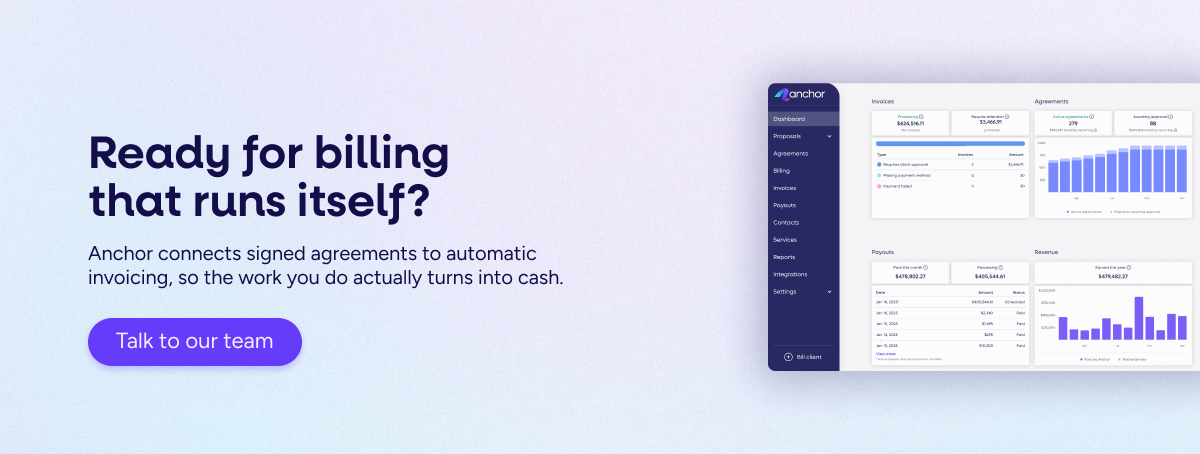
How can you make strategic decisions for your firm without a clear picture of your finances? Spreadsheets and manual tracking just don’t cut it—they’re outdated the moment you finish updating them. Automation gives you a live, accurate view of your financial standing. Anchor’s cash flow dashboard provides real-time visibility into your revenue forecasts, outstanding payments, and projected income. Instead of guessing, you get actionable insights that help you plan for growth, manage expenses, and operate with confidence. This clarity transforms cash flow from a source of uncertainty into a reliable tool for building a healthier, more predictable business.
Use Interactive Proposals to Get Paid Faster
The way you start a client relationship sets the tone for everything that follows, including payments. Clunky PDF proposals that require printing, signing, and scanning create friction and delays. Anchor replaces them with sleek, interactive proposals that feel more like an e-commerce checkout. Clients can easily review your terms, select service packages, and sign from any device in minutes, not weeks. The game-changer is that they connect their preferred payment method—free ACH or credit card—as the final step to sign the agreement. This single step puts you in control of getting paid and ensures you have a clear, agreed-upon payment structure from day one, which is crucial for managing your cash flow.
Integrate with Your Favorite Practice Management Tools
Adopting a new tool shouldn’t mean creating more manual work to connect it to your existing systems. A truly effective AR automation platform fits right into your current tech stack. The goal is to reduce manual workloads, not just shift them around. Anchor integrates seamlessly with the accounting and practice management software you already use, like QuickBooks, Xero, Karbon, and Keeper. This means payments are automatically synced and reconciled across your platforms without any tedious data entry. It eliminates the risk of human error, ensures your books are always accurate, and frees up your team to focus on high-value client work instead of administrative headaches.
Frequently Asked Questions
What's the biggest mistake firms make with their accounts receivable? Honestly, the most common mistake is being reactive instead of proactive. Many firms wait until a payment is late to start thinking about collections. This puts you in the uncomfortable position of chasing money you've already earned. The best approach is to build a system that prevents late payments from happening in the first place by setting clear expectations and making the payment process automatic from the very beginning.
Is it rude to ask for a client's payment information upfront? Not at all! Think of it less like asking for money and more like setting up a professional, streamlined process for your entire engagement. When you frame it as a simple, one-time setup that makes all future payments effortless for them, clients usually appreciate the convenience. It shows you're organized and respectful of their time, and it completely removes the awkwardness of future payment conversations for both of you.
My revenue looks great, but I'm always stressed about cash. What's going on? This is such a common feeling, and it's often called being "rich on paper." Your income statement shows the revenue you've earned (which is great!), but it doesn't show the cash you actually have in the bank. If there's a long delay between when you invoice a client and when they pay, your accounts receivable balance grows, but your cash on hand doesn't. This gap is what creates that cash flow stress, and shortening it is the key to feeling more financially secure.
How can I improve my AR process without hiring another person? This is where automation becomes your best friend. You don't need more people to chase payments; you need a better system. By using a tool that automates the entire workflow—from the initial proposal and client onboarding to invoicing and payment collection—you can eliminate almost all of the manual work. This frees up you and your team to focus on valuable client work instead of administrative tasks.
How long does it really take to switch to an automated system? It's much faster than you might think. While some software can take months to get up and running, a modern, user-friendly platform is designed for a quick start. You can typically get a system like Anchor fully implemented in a single afternoon. The goal is to save you time, and that starts with a simple and straightforward setup process.