


There’s a specific kind of frustration that only shows up once the work is done.
The project is complete, and the client’s happy, yet the invoice is still “out there,” circling. Someone “saw it,” someone “forwarded it,” but nobody gave it clearance to land.
So you do what most firm owners do: you spend twenty minutes rewriting a single email, vacillating between "too sharp" and "too soft," and wondering why you’re spending brainpower on a message you shouldn't need to send in the first place.
The uncomfortable part isn’t asking to get paid, it’s that every message feels like guesswork.
In this article, we’ll show you how to move from chasing to operating by replacing improvised emails with a consistent four-step dunning ladder. You’ll learn how to strip the emotion out of collections, turn vague follow-ups into clear payment signals, and use operational "guardrails" to ensure your invoices land on time, every time.
Key takeaways
- Dunning works best when it’s operational, not emotional: Once you stop improvising tone and timing, your follow-ups become predictable signals clients can act on without drama.
- Noise keeps invoices in a holding pattern longer than they should: Vague language, late sends, and inconsistent escalation create confusion for clients and hesitation for your team.
- A four-step ladder removes guesswork for everyone: Each message has a purpose, a clear next step, and a defined escalation path so you’re not reinventing policy inside an email thread.
- The fastest collections fix starts upstream: Tight terms, signed agreements, scheduled billing, and connected payments prevent most overdue invoices from happening in the first place.
The control tower problem that hides in “just one more follow-up.”
We often mistake dunning for a writing exercise, obsessing over the right words and the perfect tone. In reality, effective dunning is a logistics system.
When your follow-ups are improvised, every email creates turbulence: timing drifts because you’re busy, tone changes because you’re frustrated, and “next steps” stay vague because you don’t want to sound harsh.
Clients feel that inconsistency. Your team feels it too. And the invoice keeps circling.
A better way to think about dunning is in terms of signal vs. noise.
Noise is what happens when the client can’t tell what you need, when you need it, and what happens if they don’t act. Signal is a clear instruction delivered consistently, on the same frequency, every time.
Your job isn’t to be louder. It’s to be clearer.
Where dunning goes wrong: The noisy email problem
Most overdue invoices don’t stay overdue because a client is malicious. They stay overdue because the process is fuzzy.
Here’s what that fuzziness looks like in air-traffic terms:
- Late emails = lost radar contact
- Vague follow-ups = static on the channel
- Random tone shifts = wrong frequency
- No defined stop rule = planes circling indefinitely
And here’s what that sounds like in the wild. This is an example of a noisy email. It’s common, and it’s well-intended, but it’s almost always ineffective:
Hi [Name],
Just checking in on the invoice below. Let me know if you saw it or if you need anything from me.
Thanks so much!
It’s polite. It’s also easy to ignore, because there’s no signal. No next step. No timing. No consequence. It asks the client to decide what happens next, which is exactly how invoices end up living in limbo.
If you’ve ever hit send on something like this and immediately thought, “That’s not going to do it,” you’re right. Your nervous system knows when you sent noise.
Build a four-step ladder that never requires you to wing it
A control tower doesn’t improvise instructions based on mood. It runs a sequence.
A simple four-step ladder gives you that same stability. Each stage is a new signal. Nothing is implied. Nothing relies on the client reading between the lines.
Step 1: Clear to approach: Friendly, confirm the path
This is your “we’re on schedule” message. You’re not apologizing. You’re confirming the plan.
You’re reminding them what’s due, how to pay, and what happens next. Short, calm, specific.
Step 2: Confirm reason: Identify the issue
If it’s not paid, don’t keep sending variations of Step 1. Change the signal.
Ask one direct question that forces a clear reason code: was it missed, is there a billing issue, or is approval pending?
This is where most firms stay vague because they don’t want to sound confrontational. The irony is that vagueness creates more tension, not less.
Step 3: Final approach: Deadline + pause-work rule
This is where you stop hinting and start operating like a business with boundaries.
You set a deadline and a clear operational rule: if payment isn’t received by [X] date, work pauses or access changes based on your policy.
Not as a threat. As a procedure.
Step 4: Land or reroute: Leadership notice or escalation
If the deadline passes, you don’t restart the loop. You escalate to the next lane: leadership visibility, a formal notice, or whatever your engagement terms allow.
The key is that Step 4 exists. It prevents infinite circling.
What the signal sounds like
To see the difference in practice, compare these two approaches to the same past-due invoice. One relies on social pressure; the other relies on operational facts.
The noise: A hesitant check-in
This example is common because it feels "safe." However, by asking for an "update" rather than a "payment," it shifts the burden of the next step onto the client and leaves the timeline wide open.
Hi, just checking in again. Any update? We really appreciate it.
The signal: A procedural instruction
This example removes the guesswork. It identifies the specific debt, sets a hard deadline, and provides a clear "if/then" scenario that removes the need for further back-and-forth.
Invoice #1047 for $2,400 is now past due. Please submit payment by Friday, March 8.
If it’s waiting on approval, let me know who owns the approval and the date it’s scheduled for. If payment isn’t received by March 8, we’ll pause work until the account is current.
Notice what changed. It’s not colder. It’s calmer. It’s procedural clarity, not personal frustration.
Calm control is the whole point
Good dunning feels embarrassing when it’s ad hoc. You’re making it up as you go, and you can feel the subtext of your own frustration in the writing.
With a system, it becomes neutral. Just another signal on the radar. When you move that system into a platform like Anchor, that neutrality is baked into every step of the flight path:
- The clear approach: Anchor triggers the first reminder exactly 24 hours after the due date. Because it’s a system-generated signal, it removes the “Is it too soon to ask?” anxiety from your plate entirely.
- Confirming the reason: If the first signal goes unanswered, the system escalates the frequency. You stop being the “nagger” and let the software act as the objective auditor.
- The final approach: This is where software shines. You can pre-set “pause-work” dates in your initial agreement. When Anchor sends this notice, the client knows it’s a programmed business rule, not a personal snap judgment.
- Landing or rerouting: Instead of you remembering to “check the list” on a Friday afternoon, Anchor moves the invoice to a high-priority dashboard or triggers a final internal notification, ensuring no plane stays in the air indefinitely.
That neutrality does a few things at once:
- You stop spending emotional energy on tone.
- Your team stops wondering how firm they’re “allowed” to be.
- Your client gets a consistent experience, even if they’re behind.
Consistency earns credibility. The firms that look most professional aren’t the ones who “chase.” They’re the ones who don’t leave the payment lifecycle to chance.

Fix it upstream, and your overdue list shrinks on its own
Here’s the part nobody wants to hear when they’re staring at a past-due balance: every overdue invoice was created upstream.
Not the lateness, necessarily. The conditions for lateness.
- If proposals are slow to get signed, billing starts late.
- If terms are unclear, approvals stall.
- If invoicing is manual, it slips.
- If payments require back-and-forth, they get deprioritized.
When your agreements, billing schedules, invoices, and payments are connected, fewer invoices ever enter the “circling” phase. That’s operational hygiene. It keeps your team focused on client work instead of accounts receivable admin.
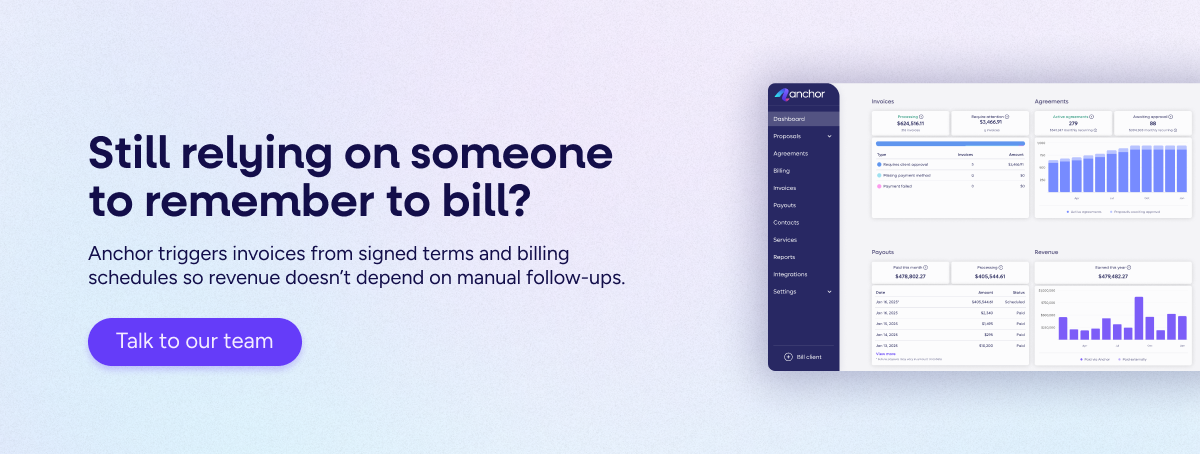
This is also where automation changes the dynamic. Not because it sends more follow-ups, but because the system is built to make payment predictable: signed terms trigger billing on schedule, payment methods are set upfront, and the payment lifecycle stays under your control.
A simple way to start today
You don’t need to rewrite your whole collections process overnight. Start by making two decisions you can stick to:
- Define your four steps in writing, including timing.
- Decide what Step 3 and Step 4 mean operationally for your firm.
Once those are set, the writing gets easy because you’re no longer inventing policy in an email thread.
If you want help turning that ladder into a connected flow from signed agreement through payment, Anchor was built for exactly that.
Ready to map your current ladder and reason codes with Anchor? Schedule a 15-minute call with one of our advisors, and we’ll show you how.