


Tax season presents an odd role reversal: the professional (you) ends up chasing the client to meet the client’s deadline. It feels normal because you care. You don’t want them hit with penalties, stress, or last-minute surprises. So you follow up, you nudge, you keep the file alive.
But that “helpful” reflex has a cost.
When documents arrive late and unpredictably, your schedule stops being a plan and starts being a series of rescues. Work gets compressed into the same few weeks, review stacks up at the exact wrong time, and “urgent” becomes the default setting. The result is familiar: late nights, rushed reviews, and a season that runs on fire drills instead of a workflow.
Below, I’ll break down why this role flip happens, why good accountants unintentionally reinforce it, and how to reset it with simple commitments, clear lanes, and consequences you can enforce calmly without picking a fight with clients.
Key takeaways
- Tax season creates a role flip: The pro ends up chasing the client to meet the client’s deadline, and that’s where chaos starts.
- Good accountants unintentionally enable it: Caring, competence, and relationship protection can lead clients to believe “late still works.”
- Normalization happens through a predictable loop: Silence → Panic → Rescue → Relief → Repeat, until your capacity becomes fictional.
- The fix is procedural, not emotional: Commitments, lanes, and clear consequences make on-time behavior the default without turning you into the bad guy.
The backwards dynamic
You’ve lived this.
You’ve sent three follow-ups for a missing K-1. You’ve waited on one last “quick item” that somehow takes two weeks. You’ve watched a client go quiet in January, then reappear in mid-February with urgency, as if you moved the deadline.
And because you’re a professional, you do what professionals do. You try to protect the outcome. You keep the work moving. You take the hit in your schedule so the client doesn’t take the hit in theirs.
That’s the backwards part. The person with the expertise is the one chasing down the inputs.
In most industries, buyers chase providers because they want the outcome. In tax season, the provider often chases the buyer because the deadline is imminent and the provider doesn’t want the client to be penalized.
That role flip is the start of a chain reaction:
- Work arrives in spikes instead of steadily.
- Review piles up simultaneously.
- “Urgent” starts to mean “everything.”
- Partners and managers get pulled into triage.
- The season becomes a series of fire drills.
It’s not because your team isn’t doing its job. It’s because your system allows “late” to remain vague.
So, the real question is: why does this happen so reliably, even in good firms with smart people?
Why good accountants enable it
In my experience, the firms that struggle most with this aren’t careless firms. They’re firms with high standards.
Accountants care about their clients. They want their clients to be successful. They often protect clients from the consequences of the client’s own timing.
That care is a strength. But it can also become a trap:
You protect the client from pain
If the return isn’t filed on time, the client pays the price, not you. And you don’t want that outcome. So you chase, you nudge, you follow up, and you keep things alive.
You absorb urgency that isn’t yours
The urgency came from late inputs. But the pressure lands on your team. You compress the work, you reshuffle the schedule, and you “make it work” because that’s what you do.
You reward late behavior with priority
Even when you don’t mean to, late clients often get more attention. More emails. More calls. More exceptions. And that teaches a lesson: being late still gets a rescue.
Your team learns the real rule
Your written policy might be “documents by X date.” But your team watches what happens when a client misses it. If the work still gets done the same way, the rule becomes: “We’ll always make it work.”
Here’s the blunt truth: competence becomes consent.
If your firm can always pull a rabbit out of the hat, clients learn they don’t need to change. You will.
Once this dynamic exists, it doesn’t remain confined to documents. It also extends to scope, pricing, and payment. Because when a relationship is human-to-human, people naturally test what’s flexible.
That leads to the next problem: it becomes the norm.
How the dynamic becomes normalized
The reason this is hard to fix is that it doesn’t fail loudly. It fails quietly, in small cycles that feel survivable in the moment. One client here, one late upload there. You patch it, you move on.
Then February hits, those small cycles stack up, and your “plan” becomes a stress test.
Here’s the loop most firms end up living in:
Silence → Panic → Rescue → Relief → Repeat
Silence
This is the calm before the scramble. The client delays. The documents aren’t in. The “I’ll send it tomorrow” turns into next week.
From your side, it feels like you’re being patient. From their side, it feels like there’s still time because nothing bad has happened yet.
Panic
The deadline gets closer. The client gets urgent. Sometimes you get urgent, too, especially when you see a bottleneck forming.
This is where “one missing item” suddenly threatens the whole timeline, and the client’s urgency becomes your interruption.
Rescue
Your team jumps. You chase. You pull favors internally. You shift other work. You do nights and weekends. You protect the outcome.
This is also where the real lesson gets taught. The client learns that late inputs don’t change the outcome. They just change how hard you have to work.
Relief
It gets filed. The immediate pressure lifts. Everyone moves on.
No post-mortem. No reset. The season is too busy, and the fastest way to feel better is to close the loop and move on to the next priority.
Repeat
The client remembers what happened last time. The lesson isn’t “I should be earlier.” The lesson is “they’ll save me.”
And your team remembers something, too: “We’ll always make it work,” even if it means nights, weekends, and a crushed schedule.
Over time, two things happen inside the firm:
- Your capacity becomes fictional. The plan looks fine until the late wave hits.
- Heroics become the operating model. Not because you prefer heroics, but because the system leaves you with no other option.
And when the season runs on heroics, it usually creates another downstream mess: billing and payment friction.
Many firms begin work after a client “confirms,” without first setting clear terms. They do the work, then struggle to get paid. Many firms will say, “We won’t submit until we’re paid.” In reality, fear of friction and fear of losing the client often lead to submitting anyway, then chasing payment after. That’s how the cycle expands beyond documents into money conversations, discounts, and write-offs.
But you don’t fix any of this by sending stronger emails.
You fix it by flipping the system back to a normal posture: clients commit, clients meet deadlines, and when they don’t, the outcome changes by design.
That’s the reset.
The flip: commitments, lanes, and consequences
You don’t need a 12-page policy. You need a process your team can explain in one minute and enforce on a random Tuesday in February, when the inbox is full, and nobody has patience for exceptions.
The goal is simple: protect clients without sacrificing your sanity.
The easiest way to do that is to stop treating late inputs as a surprise you handle on a case-by-case basis. Treat them as a known scenario with a known path. That’s what the structure below does. It turns “we’ll see what we can do” into “here are the options you already agreed to.”
The 3 commitments
These commitments prevent role flipping. They help you make decisions earlier, while everyone’s calm, instead of forcing your team to improvise under deadline pressure.
1. Commitment to start
Work starts after terms are accepted and payment is set up.
This prevents the “soft yes” problem, where the firm starts out of goodwill and then spends weeks trying to bring the engagement into shape. It also gives you a clean, professional starting gate: the client commits, the engagement begins.
Additionally, it reduces a second, quieter problem: the end-of-season scramble where the work is done, the return is ready, and payment becomes a separate thread. When payment is handled up front as part of the commitment, you’re not trying to bolt it on later.
Once “start” is clear, the next thing that breaks tax season is inputs.
2. Commitment to inputs
Documents are due by a real date.
Not a suggestion. Not a “please try.” A date that means something operationally.
This matters because, without a real cutoff, you train the exact behavior you want to avoid. Clients learn that late inputs just create more follow-up, not a different outcome. So they keep delaying, and your team keeps chasing.
A real input date also makes your internal schedule honest. You can plan review windows, staffing, and turnaround because you’re not pretending every client will behave the same way.
The final commitment is the one that makes the first two stick.
3. Commitment to outcome
If inputs are late, the outcome changes.
This is the part firms hesitate on, but it’s the part that actually resets the dynamic. If a client misses the input deadline, you don’t improvise in a heated email chain. You route them to a defined lane.
That’s what turns the process from “we’ll try to save you” into “we’ll take care of you, but the timeline depends on when you show up.” Calm. Fair. predictable.
The 3 lanes
A lane system makes enforcement calm because you’re not arguing. You’re choosing an option. It also protects your team from the worst tax-season pattern: reordering the line for free.
Lane 1: On-time lane
Standard price, standard timeline. Documents arrive by the deadline, and the engagement runs as planned.
This lane is where you want most clients, because it delivers the highest quality, the cleanest schedule, and the least stress. It also feels fair to clients who do the right thing, because they’re not getting bumped by people who didn’t.
Lane 2: Late lane
Premium timing, only if capacity allows.
This lane exists because some clients consistently require urgency. That’s fine. The key is that urgency is a capacity decision, not a guilt decision. Your team doesn’t “try harder.” Your firm decides whether you have room.
Here are two rules keep this lane from becoming chaos:
- It’s limited. You can only take so many.
- It’s priced and explained up front, not negotiated in the moment.
Done right, this lane isn’t a scramble. It’s a choice.
Lane 3: Extension lane
Default outcome when inputs are late.
This is often the cleanest lane because it protects quality and protects your team. The client isn’t “punished.” The client is routed to the realistic outcome given the timing.
This lane also provides your staff with a clear script: “Based on when we received your documents, we’re filing on extension.” No drama. No reordering the whole calendar. Just a defined path.
The 3 consequences
Consequences aren’t about being harsh. They’re about making the process real. If there’s no consequence to being late, “late” stays free, and your team keeps paying for it with nights and weekends.
Pick one or two you can enforce consistently.
Option A: Move the delivery window
If inputs arrive after the deadline, the client moves to the next delivery window. Clear, fair, predictable.
This works well when you want to protect your calendar without turning every conversation into a payment discussion. It’s simple: timing determines the slot.
Option B: Default to extension
If inputs are late, the engagement defaults to an extension. No drama. No scramble. Just a defined operational outcome.
This works well when quality risk is your biggest concern. It also removes the emotional pressure to “make it happen” at the expense of your team.
Option C: Premium timing fee tied to late inputs
This matters: tie the fee to late documents, not late payment.
Why? Because late payment fees tend to lead to more follow-up and more negotiation. Late document fees price the operational disruption when it occurs: compressed timelines, reshuffling, and the cost of urgency.
If you’re going to charge for urgency, make it clean:
- The deadline is visible
- The fee is defined
- The behavior is clear
- The collection is procedural
When you run this structure, something changes fast. The client stops thinking, “They’ll chase me.” The client starts thinking, “I need to pick a lane.”
That’s the whole flip.
Now the practical question becomes: how do you enforce this without adding more admin work?
How you can make the rules executable
Policies fail when they depend on perfect follow-through in the busiest weeks of the year.
In too many firms, the rules live in someone’s head or in a PDF. The workflow lives in email. And the consequences live in awkward conversations. That’s why the system collapses under pressure.
A better model is agreement-led and procedural:
- Terms are clear up front
- Billing follows the agreed schedule
- Changes are handled cleanly
- Payments don’t require a separate chase
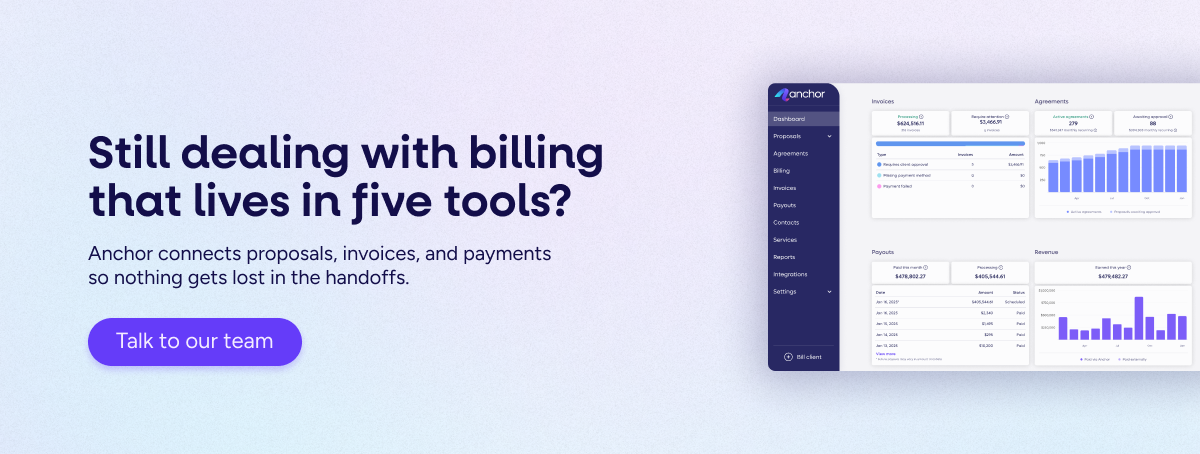
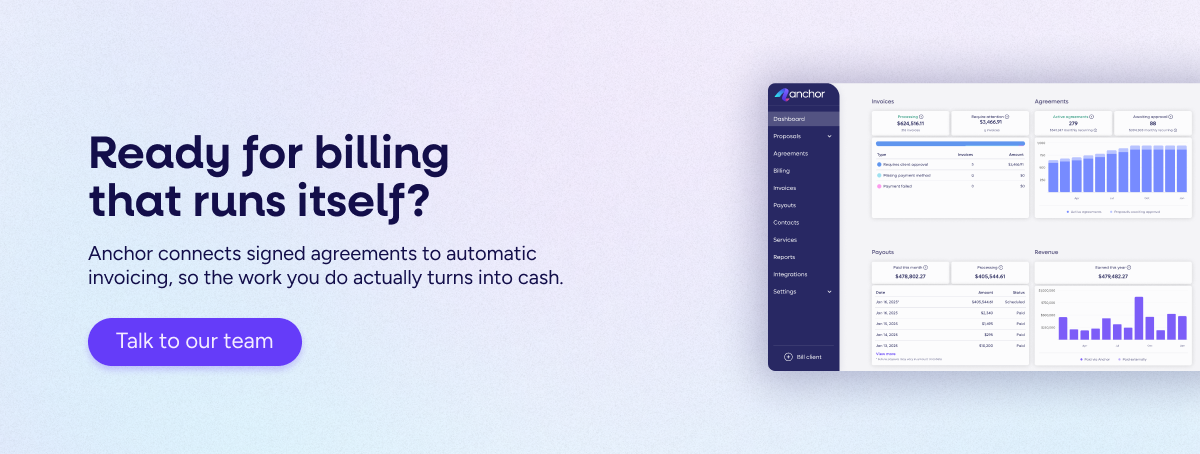
This is what Anchor is built to support, by connecting the parts that usually break apart during tax season:
- Interactive proposals and digital agreements: Commitments, deadlines, pricing, and lane rules are visible and accepted up front.
- Automated invoicing: Based on the signed agreement and the billing schedule, so billing doesn’t depend on anyone remembering.
- Automatic payments: Collection (via ACH or credit card) is part of the process, not a separate negotiation after the work is done. This eliminates most reminders because the client isn’t required to take action each time.
- Amendments: When scope changes or a late-document fee applies, you can update the agreement and collect under the updated terms without restarting the engagement or creating a new paperwork thread.
- Integrations and reconciliation: Ensure payments remain linked to the correct invoices and sync with your team's existing systems to reduce cleanup.
- Dashboards: Gain visibility into what’s expected, what’s outstanding, and what cash flow looks like ahead.
The point isn’t to “be tougher.” It’s to stop running tax season on heroics and memory.
The human result: less stress, fewer late nights
When you fix the role flip, you don’t just change operations. You change how tax season feels.
The first thing you notice is time. Not because clients suddenly become perfect, but because late work no longer hijacks the plan. Fewer nights. Fewer weekends. Fewer “we’ll just squeeze it in” decisions that quietly become the norm.
Then the work itself gets calmer. When everything isn’t compressed into the same two weeks, review no longer feels like a sprint. Your team can review like professionals, not firefighters, and quality stops being something you hope survives the crunch.
You also see it in escalation. Partners and managers get pulled into fewer exceptions because there are fewer exceptions to handle. They can focus on the work only they can do, rather than spending February mediating on timing, scope, and urgency.
The surprising part is that the client experience usually improves, too. Structure lowers the temperature. You’re not negotiating in the moment. You’re following a process the client already agreed to, which makes the boundaries feel fair rather than personal.
Tax season will always be busy. The goal isn’t to make it easy. The goal is to stop making it unnecessarily chaotic.
Protect clients without sacrificing your sanity
If you’re chasing clients for documents every February, that isn’t a personality problem. It’s a system problem. Flip it with three commitments, three lanes, and consequences you can enforce calmly.
If you want to see how an agreement-led workflow can streamline deadlines, billing, and collections, book a call with an Anchor advisor, and we’ll walk you through it.
Or share this article with your ops lead and pick one change to implement this week: lanes, input deadlines, or a late-document fee tied to capacity.