


AI is making firms faster. Drafts, summaries, categorization, and first-pass prep can now happen in minutes instead of hours. But most billing systems still operate as if it’s 2015: manual handoffs, one-off exceptions, and invoices issued after the work is done.
That mismatch is creating a new problem: growing cash lag for an increasing number of firms. You’re delivering faster, but you still get paid slowly.
The issue stems from workflow design, as the path from completed work to cash collection remains disconnected. If you don’t fix it, you’ll feel the squeeze in all the places that matter: more AR, more admin work piling on, and leadership losing confidence in cash flow.
Below, we’ll walk through what’s causing the lag, how to spot it in your own processes, and the specific system changes that close the gap between delivery and payment. Let’s dig in.
Key takeaways
- AI shrank delivery time, not billing time: Faster work means nothing if invoicing and payment still depend on manual steps.
- Cash lag is the new leak: When work speeds up, but billing remains slow, AR rises, and forecasting becomes less reliable.
- The fix is to connect work-to-cash: Agreements should automatically trigger invoices and payments, with clear change control.
- Anchor removes the bottleneck: It connects proposals, agreements, invoicing, payments, amendments, visibility, and reconciliation into a single flow.
The new reality: speed moved upstream, bottlenecks moved downstream
Most firms have adopted AI in the most obvious place first: production. That’s where the hours are, so speeding it up feels like instant capacity. Drafts are completed faster, prep work is done sooner, and the team feels it can finally move forward.
But when delivery compresses while billing remains the same, the bottleneck simply shifts. You complete more work each week, yet invoicing and collections still run on the old timeline. That’s how you end up with a higher-output firm operating on a low-output cash system.
Faster delivery doesn’t automatically translate into faster cash. Cash only speeds up when the steps between finished work and payment are designed to run without constant handoffs.
If billing still depends on someone noticing the work is done, building an invoice, checking terms, and handling payment after the fact, it will fall behind more often as volume increases.
You can usually spot it in a few familiar symptoms:
- Invoices go out late because delivery always wins the priority battle.
- Scope changes pile up because updating terms feels like a project.
- Billing becomes exception-driven with “special cases” that only one person understands.
- Payment timing stays awkward because it’s handled after the work, not built in upfront.
- Reconciliation becomes cleanup because data lives across tools and threads.
AI didn’t create these issues. It just made them louder by putting pressure on every handoff. And when those handoffs stack up, billing stops being a back-office detail and becomes an operating constraint.
Why billing becomes the bottleneck in AI-fast firms
Billing becomes the bottleneck when it’s built as a series of handoffs rather than as a system. Every time the work moves from delivery to pricing, to invoicing, to payment, to reconciliation, someone has to translate context.
In an AI-fast firm, that translation becomes the tax you pay on every engagement. So what should you look for? These four issues are often the usual suspects.
1. Manual invoicing can’t keep up with faster delivery
When invoices are built by hand, they lose every priority battle. The team will always choose client work over admin work, and that’s normal. The problem is that when delivery speeds up, billing must either keep pace or fall behind. Most firms experience the second outcome, not because people don’t care, but because “send the invoice” still depends on someone having time, context, and follow-through.
At that point, billing becomes a fragile chain of steps. Miss one handoff and the cash cycle starts late, even if the work was finished early.
2. Exceptions multiply as volume increases
Faster delivery increases throughput. Throughput increases edge cases. Even if only a small percentage of engagements have special terms, custom schedules, or one-off pricing, that percentage becomes a real load as your firm takes on more work.
If billing rules aren’t standardized, every additional client adds complexity. Your team serves as the integration layer between what was promised and what’s billed. That’s where “billing knowledge” turns into tribal knowledge, and where delays start to feel random even when they aren’t.
3. Scope changes move faster than your change control
AI can accelerate iteration cycles. Clients ask for more, teams can do more, and the work expands quickly. But if your process for updating scope, terms, and billing is slow, you get the worst combination: more scope changes with less billing alignment.
That gap is where revenue leakage lives. Not because anyone is trying to underbill, but because the system makes it easy to deliver the extra work and hard to reflect it in updated terms and billing.
4. Payment timing stays emotional when it isn’t designed
If payment expectations aren’t clear until after work is delivered, payment becomes a conversation. Conversations get delayed. Delays turn into AR. And the longer it’s been since delivery, the more awkward it can feel to bring it up, which creates even more lag.
The fix isn’t being “tough” or tightening your follow-up scripts. It’s about designing payment expectations to be normal and visible from day one, so payment timing is part of the workflow rather than a separate step someone has to initiate.
The good news is that bottlenecks like this are fixable because they’re structural. Once you reduce handoffs and make the rules executable, billing no longer relies on memory, and momentum is no longer lost between steps.
What “fixing the bottleneck” actually means
To align cash timing with faster delivery, you don’t need more effort from your team. You need a connected work-to-cash system where the rules are set once and executed repeatedly, without relying on memory or heroics.
When the system is connected, billing is no longer a separate project that starts after the work is done. It becomes part of how the engagement runs from day one.
Here are the changes that matter most.
Fix 1: Make the agreement the source of truth
Your agreement shouldn’t be a static PDF that lives in a folder. It should function like an operating manual your team can follow, and your billing process can run on.
That starts with clarity. The agreement needs to spell out the scope boundaries, pricing, billing cadence, payment terms, and what changes when scope changes. When those basics are clear and consistent, billing becomes less personal and more predictable because you’re executing what was agreed to, not renegotiating afterward.
Fix 2: Standardize billing patterns by service line
Stop reinventing billing for every client. Most firms don’t need infinite flexibility. They need a small set of repeatable engagement patterns that cover most work. Monthly bookkeeping, payroll, tax, advisory, and CAS. Each service line should have a default billing cadence, a template set of terms, and a clear path for add-ons and changes.
Standardization isn’t rigidity. It’s how you deliver consistent service at scale without turning billing into a custom build every time a client says yes.
Fix 3: Trigger invoices from signed terms and schedules
If invoices are still “something someone has to remember,” billing will always become the bottleneck the moment things get busy. The goal is straightforward: when an engagement is signed and scheduled, invoicing should run on rails. That eliminates the dead space between finishing work and starting the cash cycle.
It also reduces internal back-and-forth because the schedule is already set, and the system is simply executing it.
Fix 4: Treat scope changes like routine operations
Scope changes shouldn’t require a mini-renegotiation within a long email thread. They should trigger a simple, professional amendment to update the terms and adjust the billing amount or schedule.
When change control is easy, teams stop postponing it. And when teams stop postponing it, billing stays aligned with the work as it evolves, which is where much of the leakage is prevented.
Fix 5: Build AR visibility that doesn’t require detective work
Leadership should be able to answer a few basic questions without hunting through spreadsheets and inboxes: what is owed, what is projected, what is slipping, and why it’s slipping. If the answer lives in someone’s spreadsheet, it will be late and incomplete by definition. That’s how firms end up managing cash flow by gut feel, even when they're growing, and the stakes are higher.
AR visibility isn’t just a reporting preference. It’s what lets you make decisions early, before small delays turn into real pressure.
Fix 6: Reduce month-end cleanup with connected reconciliation
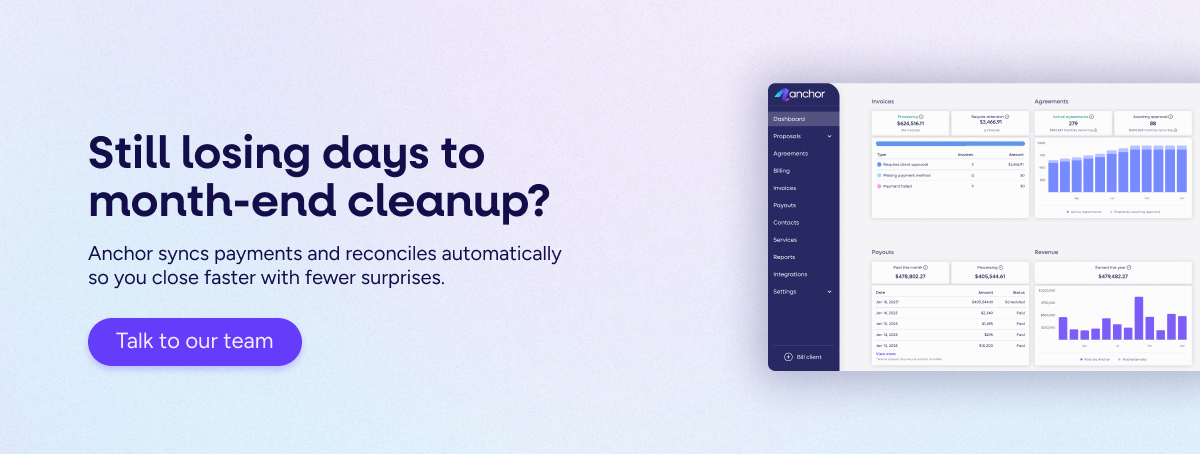
Even when payments happen, the work isn’t done until the books are clean. Disconnected tools lead to re-keying, mismatches, and manual reconciliation, which drain time and undermine reporting accuracy. A connected flow reduces cleanup and increases confidence because payment and invoice data remain aligned throughout.
When these six fixes work together, billing stops being the bottleneck you fight every month. It becomes a system that quietly keeps pace with delivery, even as your firm gets faster.
How Anchor helps remove the billing bottleneck
Anchor is built for firms that want work-to-cash to run like a system, not a relay race. Instead of asking your team to translate context from tool to tool, Anchor connects the parts that usually get separated: What the client agreed to
- What gets billed.
- How payment happens.
- What changes when scope changes.
- What your leadership team needs to see to trust the numbers.
In practice, that means the engagement becomes executable. Once the client signs, billing can follow the terms automatically. When scope changes, you can update the agreement and billing without reopening a messy thread. And when payments come in, they remain linked to the correct invoices, so reconciliation doesn’t become month-end cleanup.
Anchor connects the full flow in one place:
- Interactive proposals and agreements that set clear terms up front.
- Automated invoicing triggered by signed terms and billing schedules.
- Flexible payment options so clients can pay the way they prefer.
- One-click amendments that keep scope, terms, and billing aligned as work changes.
- Cash visibility into what’s outstanding and what’s projected, without rebuilding a spreadsheet.
- Reconciliation and data syncing through integrations with the tools firms already use.
The practical outcome is simple: billing no longer competes with delivery. The system executes the rules in the background, your team gets time back, and cash flow becomes something you can predict instead of chasing.

Turn faster delivery into predictable cash flow
If AI sped up delivery in your firm, your next leverage point is billing. Fixing the bottleneck isn’t about chasing clients. It’s about setting clear terms up front and letting your billing system execute them consistently.
Learn how Anchor turns agreements into an automated proposal-to-retention flow so cash timing keeps up with faster delivery.
Want a quick gut-check? Book a short call, and we’ll help you spot where your current process is creating cash lag.