


If you’ve ever talked to someone who sold their firm, you might have heard some version of this: the price sounded great, then the terms showed up, and the deal got complicated.
That’s not bad luck. When buyers feel uncertainty, they protect themselves by shifting risk into the terms, not just the price. And most of that uncertainty isn’t about the work you do. It’s about what they can’t quickly verify in due diligence, and what might break after you step back.
That’s why sellers get surprised by the deal structure. If a buyer isn’t fully confident the firm will run smoothly without you, they’ll push for deferred payments, holdbacks, and earnouts tied to retention or collections.
So if you want a better deal, the goal is simple: make your firm hard to poke holes in. Make it easy to verify, easy to transition, and boring in the best way.
Key takeaways
- Better terms come from removing buyer doubt, not just “getting a higher multiple”: If buyers can’t quickly verify how your firm runs, they protect themselves with holdbacks, earnouts, and deferred payouts.
- Make your work-to-cash flow easy to trust: When agreements, billing schedules, payments, AR, and reconciliation are consistent, diligence moves faster and buyers have fewer reasons to discount you.
- Fix the risk signals buyers price into the structure: Scattered engagement terms, memory-based billing, unclear receivables, and slow reconciliation are the exact issues that turn into tougher deal terms.
- Use Anchor to make your firm easier to buy and transition: By connecting engagement terms to invoices, payments, and reconciliation, you reduce surprises during diligence and protect your payout after close.
Why “messy ops” turn into worse deals
Buyers can live with a lot. What they hate is surprises. And they’ve learned that surprises tend to hide in the work-to-cash flow.
When engagement terms live in email threads, invoices get rebuilt by hand, and AR is more hope than process, buyers start asking, “What else is loose?” Even if your revenue is strong, uncertainty makes them cautious.
Here’s what that looks like in real diligence.
A buyer asks, “Show me the engagement terms for your top 20 clients and how billing is set up.” You can pull the invoices, but the scope lives in a doc someone emailed two years ago, which was then “updated” in a few one-off messages. Billing still happens, but it depends on someone remembering what changed and when. A buyer doesn’t call that flexible. They call it unverified.
Or they ask about AR and collections. You explain that most clients pay, and you can usually get the stragglers in. But the aging report isn’t clean, and there’s no consistent story for what’s collectible versus what’s just sitting there. Again, the buyer doesn’t assume you’re hiding something. They assume you don’t yet have full control of the system.
And when buyers feel that kind of uncertainty, they don’t always renegotiate the headline number first. They protect themselves in the structure. That’s where you see more holdbacks “just in case,” more deferred payments tied to collections, and more earnouts tied to retention.
That’s why cleaning up operations isn’t just an internal efficiency play. It’s a deal-improvement project. The goal is to make your firm easy to verify and hand off, so buyers have fewer reasons to shift risk to the terms.
Want a clear view of what buyers flag in diligence and price into the terms? The next section covers the four most common risk signals.
The four “risk signals” buyers price into your deal
1. The agreement isn’t the system of record
Buyers want to see a clear chain from “what the client agreed to” to “what got billed” to “what got paid.” When agreements are scattered or outdated, every other number becomes easier to question.
Many firms are moving toward a cleaner default, where engagement becomes the source of truth. If you want a clear breakdown of this concept in plain English, start here:
What Happens When the Engagement Becomes the System of Record?
2. Billing depends on memory
When billing relies on someone remembering to invoice, it creates two problems at once. Revenue leakage (missed or late bills) and credibility risk (buyers can’t tell if billing is consistent).
This shows up as diligence friction and often results in terms that protect the buyer “just in case.”l
The antidote to this? Operational clarity, which not only helps your firm run more smoothly and profitably but also makes it harder to poke holes in when you’re at the negotiating table.
3. Receivables are unclear or hard to explain
Not all AR is bad. But buyers want it to be visible and explainable. If AR aging is outdated or collectability is unclear, buyers may begin linking your payout to future collections.
If you want a closer look at what “good” looks like, here’s a helpful guide:
Accounts receivable automation: A comprehensive guide for accounting firms
4. Reconciliation takes too long, so nobody trusts the numbers
If reconciliation is a quarterly fire drill, buyers assume there are gaps. That can lead to holdbacks, extended due diligence, and last-minute re-trading.
Clean reconciliation is boring. That’s the point. Boring is what gets paid.
How Anchor helps you protect your payout when you sell
Anchor isn’t a “nice-to-have” if your goal is to close the sale more smoothly. It helps you build the kind of operating clarity buyers can quickly verify, reducing the need for defensive deal terms.
It turns agreements into something buyers can actually audit
When your engagement terms are captured clearly and consistently, a buyer can review scope and billing terms without digging through inboxes.
That matters because diligence is basically a trust test. If the buyer can’t see the rules of your client relationships, they assume risk.
It makes billing predictable, not heroic
Anchor connects billing to signed terms and schedules, so invoicing doesn’t depend on someone rebuilding the same work each month.
If you want a simple walkthrough of how that works, this piece explains it well:
How Anchor proposals automate client billing
It reduces AR risk by making payments run the way you set them up
This is the difference between “we hope clients pay on time” and “payments happen on schedule because the process is set up that way.” When payments are predictable, buyers have less reason to tie your payout to future collections.
For a clear view of how this kind of system works end-to-end, this is a solid read:
What is autonomous billing? A complete guide
It keeps reconciliation tight because payments sync back to your accounting system
The goal is simple: fewer gaps between what happened and what the books say happened. That’s what reduces surprises in diligence and chaos after close.
What changes in the deal when you remove those risk signals
When your work-to-cash flow is consistent, you’re not just “more efficient.” You’re easier to buy.
That tends to show up in the parts of the deal that actually affect your life:
- Less pressure for large holdbacks “just in case.”
- Fewer earnouts are tied to collections.
- Faster diligence because fewer questions stall the process.
- A cleaner transition because the buyer isn’t inheriting a pile of unwritten rules.
Put differently, you’re helping the buyer say, “This firm runs like a system, not a person.” That’s the kind of confidence that protects your payout.

A simple way to use this before you go to market
If you’re thinking about selling in the next 12 to 24 months, don’t wait until you’re deep in buyer calls to tighten this up. Give yourself time to make the new way “normal” for the team.
Start with one goal: make it easy for someone else to understand how you get paid.
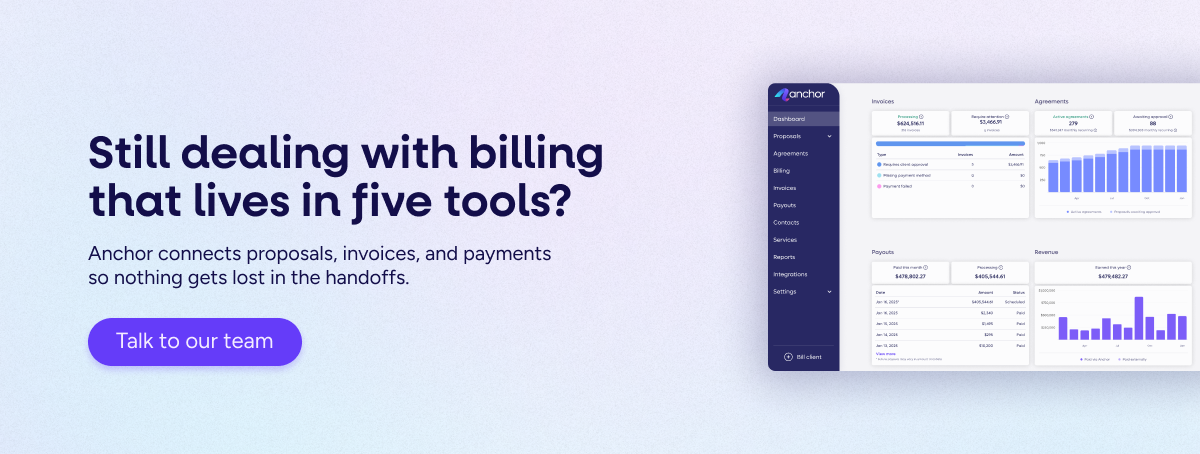
If you want to see what that looks like in practice, learn more about Anchor here. Or book a quick call with our team to see the workflow live.